

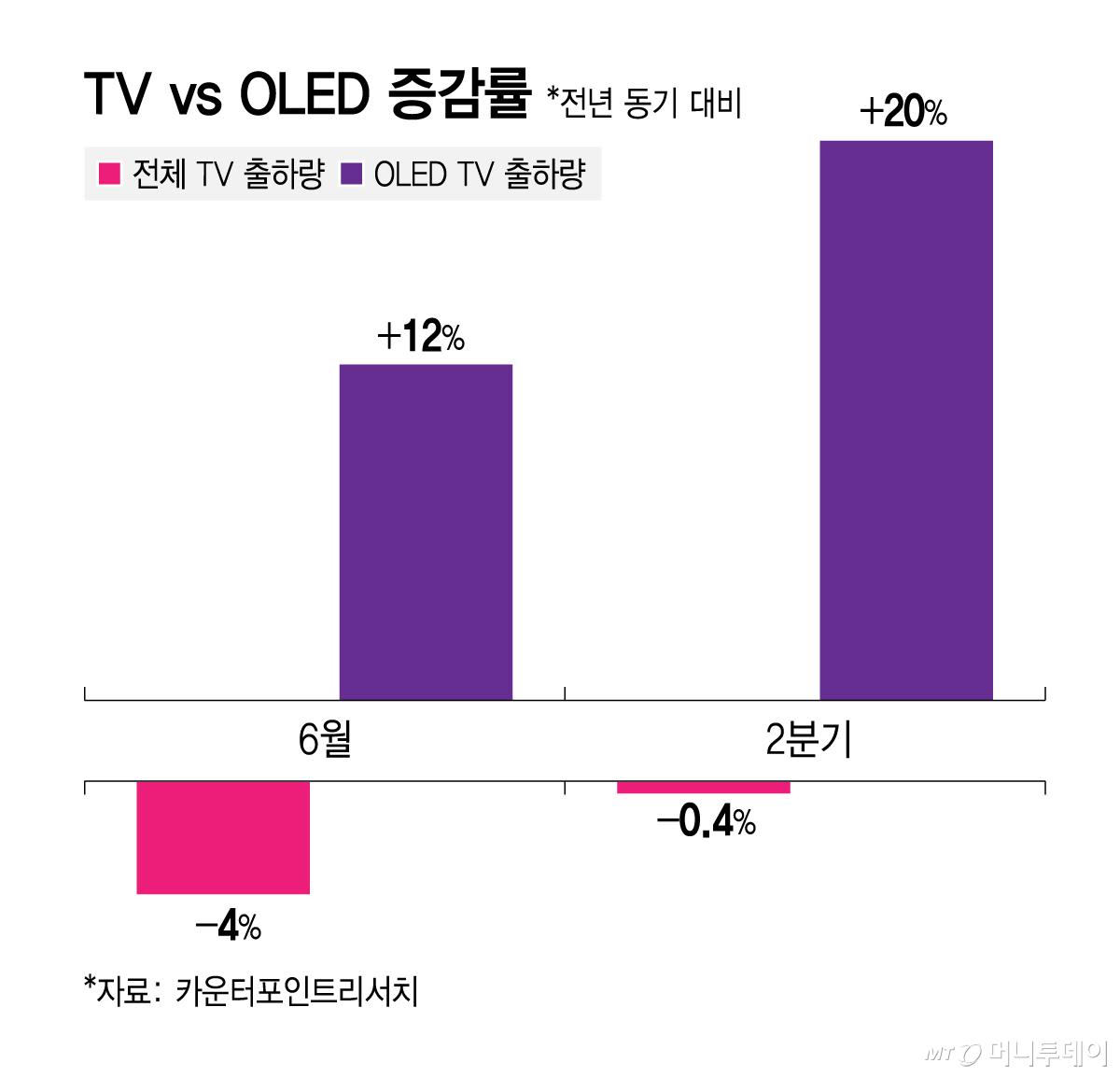
While the global TV market remains stagnant, OLED (organic light-emitting diode) TVs continue to grow independently, driven by premium demand. With robust OLED demand, lowering panel costs to secure price competitiveness is expected to accelerate expansion of the OLED TV market.
According to market research firm Counterpoint Research on the 14th, global TV shipments in the second quarter of this year declined by 0.4% compared to the same period last year, remaining essentially flat. In contrast, OLED TV shipments increased by 20%. Shipments of OLED TVs also rose by 12% in June compared to the same month last year. However, the 4th% decline in total TV shipments in June is believed to be largely due to timing factors rather than a genuine contraction in demand. Analysts suggest that World Cup promotion demand was shifted to April, and its counter-reaction was reflected in June's shipment figures.
The driver behind this growth in the OLED TV market is LG Electronics. LG Electronics maintained over half of the global OLED TV market share in the second quarter while increasing shipments. Amid stagnant overall TV demand, it has expanded sales of premium OLED products and retained its position as the market leader.
As OLED TV shipments rise, operating rates at domestic panel manufacturers remain stable. According to Counterpoint Research, South Korean display fab (factory) utilization rates held steady at 68–72% in the second quarter. With demand expanding beyond smartphones and TVs to include IT (information technology) devices using OLEDs, panel manufacturers are reportedly adjusting production volumes according to product-specific demand.
Managing operating rates is critical because panel supply levels directly affect pricing and profitability. If production increases faster than demand, it leads to inventory burdens and price declines; thus, panel makers regulate operating rates to curb oversupply. Particularly for OLEDs, application areas are expanding beyond smartphones and TVs to include IT devices such as laptops and tablets, making it increasingly important to allocate production volumes according to demand changes across product categories. Diversifying customer bases helps mitigate the impact of underperformance in any single product on overall operating rates.
However, sustaining growth in the OLED TV market requires overcoming the challenge of securing panel cost competitiveness. Counterpoint Research identified the cost structure of WOLED (white OLED) as a key variable for the future OLED TV market. LG Display's Large Panel Business Division is reportedly focusing on enhancing the price competitiveness of WOLEDs for TVs. Having already launched 'WOLED SE,' which reduces costs by eliminating polarizers, it is also developing a two-stack tandem structure that maintains and improves image quality while reducing the number of stacks. The strategy aims to lower panel costs, boost the price competitiveness of OLED TVs, and broaden their customer base. As OLED TV shipments continue to grow primarily in the premium segment, how much panel prices can be reduced is seen as a decisive factor determining the scope of future market expansion.
An industry executive stated, "OLED TVs are growing even as the overall TV market stagnates, confirming that demand fundamentals already exist." He added, "If price competitiveness is also achieved, we can expect not only to regain demand that shifted to mini-LED but also to expand the market itself."

 in INDUSTRY
