

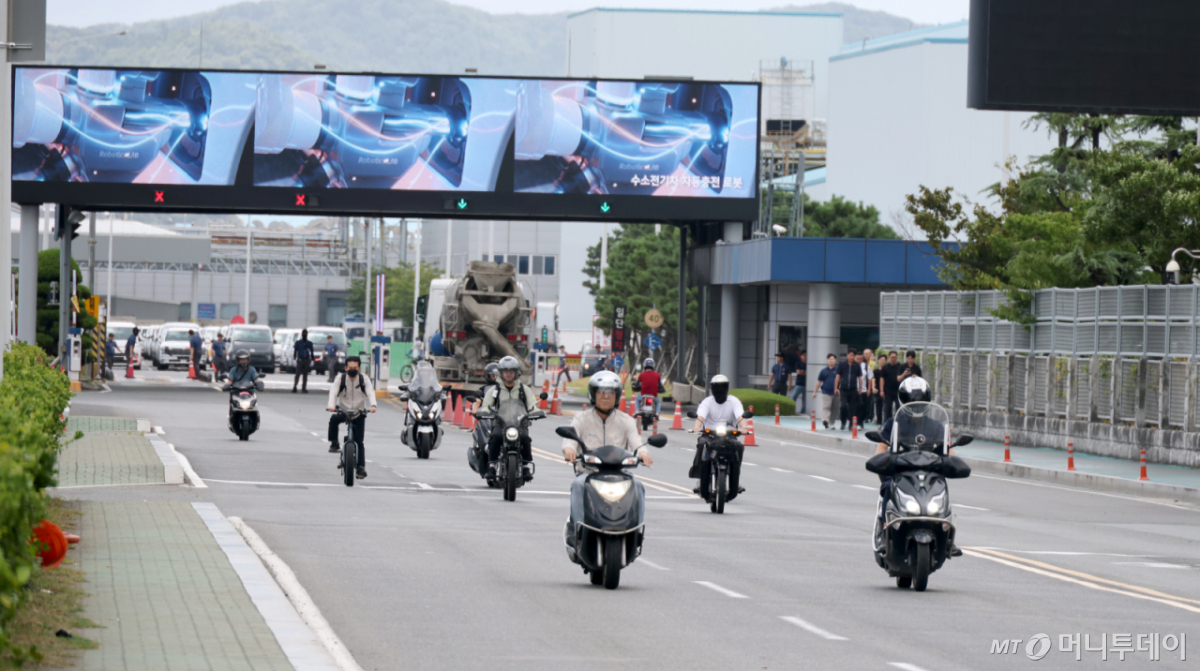
Hyundai Motor and its labor union will resume formal wage negotiations on the 18th. The union, which has been conducting strikes recently, had initially planned to hold a six-hour partial strike per shift on the 18th as well but decided to suspend the strike upon agreeing to resume negotiations that day.
According to industry sources on the 14th, Hyeon Dae-cha (CEO) visited the Hyundai Motor branch of the National Metal Workers' Union at 2:30 p.m. that day to request a resumption of negotiations and agreed to hold the 16th formal negotiation session at 2 p.m. on the 18th.
If formal negotiations resume, production lines will operate normally on the 18th in accordance with the union's policy to suspend strikes on days when negotiations are held. Immediately after the conclusion of negotiations, the union plans to convene its sixth Central Dispute Countermeasures Committee (Dispute Committee) to determine the level of future actions. The decision to set aside the strike and return to the negotiation table appears to reflect the company's intention to first review additional proposals it may present.
On this day, the union began a six-hour strike for the first shift (morning workers) starting at 8:50 a.m. and for the second shift (afternoon workers) starting at 5:30 p.m. Regular daytime shifts and general staff stopped work from 10 a.m. Combined, both shifts can halt production lines for up to 12 hours per day. Following four-hour partial strikes per shift on the 12th and 13th after returning from summer vacation, the union carried out its third consecutive day of partial strikes today. Previously, the union conducted nine days of partial strikes last month: two hours daily per shift from the 13th to the 15th, and four hours daily per shift from the 20th to the 22nd and from the 29th to the 31st.
Industry sources estimate that three rounds of strikes last month combined with refusals to work on Saturdays caused production disruptions for approximately 42,000 vehicles. The resulting loss in sales revenue is estimated to exceed 1 trillion won.
Labor and management have held 15 formal negotiation sessions since their initial meeting on May 6 but have failed to find common ground. The union is demanding a base wage increase of 149,600 won, performance bonuses equivalent to 30% of last year's net profit, an 800% increase in year-end bonuses, extension of the retirement age, and reinstatement of dismissed workers. On the other hand, at the 15th negotiation session on the 8th of last month, the company proposed a base wage increase of 89,000 won, performance bonuses of 350% plus 10 million won, and allocation of 15 shares of company stock, but the union rejected these offers as falling short of members' expectations.
In a bulletin released today, the union compared average salary changes between union members and executives from 2018 to 2025, highlighting the widening gap in wage increases. It also pointed out that year-end bonuses have remained at around 750% since 2007, arguing that management should not shift responsibility for deteriorating business performance onto frontline workers.
Beyond wage conditions, significant gaps remain over separate demands such as retirement age extension, the implementation of an income peak system, and reinstatement of dismissed workers. The issue of extending the retirement age is intertwined with discussions in the National Assembly, leading to speculation that the company cannot provide a unilateral response.
The company maintains that it must consider production and sales losses resulting from the prolonged strike. Whether additional proposals will be presented during negotiations on the 18th remains critical. If no agreement is reached, there remains a possibility that the union will escalate its strike actions again.

 in INDUSTRY
