

Hanwha Aerospace has taken its first step into the U.S. defense market by leading with the K9 wheeled self-propelled howitzer (K9MH). The initial contract covers six prototypes, but if the U.S. Army passes a four-year test evaluation, the project could expand to up to 500 units and reach approximately 10 trillion won in value. This deal is seen as a significant "first-order" achievement for Hanwha in the world’s largest defense market.
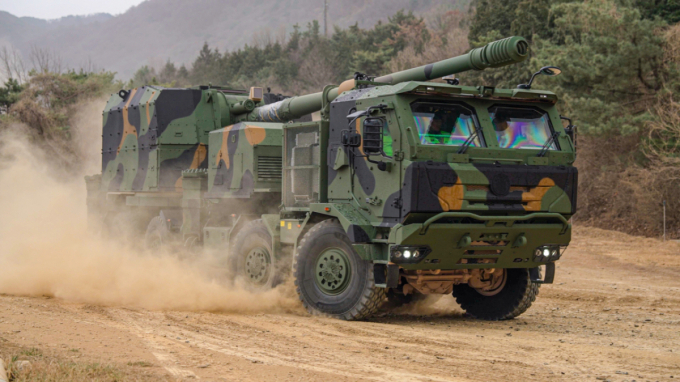
According to industry sources on the 19th, Hanwha Defense USA, the U.S. subsidiary of Hanwha Aerospace, has been selected as the developer and supplier of mobile tactical howitzer (MTC) prototypes. The initial contract covers six K9MH prototypes valued at 141.7 billion won, with an option to add 12 more units. If a total of 18 units are delivered, the contract value will rise to approximately 371.5 billion won ($262.903274 million).
Hanwha’s immediate goal is to finalize a definitive contract in four years. The U.S. Army will operate the K9MH to verify its performance, reliability, compatibility with domestic ammunition, and local production capabilities. Following this test evaluation, decisions on operational deployment and scale comparable to Yangsan facilities will be made. Hanwha’s K9MH was selected as the prototype supplier after outperforming formidable global defense companies such as Germany’s LINE Mettal and the UK’s BAE Systems, raising expectations for securing the definitive contract.
The U.S. market holds symbolic significance as it has remained a barrier that the K9 had not previously breached. While Hanwha has expanded its K9 supply markets to Europe, Asia-Pacific, and the Middle East, this marks its first entry into the U.S. Army’s next-generation weapon system program. Seventy-six years after South Korea received artillery support from the United States during the 1950 Korean War, it is now providing support for U.S. artillery capabilities and defense industry reconstruction.
This contract represents a breakthrough nine years after Hanwha began targeting the U.S. market, starting with the largest ground forces exhibition in North America (AUSA) in 2017. At that time, Hanwha directly transported full-scale K9 units weighing dozens of tons and non-composite armored vehicles to the U.S. exhibition site. Since then, it has established a local business foundation by setting up a subsidiary in Washington D.C., recruiting former commanders of all U.S. forces in Korea, former U.S. government officials, and personnel from global defense companies.
The commitment to nurturing the defense industry across two generations of leadership under Chairman Kim Seung-yeon and Executive Vice President Kim Dong-kwan has further supported this achievement. Kim Seung-yeon has consistently promoted defense as an industry directly linked to national security and a key global export sector. A representative example is his encouragement of the Cheonmu development in the early 2000s, when he told skeptics, "It’s okay if it fails," pushing forward with the project. His long-standing network with former U.S. Presidents Bill Clinton and George W. Bush, Heritage Foundation founder Edwin Meese, and others has also bolstered expansion into the U.S. market.
Executive Vice President Kim translated this vision into concrete business strategies. Most notably, he led the 2014 acquisition of Samsung Techwin and Doosan DST, followed by a merger with Hanwha’s defense division, laying the foundation for today’s Hanwha Aerospace. He also quickly identified shifting demands from the U.S. Army for self-propelled howitzers, driving the development of the wheeled K9 and local investments in the United States, which ultimately led to this contract. Proactive investments, including the successive recruitment of talent from global defense companies, have proven effective in capturing the U.S. market.

 in INDUSTRY
