

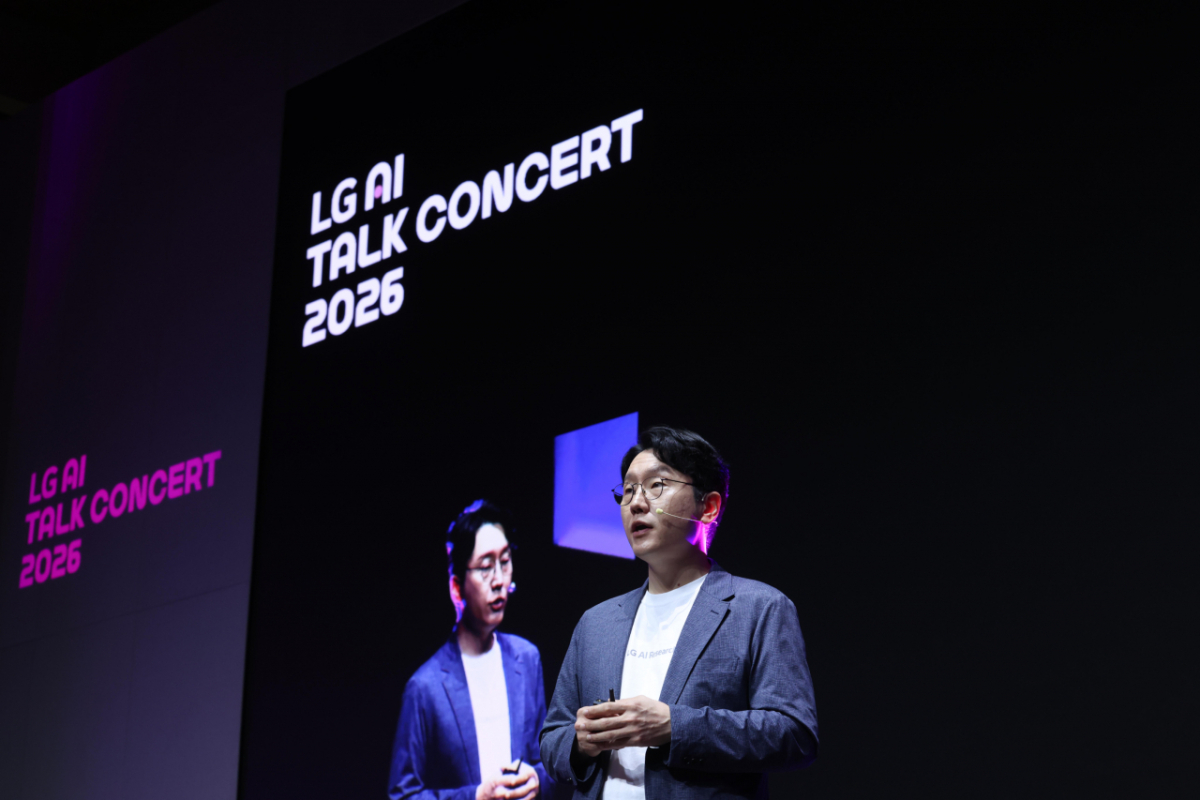
"Creating a good AI (artificial intelligence) model is important, but solving difficult problems that have long remained unsolved in industrial sites is the mission of the AI Research Institute."
On the 14th at 'LG AI Talk Concert 2026' held at LG Science Park in Magok, Gangseo-gu, Seoul, Im Woo-hyung, Co-Yeon Gu (Director) of LG AI Research Institute, revealed LG's direction toward such 'Expert AI'.
LG AI Research Institute is accelerating the transition to AI in science and manufacturing by leading with Expert AI that directly solves problems in industrial sites. The institute focuses on solving problems using industry-specific expertise and site data, then reflecting the results back into AI research to advance technology. In fact, since its establishment in 2020, it has solved more than 100 industrial challenges. Going forward, it plans to focus on evolving AI beyond merely analyzing problems to technologies that can judge and act independently.
A representative achievement is the development of new materials. Using the new material discovery platform 'ExaOne Discovery' with LG H&H, LG AI Research Institute analyzed over 420,000 candidate substances in one day and found 'Ramshidil', a substance with hair loss improvement effects. This drastically shortened the cosmetic ingredient development period, which typically takes 22 months. LG H&H is currently preparing to commercialize Ramshidil.
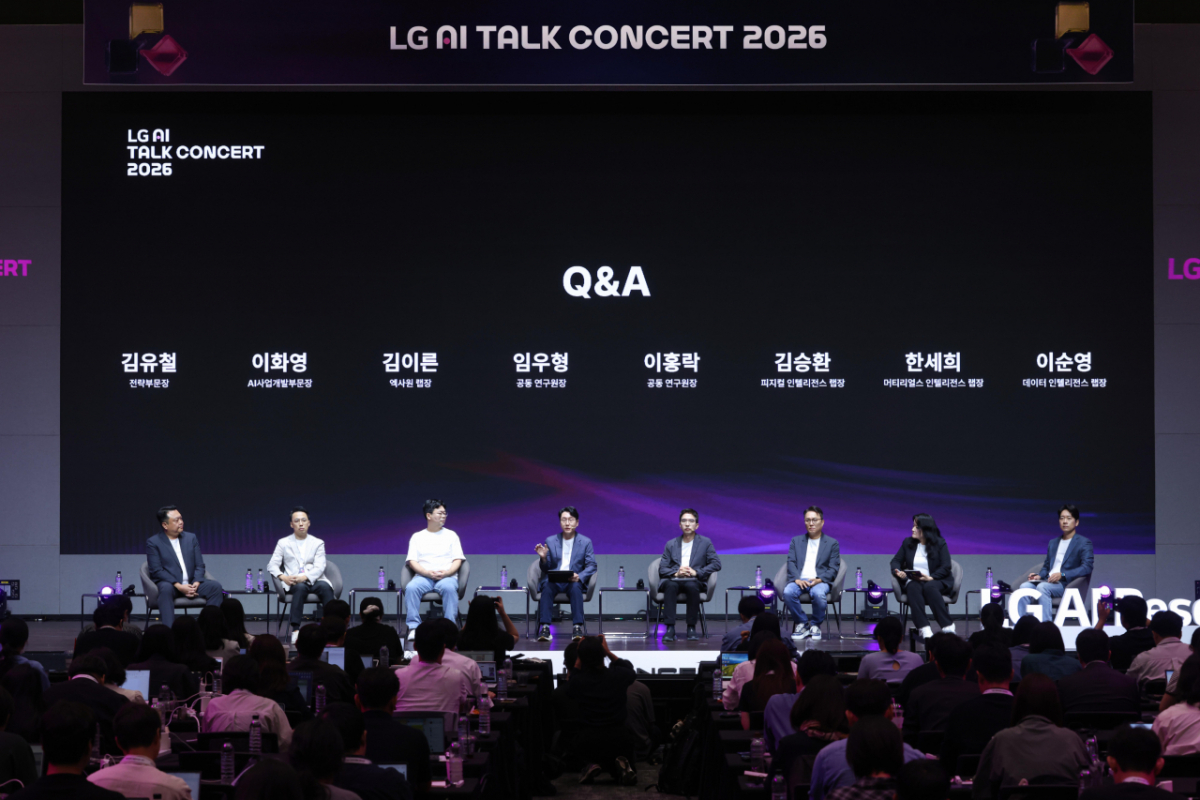
The role of Expert AI is also expanding from candidate substance exploration to actual experiments. On this day, LG AI Research Institute unveiled 'AI Autonomous Laboratory', which combines material-specific AI and robots for the first time. When AI sets experimental conditions, robotic arms and automated equipment carry them out, and AI learns the results to design follow-up experiments. Park Jae-seop, AX (AI Transformation)Chu Jin (Team Lead) of LG Chem R&D (Research & Development), emphasized that "robots are similar to researchers' hands, while material-specific AI and data systems correspond to their brains." He explained that through role division, repetitive tasks are entrusted to AI and robots, allowing research teams to focus on establishing new hypotheses and creative problem-solving.
The scope of AI judgment is also expanding into manufacturing processes. 'ExaOne Tabular' predicts quality and defect possibilities with only small amounts of process data. LG Innotek previously required a minimum of 14 days and approximately 300 hours of production process data for retraining existing models at manufacturing sites. However, through ExaOne Tabular, changed conditions could be reflected within a maximum of 50 hours. Yoo Jeong-seon, in charge at LG Innotek, introduced that "lead time (required time) to respond to the model was reduced by about 85%." In the case of 'ExaOne Omni Inspect', inspections can continue without separate retraining even if products or processes change. This reduces the burden of relearning AI.
Representative cases of problem-solving by LG AI Research Institute include battery life and capacity prediction, defect product selection, and discovery of new drug candidate substances. LG AI Research Institute has published 368 papers at top global AI conferences and filed 1,080 patents domestically and internationally.
President Im stated, "For the past six years, LG has enabled AI to understand industrial problems, and now that AI is preparing for a stage where it can judge and act independently," adding, "Based on the robot foundation model, we are moving toward the future of autonomous factories where entire factories move with a single intelligence beyond automating individual robots."

 in INDUSTRY

