

From solo-drinking bars to pork stir-fry restaurants promoting low sugar, new brands targeting recent trends have entered the food service franchise market. They are differentiating themselves by embedding not only menu items but also drinking styles and dining preferences onto their signs.
On the 14th, MoneyToday conducted a comprehensive analysis of the new registration list for information disclosure documents released from January to August this year on the Fair Trade Commission's franchise transaction website. The result showed that 694 new registrations were recorded in the food service sector. Among them, 8 registrations included "solo drinking" (hon-sul) in their trade names or brand names. Brands promoting solo drinking appeared on the new registration list every month from February to August, excluding March. Following "Freedom Will" and "Solo Drinking Bar Godo" in February, "Gyeon Solo Drinking Bar" was registered in April, "Onae Hon-Sul" in May, and "Today's Solo Drinking" in June. In July, "Seoul Solo Drinking Bar Jeju Only Here" and "Herz Solo Drinking Bar" joined the list, and in August, "Doel-dae-ro" also registered. "Freedom Will" and "Doel-dae-ro" explicitly stated "solo drinking" in their trade names rather than brand names. This count is based on the number of new registrations with the Korea Fair Trade Commission for franchises, not the number of store openings.
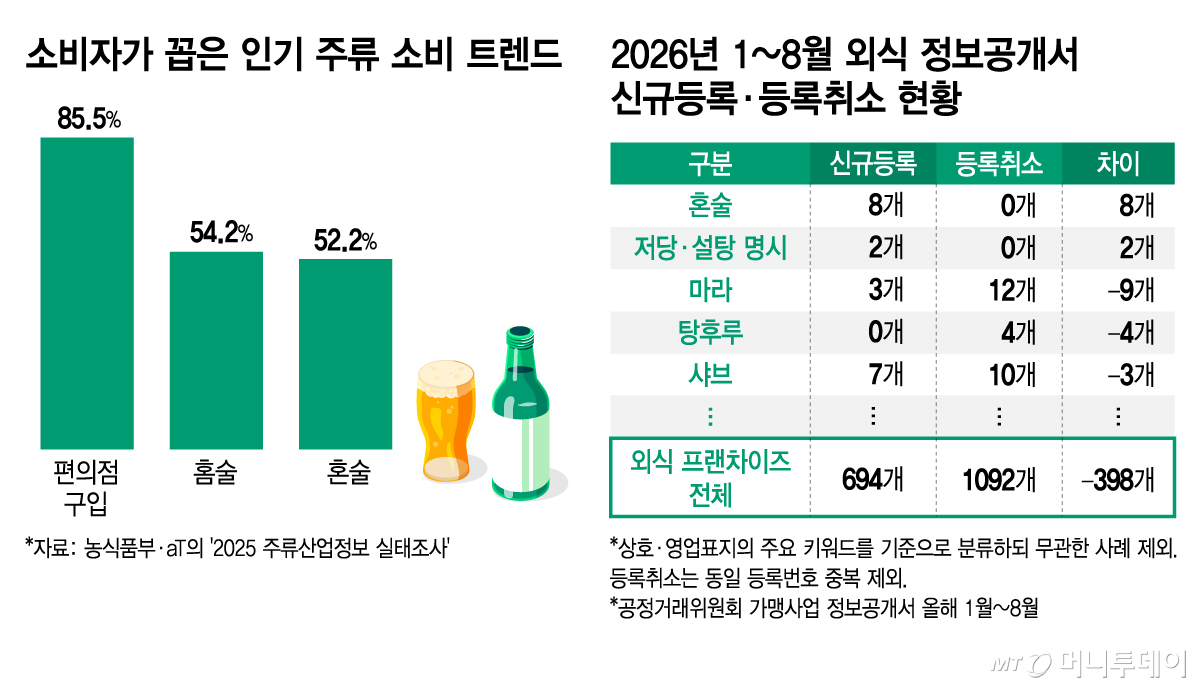
Solo drinking has emerged as a notable drinking style amid a recent decline in domestic alcohol consumption. According to the "2025 Alcohol Industry Information Survey" conducted by the Ministry of Agriculture, Food and Rural Affairs and the Korea Agro-Fisheries & Food Trade Corporation (aT), consumer perceptions of alcohol trends (multiple responses) were: △"Purchase at convenience stores" 85.5%, △"Home drinking" (home-sul) 54.2%, and △"Solo drinking" (hon-sul) 52.2%. Looking at the list, cases where "Jeju" is included alongside trade names or brand names are noticeable, such as "Freedom Will Jeju Solo Drinking Bar," "Jeju Solo Drinking Bar Godo," and "Doel-dae Rosé Alcohol Solo Drinking Bar." For example, "Gyeon," which originated in Jeju, operates by combining solo drinking with a party atmosphere. It can be enjoyed alone or with companions.
Among Korean food brands registered during the same period, those targeting the "low sugar" trend also stand out. "Vegetable and meat stew is not guilty even if you're full," "Low Sugar Stir-Fried Pork," "Roche Direct Fire Stir-Fried Pork," and "Grilled Chicken - Butcher Shop Without Sugar" made the list. These reflect a trend of considering health by featuring low-sugar ingredients in familiar menus like stir-fried pork, grilled chicken, and meat stews.
On the other hand, brands related to "Mala" had more cancellations than new registrations. Among cases including "Mala" on their trade names, excluding unrelated brands such as bakeries, there were 3 new registrations and 12 cancellations, meaning cancellations exceeded new registrations by 9. Brands featuring "Tanghulu" had no new registrations but recorded 4 cancellations. Brands including "Shabu" also saw more cancellations (10) than new registrations (7), a difference of 3.
A franchise industry official interpreted this as, "Despite cancellations exceeding new registrations overall, the entry of brands aligned with trends such as solo drinking and low sugar into the franchise market has been relatively active."
Meanwhile, during the same period, there were 1,092 cancellations of information disclosure documents in the food service sector, excluding duplicate registration numbers. This is 398 more than the number of new registrations. However, there are limits to interpreting these cancellations as brand withdrawals or store closures. The cancellations included cases where information was revised and re-registered after cancellation, or existing registrations were consolidated due to business restructuring.

 in INDUSTRY
