

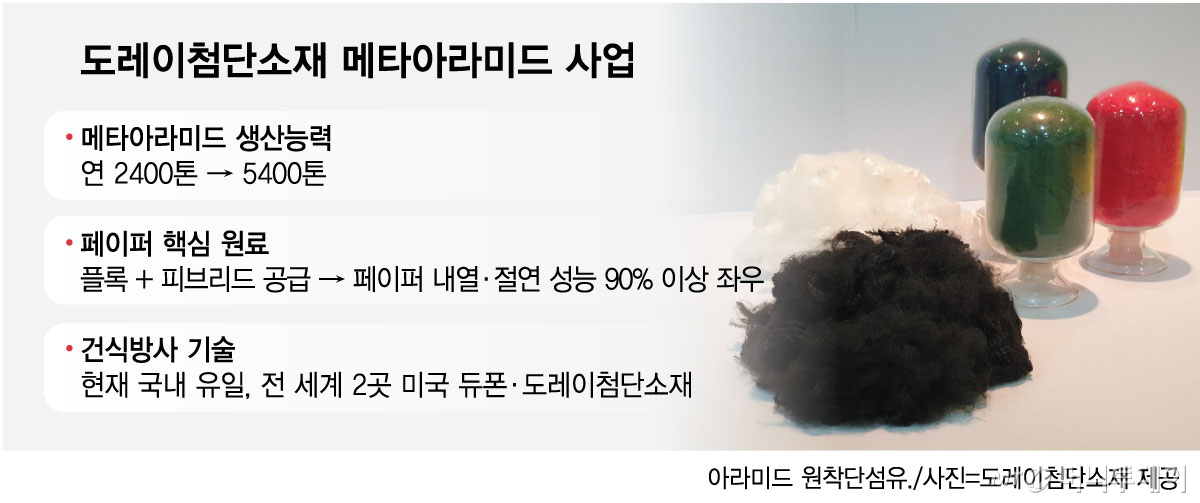
"We are currently obtaining customer certifications for Floc and Fibril, the raw materials for Metaaramid paper destined for North American artificial intelligence (AI) data centers, from more than 10 companies."
On the 25th of last month, Lee Gwang-gyo, head of the Special Industrial Materials Division at Doire Advanced Materials (photo), stated this during a meeting at the Korea Doire R&D Center in Magok-dong, Seoul. The explanation was that Doire Advanced Materials' Meta-aramid, which maximizes the advantages of 'super fiber' aramid possessing heat resistance, flame retardancy, and insulation properties, has positioned the 'paper materials business' as a new growth engine.
Doway Advanced Materials is actually focusing its efforts on supplying paper manufacturers with floc and fibril, which are produced based on meta-aramid. Floc and fibril are key materials that determine more than 90% of the heat resistance and insulation performance of paper. Meta-aramid paper made from these raw materials serves as a high-temperature insulation material that prevents electrical leakage or short circuits inside transformers, generators, and motors for AI data centers. It can withstand temperatures up to 220 degrees Celsius for over 60,000 hours.
As the expansion of AI data centers accelerates the trend toward higher output and larger capacity for power equipment such as transformers, demand for paper and its raw materials is also rising. In the past, general paper was mainly used as coil insulation material, but with increasing requirements for higher heat resistance and insulation performance, there is a growing trend to replace it with meta-aramid paper.
The division director stated, "Current Fibril production capacity is at an annual level of 400 tons," adding that "considering the fact that Plock and Fibril are each used in half, the available paper raw material supply is approximately 800 tons annually." He further emphasized, "Considering the increasing demand going forward, additional expansion will be necessary before 2030."
To meet this demand, Toray Advanced Materials added a second meta-aramid production line with an annual capacity of 3,000 tons at its Gumi plant in June. The company's total meta-aramid production capacity has increased from the previous annual output of 2,400 tons to 5,400 tons. Meta-aramid is used not only in paper but also in various fields such as electrical insulation materials, heat-resistant clothing, firefighting suits, bulletproof vests, reinforcement materials, and industrial filter nonwovens.
The division head stated, "The paper materials business is poised to grow into a key business group that will become a cash cow," and added, "Toray Advanced Materials is continuously enhancing its business competitiveness by developing Metaaramid, a high-value-added product with strong profitability." Toray Advanced Materials' competitive edge stems from its 'dry spinning' technology used to produce Metaaramid. The process requires converting liquid polymer solutions into uniform solid fibers within a short timeframe, making it technically challenging. This is because multiple variables—including the supply volume and speed of the spinning solution, temperature, and solvent evaporation conditions—must be precisely controlled simultaneously to ensure that all fibers exhibit identical physical, thermal, and chemical properties. Currently, only two companies worldwide commercially produce Metaaramid using dry spinning: DuPont and Toray Advanced Materials.
The dry-spinning technology was developed entirely through independent research from the outset. Toray Advanced Materials established a task force with just four members in 2009, despite having no aramid Gi Sul-i (EVP), and began development. Within about a year, they constructed a pilot facility with an annual capacity of 500 tons. After repeatedly adjusting equipment and process conditions, they succeeded in achieving polymerization at the target level in February 2011, enabling them to proceed to Yangsan.
More than 10 years later, the stage for technological development has shifted to AI data centers. The head of this division stated, "Even now, we are continuously enhancing the physical properties of raw materials themselves to achieve the thin-film and heat dissipation and insulation performance required for transformers used in AI data centers," adding that he will strive to improve his technical capabilities with pride as an aramid fiber company Han Guk-eul (CEO) aiming for the best.

 in INDUSTRY
