

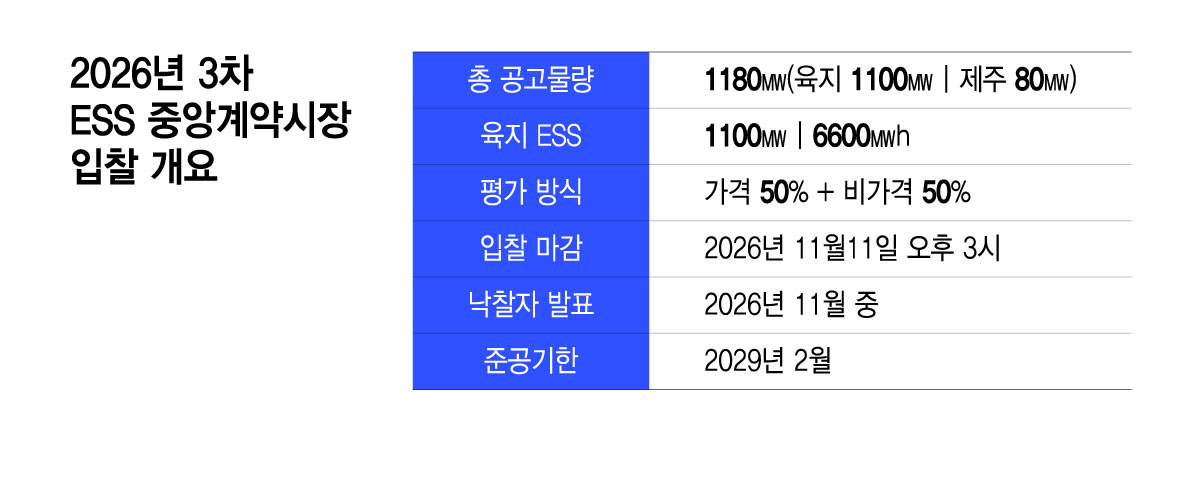
With the government releasing an unprecedented volume of 1.18 gigawatts (GW) of ESS (energy storage system) capacity to the market, competition among South Korea's three major battery companies has resumed again. While the released volume is more than double that of the previous round, offering greater opportunities for order expansion, concerns over profitability due to price competition remain unchanged. The three battery companies are carefully deliberating their bidding strategies while considering both order volumes and profitability.
According to the battery industry on the 23rd, the Ministry of Climate, Energy and Environment announced yesterday that it would open the 2026 ESS central contract market and select ESS power plant operators with a total capacity of 1,180 megawatts (MW). The breakdown includes 1,100 MW for land-based projects and 80 MW for Jeju. Selected operators must complete ESS construction by February 2029. Bidding will proceed until November 11, with the winning bidder to be determined in the same month.
The volume announced in this single round exceeds the cumulative awarded amounts from the previous two rounds. In last year's first ESS central contract market, a total of 563 MW was awarded, and in this year's second round, 565 MW was selected. This time's 1,180 MW is approximately 4.6% larger than the combined 1,128 MW from the two prior rounds. As the government accelerates ESS deployment, the market size is rapidly expanding.
The expansion in volume aligns with what the domestic battery industry has long advocated. The industry conveyed to the government its view that there is a need to expand the order volume for the ESS market in the first half of this year. With slowing demand for electric vehicles leading to increased surplus production capacity for batteries, competing over limited volumes could lead to a race to the bottom on pricing. The industry's stance was that sufficient initial market volume must be supplied to secure economies of scale. Overall, it is assessed that since the market itself has more than doubled compared to previous bidding rounds, the absolute order volume that the three battery companies can secure has increased.
However, concerns over price competition remain. In this bidding round as well, the weighting between price and non-price evaluation remains at 50-50, identical to the second market. After the first market (price 60%, non-price 40%), concerns were raised about excessive price competition, leading to adjustments in evaluation criteria from the second market onward to reduce the weight of pricing. The same standard applies this time. Ultimately, battery companies find themselves weighing order expansion against securing adequate profitability amid the largest volume ever offered.
Additionally, the industry expresses dissatisfaction with technical standards. The battery sector has consistently urged for a relaxation of the ESS residual capacity criterion from the existing 90% to the range of 80-85%, but this time the 90th% standard remains unchanged. Meeting the 90th% residual capacity requirement necessitates not only higher initial installation capacity but also elevated specifications for cooling systems and battery management systems (BMS). Industry voices argue that since these requirements amount to practically excessive specifications, there is a need to make future technical standards more realistic.
This bidding round is expected to offer opportunities for order expansion to LG Energy Solution, Samsung SDI, and SK On alike. In the first market, Samsung SDI accounted for over 75% of the total volume, but in the second round, SK On secured half, shifting the landscape. Given that the largest-ever volume is being released all at once, how much volume each of the three companies secures through what pricing strategy will likely determine future domestic ESS market share and profitability.
A representative from the domestic battery industry stated, "The expansion in order volume for this central contract market is positive from the industry's perspective," adding, "While concerns over price competition remain, the weighting between price and non-price evaluation has already been adjusted once in previous markets." The representative further noted, "It is regrettable that technical standards such as residual capacity, which the industry has consistently advocated for, remain unchanged this time as well."

 in INDUSTRY
