

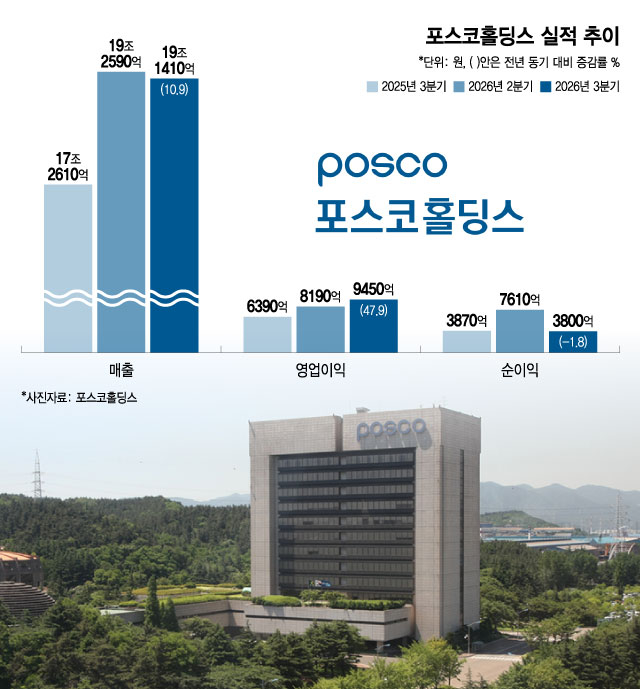
POSCO Holdings continued its earnings improvement in the third quarter of this year, driven by the recovery in profitability in its steel and infrastructure segments, despite sluggish performance in secondary battery materials. The company plans to strengthen profitability through a 'Triple Core' strategy centered on steel, secondary battery materials, and energy resources.
POSCO Holdings said Monday that it recorded consolidated revenue of 19.141 trillion won and an operating profit of 945 billion won in the third quarter. These figures represent year-on-year increases of 10.9% and 47.9%, respectively.
The earnings improvement was led by the steel segment, the company's core business. Despite rising raw material prices, both selling prices and sales volumes increased, allowing operating profit to recover to the 400 billion won range for the first time in four quarters. However, the company forecast that the recovery in steel demand will remain sluggish next year.
This is because, while demand improves in some downstream industries such as automobiles and shipbuilding, sluggishness continues in construction and home appliances, leading to clear differentiation by industry.
A POSCO Holdings official stated, "Increased demand for energy infrastructure such as power, data centers, and semiconductor factories is expected," adding, "We will proactively respond to changes in domestic and external conditions through profitability-focused sales and securing cost competitiveness."
It is also preparing for the possibility of strengthened U.S. steel import regulations. The company is monitoring policy trends through local subsidiaries and cooperating with the government and the steel association, while reviewing response measures that include the impact by product and customer, as well as local production and supply chains.
The secondary battery materials segment was relatively sluggish. POSCO Future M saw its operating profit improve from the previous quarter due to the recovery in cathode material sales and rising prices. However, the entire segment recorded an operating loss due to falling global lithium prices and reduced winter-season production at POSCO Argentina.
POSCO Future M is accelerating investment in lithium iron phosphate (LFP) cathode materials amid expanding demand for energy storage systems (ESS). The company plans to convert part of its Pohang cathode material plant into an LFP production line and increase production capacity to 105,000 tons annually in line with future orders.
It is also targeting the non-Chinese materials market through the development of high-density LFP cathode materials, a particle-free process, and low-cost, high-density natural graphite technology. The company is advancing the development of cathode materials for all-solid-state batteries and positive and negative electrodes for sodium-ion batteries (SIB).
The company judged that the recent decline in lithium prices has also been excessive. While slowing growth in Chinese electric vehicle sales and increased ore supply have pushed prices down, it expects demand increases from larger battery capacities to support future prices.
The infrastructure segment maintained solid profitability. POSCO International posted stable results thanks to expanded production at its gas fields and Indonesian palm business. Combined with increased orders for POSCO E&C, the segment's operating profit rose from the previous quarter.
POSCO Holdings aims to expand its foundation for future growth in line with its Triple Core strategy. POSCO Argentina completed its second plant with an annual production capacity of 25,000 tons. In the energy and resources sector, the company acquired shale gas assets from U.S. energy firm Chord, securing an annual production volume of approximately 1 million tons on a liquefied natural gas (LNG) equivalent basis.
Meanwhile, POSCO Holdings opened 'Beijing K-Maru' at the POSCO Center in Beijing, China, on the same day. K-Maru is an integrated platform that gathers scattered public institution offices overseas to support local companies and Korean residents. Companies entering China can receive support related to marketing, finance, technology, and infrastructure here. It is expected to become the largest integrated hub among all K-Marus worldwide.

 in INDUSTRY
