

As the global steel industry's supply surplus persists, domestic steelmakers are accelerating their push into new business areas. They are targeting emerging demand in artificial intelligence (AI) data centers and the aerospace sector while expanding into eco-friendly steel operations, such as electric arc furnaces, to find a breakthrough.
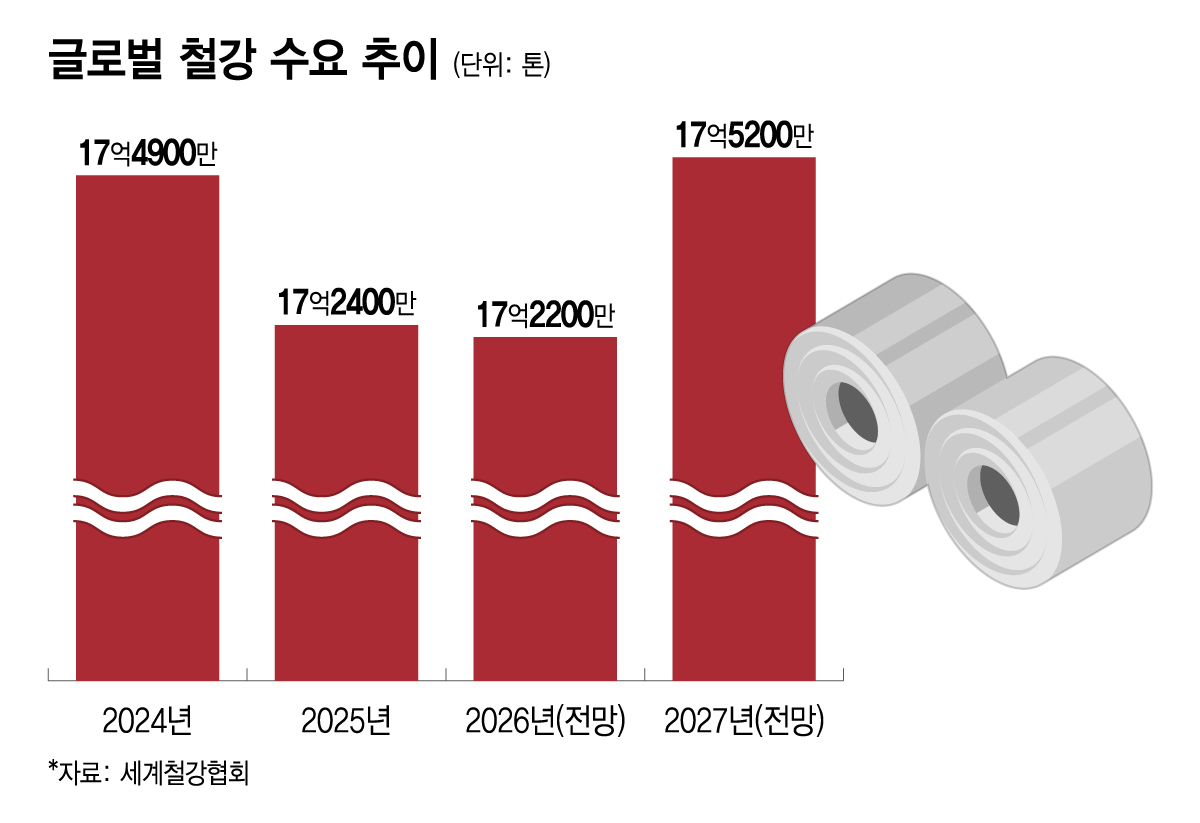
According to the World Steel Association on the 3rd, global steel demand is projected to decline by 0.1% year-on-year this year to 1.722 billion tons. While it is expected to rise by 1.7% next year to 1.752 billion tons, the increase is modest.
Demand in China, the world's largest steel consumer, is seen falling by 2% this year and dropping a further 1% next year. In South Korea, demand is projected to grow by 1.8% this year and 1.3% next year. This backdrop underpins analyses suggesting that sluggish demand and supply surplus in the global steel industry will be difficult to resolve for the time being.
The third-quarter results of domestic steelmakers were mixed. Hyundai Steel's operating profit fell by 6.5% year-on-year to 87.1 billion won, while SeAH Steel Holdings' profit decreased by 46.4% to 14.4 billion won.
In contrast, POSCO and Dongkuk Steel demonstrated improved profitability compared to the same period last year. However, industry analysts generally assess that a significant recovery in steel demand is unlikely next year, given the continued slump in downstream industries such as the construction sector.
Consequently, steelmakers are intensifying their efforts to expand into new businesses. Major steel companies outlined plans during their third-quarter earnings releases to boost profitability in existing operations while cultivating new growth engines to drive growth next year.
POSCO completed and began operating an electric arc furnace with an annual production capacity of 2.5 million tons at its Gwangyang Steelworks in June.
Initially, the company will produce general steel by blending hot metal from blast furnaces with electric arc furnace molten steel, but it plans to expand its production scope to include high-grade steels such as automotive sheet and electrical steel in the future.
The strategy is to offset cost increases associated with electric arc furnace usage by applying a premium to low-carbon steel products. Currently, product testing is underway with global original equipment manufacturers (OEMs) and wind energy companies, with plans to significantly ramp up utilization rates and sales volumes starting next year.
Competition to find new demand sources for steel is also fierce. Hyundai Steel established a "Task Force on Expanding Sales in Core Industries of Next-Generation Power Infrastructure" at the beginning of the year. Since then, it has secured steel supply contracts worth over 30,000 tons from seven domestic AI data centers.
Targeting the market for high-specification H-beams used in data centers and semiconductor fabs, the company also launched "H One," an integrated brand encompassing rolled and welded H-beams. Dongkuk Steel is likewise aiming to expand the production and sales of bar-shaped steel by focusing on large-scale projects such as semiconductor plants and AI data centers.
SeAH Steel Holdings plans to target the aerospace market, leveraging SST, a U.S.-based special alloys subsidiary that will begin operations next year. Located in Texas, SST aims to produce 6,000 tons annually of nickel-based superalloys used in aircraft engines, space launch vehicles, and defense components.
An industry official stated, "The expansion of revenue from new businesses that steelmakers have invested in will gain momentum starting next year." The official added, "Given the difficulty of a short-term recovery in the steel industry cycle, the key issue is how much new businesses and high-value-added products can offset the profitability slump in existing operations."

 in INDUSTRY
