

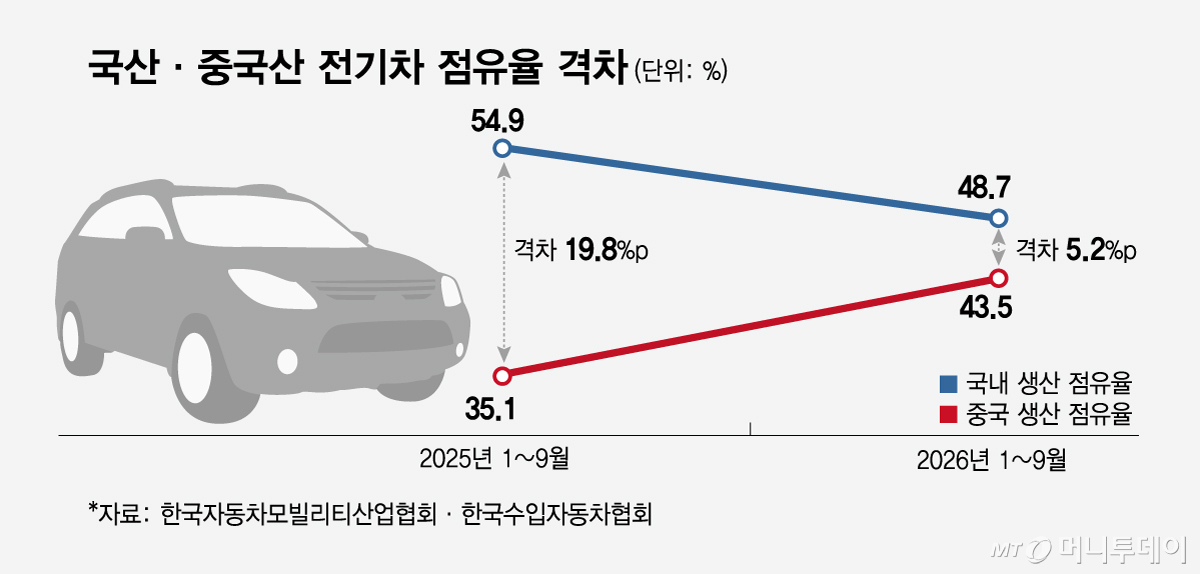
It is widely viewed that, to enhance the competitiveness of its electric vehicles (EVs), Hyundai Motor needs not only product improvements but also government support to back domestic production. In the domestic passenger EV market, the market share gap between domestically produced and Chinese-made vehicles has narrowed by a quarter in just one year.
This is the backdrop for the ruling and opposition parties’ unanimous call during this year’s national audit to include EVs in the scope of the domestic production tax credit. If tax burdens are reduced based on the production performance of EVs manufactured domestically, domestic automakers, including Hyundai Motor, could build greater capacity to respond to price competition.
According to data from the Korea Automobile Manufacturers Association (KAMA) and the Korea Importers’ Automobile Association (KAIDA), 112,417 Chinese-made passenger EVs were newly registered in South Korea from January to September this year, reaching 2.2 times the level of the same period last year.
The market share of Chinese-made vehicles rose from 35.1% in the same period last year to 43.5% this year, while the share of domestically produced vehicles fell from 54.9% to 48.7%. In other words, a gap that had been 19.8 percentage points (p) has narrowed to 5.2%p in just one year.
For Hyundai Motor, which is competing against Chinese-made EVs on its home turf, lowering vehicle prices or increasing discounts is one way to boost sales. However, the wider the discount, the lower the profit per unit sold.
If a tax credit applies to domestically produced units, some of this burden can be alleviated. Maintaining existing prices would help offset profitability, and redirecting part of the saved taxes into purchase incentives could lower consumers’ effective purchase price, thereby aiding sales recovery.
To this end, industry officials point out that finished EVs must be included in the scope of the tax credit. The tax reform plan announced by the government last August included a measure to reduce taxes based on performance for companies that produce and sell strategic items domestically.
However, it was limited to six sectors, including secondary batteries and semiconductors. While battery makers can receive credits for batteries they manufacture and sell domestically, EVs produced by Hyundai Motor at its domestic plants were excluded.
Unlike the government’s proposal, 24 bills introduced in the 22nd National Assembly include future vehicles such as EVs among the support targets. The scope of the tax credit under the government’s plan was also a key issue during last month’s national audit of the Ministry of Economy and Finance.
Democratic Party of Korea lawmaker Yoon Hoo-deok emphasized, “Chinese-made EVs are rapidly growing in the domestic market, so this must be included in the National Assembly’s tax discussions.” People Power Party lawmaker Ahn Sang-hoon also struck directly, stating, “In a situation where major countries are deploying even tariffs and tax benefits to protect their own auto industries, it seems there is virtually no country that has protected its market without an active response.”
In response, Lee Hyoung-il, Deputy Prime Minister and Minister of the Ministry of Economy and Finance, stated during the national audit that he is reviewing with relevant ministries a plan to include EVs in the scope of the tax credit. Having also expressed his intention to actively participate in National Assembly discussions during an on-site visit on the 2nd, the review of the tax law amendment bill by the Tax Subcommittee of the National Assembly’s Committee on Finance and Economy this month is expected to become a venue where the government and the National Assembly will coordinate on the scope of the credit.

 in INDUSTRY
