

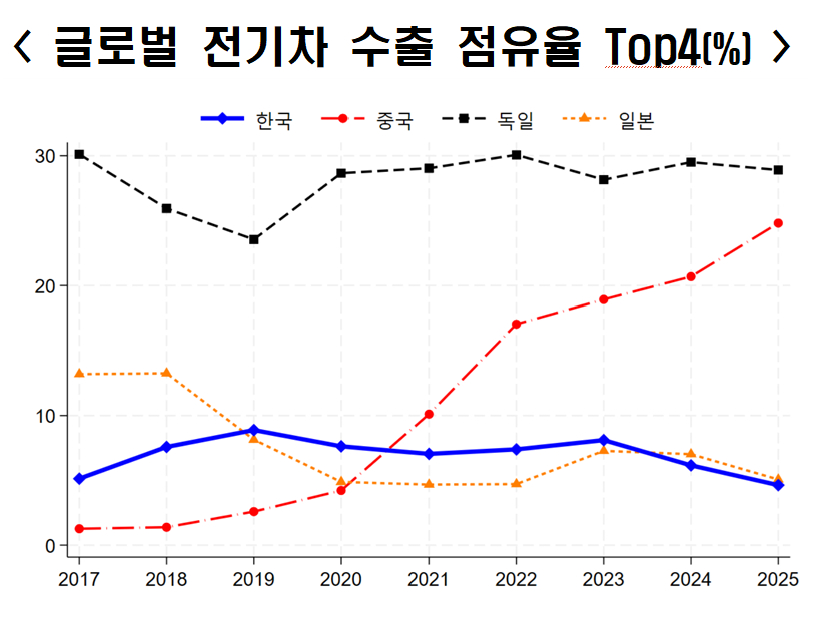
As Chinese-made electric vehicles intensify their global market offensive, analysis shows that South Korea's EV export competitiveness has plummeted over the past two years, leaving it trailing behind China. Experts point out that policy support is urgently needed.
According to a report by the Federation of Korean Industries (FKI) titled "The Current State and Implications of South Korea's Electric Vehicle Exports and Competitiveness" released on Wednesday, the share of electric vehicles in global new car sales expanded from 2.6% in 2019 to 25.0% in 2025, increasing by approximately tenfold over six years. The share is projected to rise further to 29% this year.
While the global electric vehicle market is expanding, the market share of Korean-made EVs is declining in both domestic and overseas markets. In the South Korean market, the share of domestically produced electric vehicles fell from 73.7% in 2019 to 57.0% in 2025, a drop of 16.7 percentage points (p). In overseas markets as well, South Korea's global EV export share decreased by 4.3%p over the same period, from 8.9% to 4.6%.
The comparative advantage of South Korean electric vehicle exports has also deteriorated rapidly in the last two years. An analysis by the FKI of the Revealed Comparative Advantage (RCA) index—a key indicator of export competitiveness that divides a country's share of global exports for a specific product by its total export share—showed that the RCA for electric vehicles plummeted from 2.92 in 2023 to 1.48 in 2025, nearly halving over two years.
In contrast, China's EV RCA was only 0.10 in 2017 but rose to 1.13 in 2022, surpassing the threshold of 1 to secure a comparative advantage. It further increased to 1.49 in 2025, overtaking South Korea (1.48).
China's EV imports significantly exceeded its exports until 2017, but it transformed into an export-led nation just three years later, in 2020. According to the Trade Specialization Index (TSI), which indicates whether a country is more specialized in exports or imports for a specific product, China's EV TSI surged from -0.79 in 2017 to 0.97 in 2025, indicating strengthened export specialization.
However, research shows that South Korea's level of EV export specialization is weakening rapidly. South Korea's EV TSI declined from 0.70 in 2023 to 0.50 in 2025. Over the same period, the TSI for non-electric vehicles expanded from 0.63 to 0.71, contrasting with the trend seen in electric vehicles.
The FKI expressed concern that if the trend of China's expanding EV export share continues, intensified competition with Chinese-made electric vehicles could erode approximately 2.2 trillion won (14.7% of 2025 export value) of South Korea's EV exports by 2030.
Lee Sang-ho, head of the Economic Division at the FKI, said, "China's electric vehicle industry is rapidly seizing the future automotive market thanks to strong support from its government. It is necessary to consider policy support measures, such as tax credits for domestic production, to expand the domestic EV production base."

 in INDUSTRY
