

Kolon Industries' transparent polyimide (CPI) film business, which the company has been developing for nearly two decades, has entered a growth trajectory. As it began supplying CPI films for Apple's first foldable smartphone, its production lines have reached full operation, and the potential for future capacity expansion is also growing.
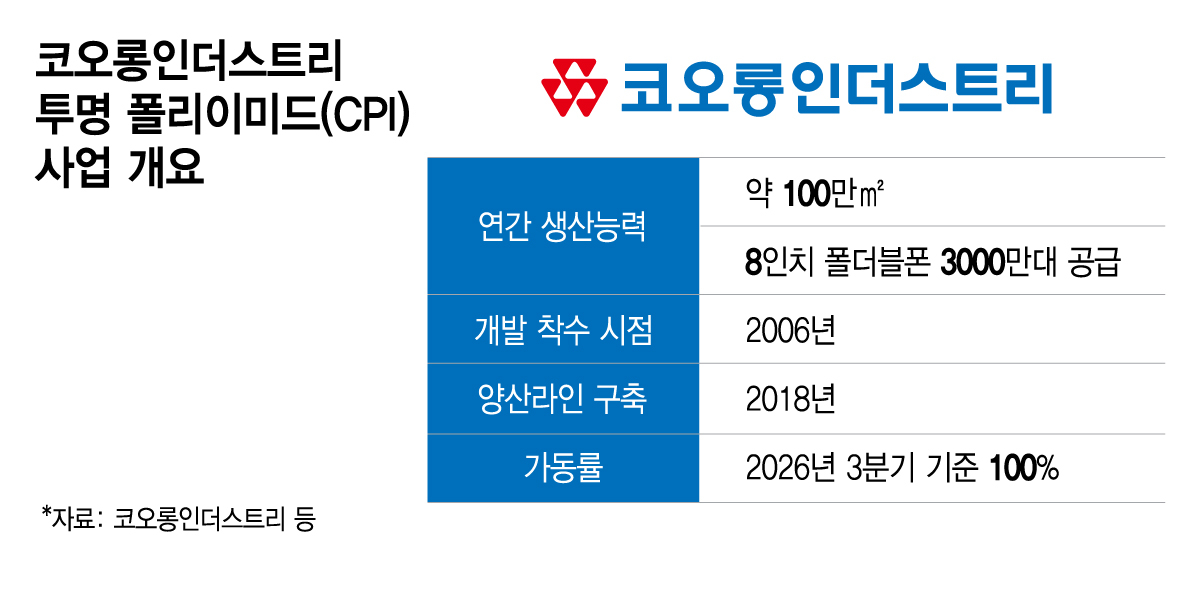
According to industry sources on the 13th, Kolon Industries is expected to begin full-scale supply of CPI films for Apple's first foldable phone, the 'iPhone Duo,' starting in the second half of this year. As of the third quarter, the utilization rate of the CPI production line stands at approximately 100%, and full operation is projected to continue into the fourth quarter. The company anticipates that this trend of expanded supply will persist through next year.
Kolon Industries' annual production capacity for CPI films is approximately 1 million square meters. This scale is sufficient to supply roughly 30 million units based on an 8-inch foldable phone. CPI is a material that maintains the high heat resistance and flexibility of conventional polyimide (PI) while ensuring transparency. It is used in protective films for foldable displays, among other applications, as it sustains minimal damage even when repeatedly folded and unfolded.
Kolon Industries began developing CPI in 2006 and built the industry's first mass production line in 2018. However, as the growth of the foldable phone market fell short of expectations, the company was unable to fully utilize its production facilities. The adoption of ultra-thin glass (UTG) instead of CPI by Samsung Electronics as a cover window material for foldable phones also had an impact.
According to market research firm Counterpoint Research, shipments of the iPhone Duo this year are expected to reach up to 6 million units. It is projected that its share of the global foldable phone market will be approximately 25%. Some observers predict that shipments could increase to a maximum of 18 million units next year. As Apple expands its influence in the foldable phone market, growth opportunities for related material suppliers are also expected to grow.
Kolon Industries is accelerating efforts to improve productivity to meet growing customer demand. With current production lines operating at full capacity, the company plans to increase actual output by speeding up process rates and improving yield. The company expects these improvement effects to become apparent starting next year.
The potential for medium- to long-term capacity expansion also draws attention. Market forecasts suggest that Kolon Industries' annual CPI film production capacity could double from the current 1 million square meters to approximately 2 million square meters by 2028. However, the specific scale and timing of any expansion may vary depending on future customer demand and investment decisions.
The growth momentum of the CPI business has begun to reflect in Kolon Industries' financial results. In fact, the company recorded an operating profit of 40.2 billion won on a consolidated basis in the third quarter of this year, a 66% increase from the same period last year. The improvement in performance is attributed to the expanded supply of CPI films and strong sales of chemical products such as petrochemical resins.
An industry official said, "If Apple's foldable phone sales continue to expand, Kolon Industries' CPI production volume and contribution to its financial results will also increase," adding, "Future productivity improvements and additional expansion plans will determine the trajectory of this growth."

 in INDUSTRY
