

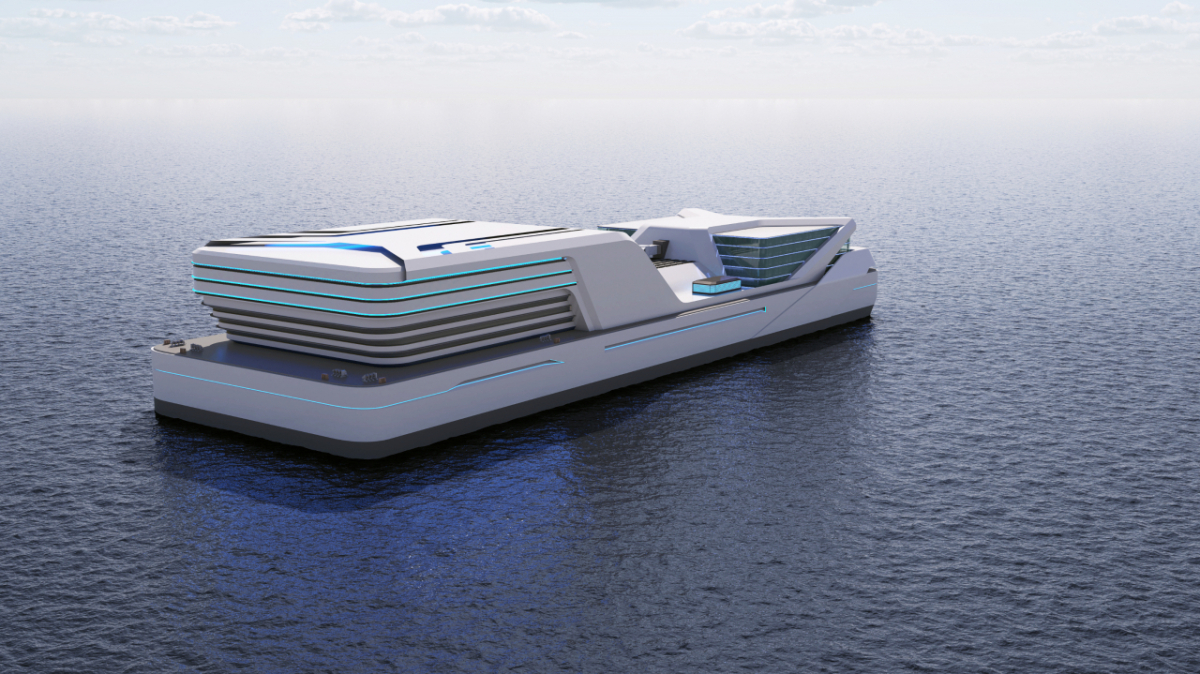
Can the opposition to land-based AI (artificial intelligence) data centers, which has been confirmed in the U.S. midterm elections, boost the expansion of the FDC (Floating Data Center) market? It is expected that domestic shipbuilders with experience in building large-scale offshore plants, such as FLNG (Floating Liquefied Natural Gas facilities), will benefit if FDC development becomes a reality.
According to the shipbuilding industry on the 17th, announcements regarding business and technology cooperation related to FDC have been made one after another since the start of the fourth quarter this year. Last month, 'Offshore Data Center' announced a project to build a gas power plant and a data center together on a semi-submersible platform near an undeveloped offshore gas field. On the 13th, Drogue revealed its plan to raise $20 million and install a single-digit megawatt (MW)-class prototype on a second-hand ocean-going vessel to begin operations in early 2028. As North American big tech companies move to expand AI data centers, they are turning their attention to the sea, where securing land and obtaining permits are relatively less burdensome.
Opposition to data center development in the United States is seen as a factor driving demand for FDCs (Floating Data Centers). Of 41 resident votes on data center-related issues conducted at the city and county level across 10 states, held alongside the U.S. midterm elections on the 3rd (local time), opinions favoring development restrictions won in 40 cases. The reasons for opposition include resource usage such as water, electricity, and farmland, as well as site and living environment issues, and electricity rates. Most of these are problems arising from the location and operation of land-based data centers. As the burden of siting and operating land-based data centers increases, attention to FDCs, which have relatively fewer site constraints, is bound to rise.
This trend is also expected to drive the scaling up of FDCs. As it becomes increasingly difficult to build large-scale data centers on land, demand may grow for securing greater power and computing capacity at sea. In fact, while early FDCs were primarily based on barges with capacities ranging from 0.2 to 7 MW, their scale has recently expanded to a maximum of 100 MW, starting from around 25 MW. The scale of concept design approvals by classification societies has also grown to as much as the 200th MW class.
Industry observers believe that as the scale of FDCs (Floating Data Centers) expands, it could present new opportunities for domestic shipbuilders. While smaller FDCs can be addressed through the conversion of secondhand vessels, larger installations require integrating data halls, power generation and electrical systems, and seawater cooling equipment into a single hull. Given that this demands design and construction capabilities comparable to those required for large-scale offshore platforms, the competitiveness of domestic shipbuilders with experience in this field is expected to stand out.
The most closely watched company is Samsung Heavy Industries, which has built up its technological expertise in the offshore plant sector, including floating liquefied natural gas (FLNG) facilities. Following its receipt of approval in principle (AiP) for a 50-megawatt-class floating data center (FDC) concept design from the American Bureau of Shipping (ABS) and Lloyd's Register (LR) in April, Samsung Heavy Industries filed a design patent for a 100-megawatt-class model in June. In August, it also secured ABS approval in principle for a 200-megawatt-class model.
HD Hyundai has also moved to develop FDC technology and evaluate its commercial viability. HD Hyundai Heavy Industries signed a memorandum of understanding with Schneider Electric, a global energy management and automation company, in July for the joint development of FDC infrastructure technology. Its affiliate, HD Hyundai Marine Solutions, also disclosed during its third-quarter earnings release last month that it is currently conducting basic design work for FDC at the request of a specific customer.
Hanwha Ocean is collaborating with ABB, a global electrification and automation company, on the development of FDC power and control systems. The two companies plan to jointly develop system design as well as operation and control technologies for stable power supply and efficient operations by May next year. Hanwha Ocean first unveiled its in-house developed FDC model at "Gastech 2026," held in Bangkok, Thailand, last September.
Han Seung-han, a research fellow at SK Securities, forecasted that “amid the U.S. midterm elections, FDC-related businesses are moving beyond the conceptual stage and being concretized into actual projects.” He added, “As the scale of FDC projects expands, newbuild demand from shipyards for integrated data halls and power and cooling equipment will also increase.”

 in INDUSTRY
