

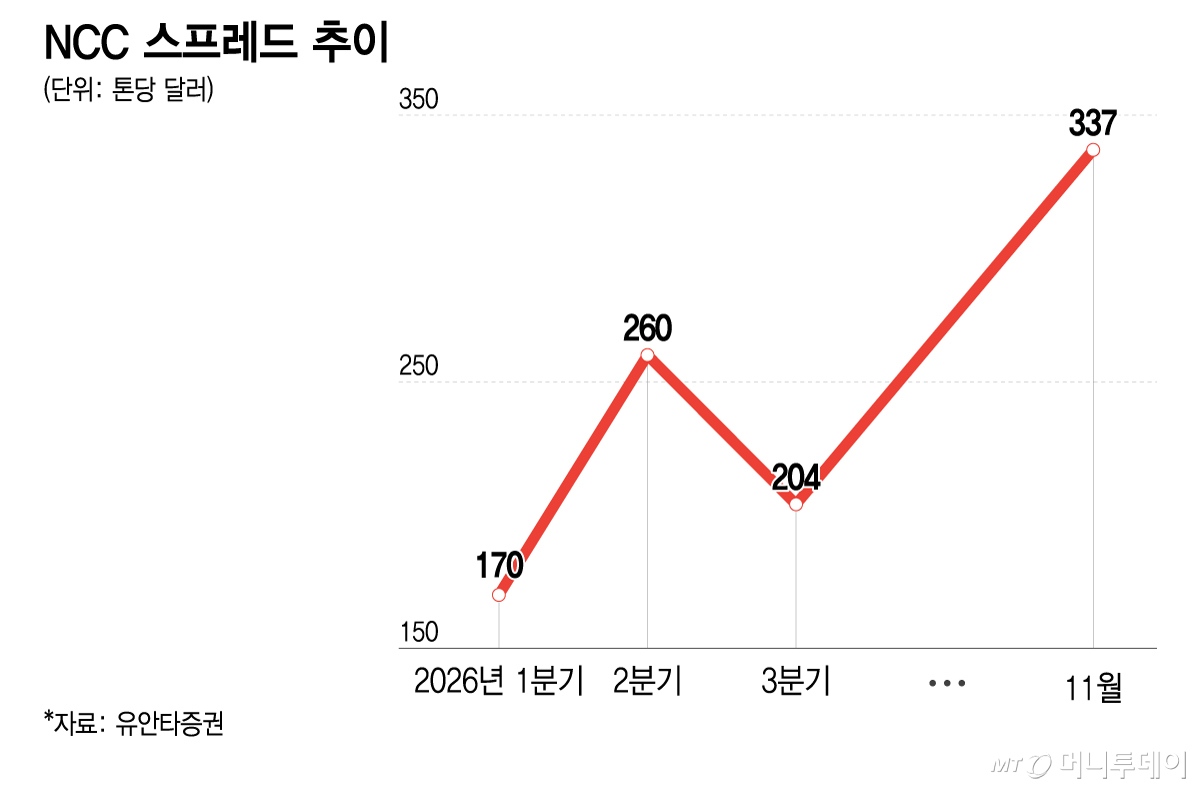
The Naphtha Cracking Complex (NCC) spread, a key profitability indicator for the petrochemical sector, has exceeded the industry's break-even point since November. Domestic companies that posted substantial losses in the third quarter of this year appear to be getting some relief as their cost burdens ease. Meanwhile, domestic petrochemical firms are accelerating restructuring efforts, including business reorganization and the consolidation of general-purpose facilities, while seeking a turnaround in market conditions.
According to industry sources on the 18th, the NCC spread in the Asia region stands at approximately $337 per ton as of this month. This represents a significant increase compared with $260 per ton in the second quarter and $204 per ton in the third quarter. The NCC spread is calculated by subtracting the price of naphtha, the raw material, from the prices of petrochemical products such as ethylene, serving as a gauge of profitability for the petrochemical industry. Having surpassed the $300-per-ton level typically regarded as the industry's break-even point, this suggests that conditions are in place to improve the profitability of companies that had to absorb losses during the second and third quarters.
The easing of cost burdens due to falling international oil prices is cited as a primary factor behind the improvement in indicators. According to Yuanta Securities, Dubai crude oil prices, which serve as a benchmark for international oil, dropped by approximately 20% from $115 per barrel at the end of last month to $91 per barrel in mid-October. In contrast, prices for basic petrochemical products such as ethylene fell only about 6% over the same period, declining from $1,296 per ton to $1,220 per ton. While raw material prices dropped sharply, petrochemical product prices experienced a relatively smaller decline. This means that because product prices fell less than raw material prices, the profit margin remaining after selling products has expanded.
This is welcome news for domestic petrochemical companies, which all recorded losses in the third quarter of this year. Previously, the combined operating loss from petrochemical-related business segments of four major domestic petrochemical firms—LG Chem, Lotte Chemical, Hanwha Solutions, and Kumho Petrochemical—was tallied at 522.5 billion won for the third quarter. By company, LG Chem's petrochemical segment recorded an operating loss of 175.6 billion won, while Lotte Chemical posted an operating loss of 281.4 billion won. Hanwha Solutions' chemical division also reported a loss of 44.7 billion won. Notably, Kumho Petrochemical, which had maintained profitability despite the sluggish market environment, recorded an operating loss of 20.8 billion won on a consolidated basis, marking its first shift into the red since the fourth quarter of 2015.
In response, the petrochemical industry is accelerating restructuring efforts aimed not only at short-term profitability improvements but also at recovering market conditions. DL Chemical is pushing forward with the sale of its key subsidiary, Cariflex. Cariflex, which produces synthetic rubber used in surgical gloves and other products, has long served as a stable source of cash flow for DL Chemical. The company plans to secure liquidity through the sale and raise funds for investment in new business areas. LG Chem is also accelerating its business reorganization, having recently decided to sell its Bisphenol A (BPA) business at its Daejeon plant in Chungnam Province.
The consolidation of general-purpose facilities is another key factor that will determine a market turnaround. Following the launch of joint venture H&L Advanced with HD Hyundai Oilbank in Daejeon, Chungnam Province, Lotte Chemical is promoting business integration with Yecheon NCC in Yeosu, South Jeolla Province. The Yeosu business reorganization is underway with the goal of launching an integrated entity with Yecheon NCC by the first half of next year, following a physical division of the Yeosu plant. LG Chem also aims to prepare and submit a business reorganization plan with GS Caltex at its Yeosu site within this year. In Ulsan, Daehan Oil & Chemical and SK Geo Centric are discussing facility reduction plans, but the upcoming commercial operation of S-Oil's Shahin project, which involves an investment of 9 trillion won and has an annual production capacity of 1.8 million tons, is cited as a challenge.

 in INDUSTRY
