

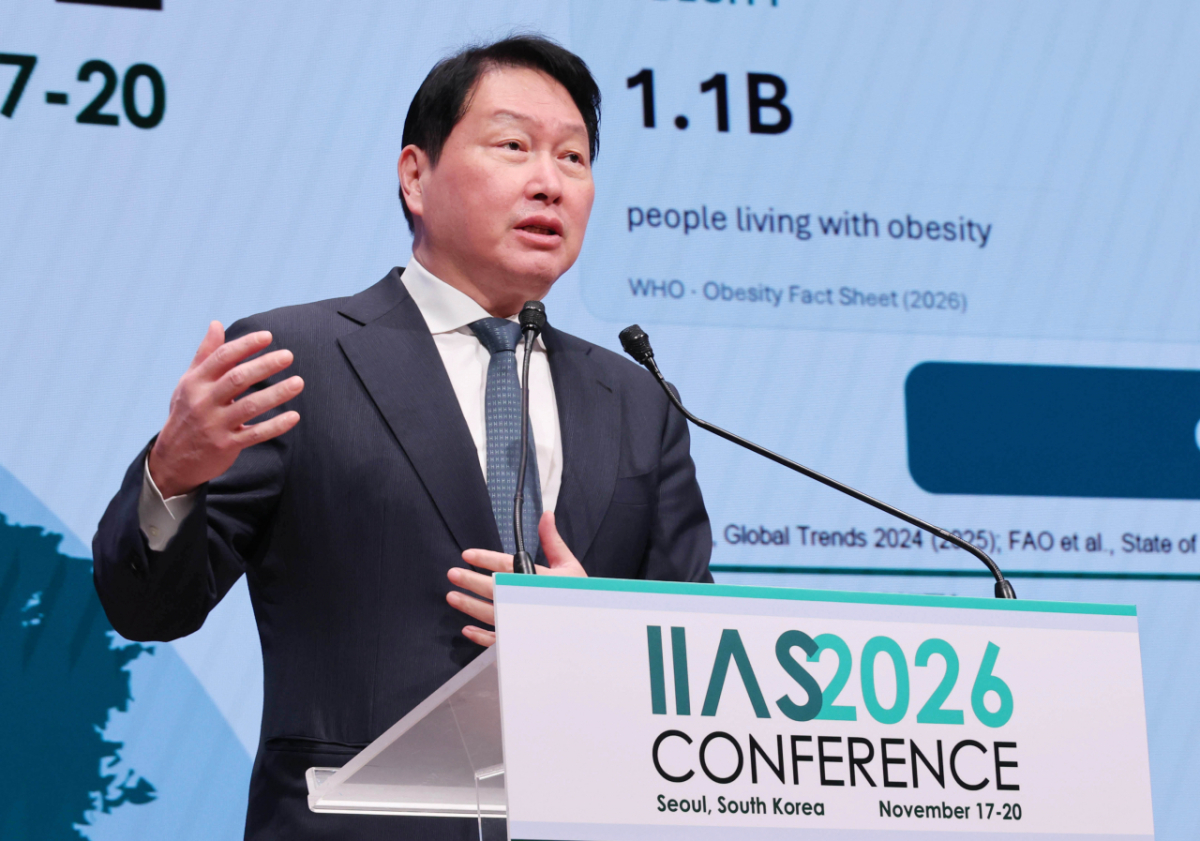
Chey Tae-won, Chairman of the Korea Chamber of Commerce and Industry (KCCI), proposed the construction of a new growth system that simultaneously drives economic growth and solves social problems, based on a social value compensation model.
Chairman Chey delivered a keynote speech titled "Methodology for Growth Based on Social Value" at the opening ceremony of the "2026 International Institute of Administrative Sciences (IIAS) Seoul National University Conference" held at the KCCI on the 18th. This proposal was formulated based on the results of social value measurement and compensation experiments conducted by SK over the past decade, as well as the public-private cooperation ecosystem built by the KCCI over approximately six years.
Chairman Chey raised the "paradox of growth," where social problems accumulate even as the economy grows, as a central theme. Comparing capitalism and democracy to the two wheels that drive society, he stated, "If the balance between capitalism, which drives competition and innovation, and democracy, which mediates conflicts, breaks down, accumulated social costs will ultimately hold back economic growth."
Chairman Chey noted, "It is difficult to solve complex social problems by relying solely on government support, corporate social contributions, or individual goodwill," adding, "We must actively utilize the inherent incentive system of capitalism, which provides definite economic rewards proportional to problem-solving, so that outstanding talent and capital naturally converge."
He then presented specific empirical data from the "Social Progress Credits (SPC)" experiment he has led as evidence. SPC is a model that measures actual social outcomes in monetary value and pays cash incentives proportional to those outcomes. An analysis of 468 companies that participated in SPC over the past 10 years showed that companies receiving incentives created social value approximately three times higher on average than non-receiving companies, with average sales also being 34% higher.
The employment and production induction effects were also at a level of 1.5 to 2 times compared to existing subsidy methods. This corporate-style compensation system, which pays incentives based on actual outcomes created rather than donations or simple cost inputs, has simultaneously driven social value creation and growth.
Chairman Chey identified AI (Artificial Intelligence) as the key driver to elevate this compensation system to a higher level. He explained that AI can significantly reduce the costs of solving problems in fields such as care and education while dramatically improving the accuracy and reliability of outcome measurement.
On this day, Chairman Chey proposed "collaborative governance" involving government, businesses, civil society, and academia to develop these innovative experiments into a sustainable global system. He also urged the international administrative science community to jointly research and verify country-specific application methods so that economic sector experiments can be established as public policies.
Meanwhile, it is unusual for the International Institute of Administrative Sciences, with a history of over 100 years, to invite a business leader as a keynote speaker. This is interpreted as reflecting the academic community's awareness that new solutions for building better nations should be sought from the experience of the business sector, as social problems that are difficult to solve with existing policy tools increase. The theme of this Seoul National University Conference was "Growth for Society: Collaborative Governance, Social Innovation and Social Value."

 in INDUSTRY
