

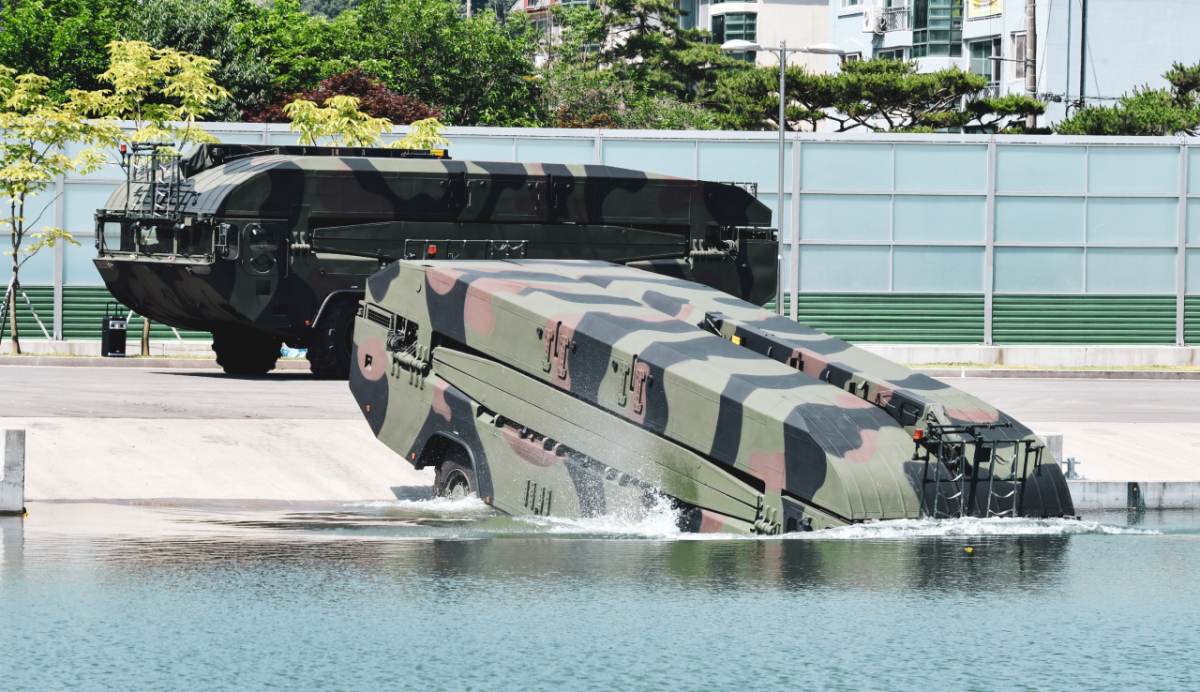
Hanwha Aerospace announced on the 25th that it has secured overseas export rights for its self-propelled pontoon bridge, "Suryong (KM3)." Through technical cooperation with the original foreign manufacturer, the company can now not only supply domestically produced equipment to the South Korean military but also export it to third countries.
On the 3rd (local time), Hanwha Aerospace amended its license manufacturing agreement (MLA) with GDELS-BS of Germany, the original manufacturer of the self-propelled pontoon bridge. Through this amendment, the company secured the rights to export the KM3 to certain countries in Europe, the Middle East, and Asia.
Hanwha Aerospace is the only company among those in countries that have adopted the German GDELS-BS M3 self-propelled pontoon bridge to possess its own production capabilities. South Korea is also the first country among M3 adopters to secure export rights.
The KM3 is equipment designed to help main ground forces assets, such as howitzers, tanks, and armored vehicles, cross rivers and streams. Hanwha Aerospace has been supplying the KM3 to the South Korean military since June 2024. Recently, it completed key verification procedures, including field operation tests and combat readiness evaluations. The company plans to supply the first batch of mass production units by next year before pushing for the deployment of the second batch starting in 2028.
The company explained that this contract amendment was the result of aligned business interests between South Korea and Germany. As actual operational cases with the South Korean military accumulate, expectations are high that sales activities targeting overseas customers will gain momentum. Package exports linked to existing domestically produced weapon systems, such as howitzers and armored vehicles, are also expected to become possible.
Hanwha Aerospace plans to target overseas markets by leveraging the performance of the KM3, which has been verified through South Korean military operations, and its achievements in domestic production of components. Having localized 1,382 types of parts to raise the localization rate to 90%, the company aims to respond swiftly to overseas customer demands and propose various business models, including performance upgrades and locally tailored supply.
Positive effects are also expected for domestic defense industry partners. If overseas sales of the KM3 gain full momentum, production participation opportunities for approximately 50 small and medium-sized domestic partner companies are expected to increase, and the supply base for domestic components is projected to be strengthened.
Park Mae-hoon, head of the LS4 Business Division at Hanwha Aerospace, said, "We will do our utmost to expand the export product lineup and promote stable follow-on domestic mass production to maximize national benefits, while fostering mutual cooperation with the partner ecosystem."

 in INDUSTRY
