

LG Display is set to aggressively target the gaming market by leveraging OLED (organic light-emitting diode) panels that achieve world-class refresh rates. Amidst a slowdown in the overall display industry, the gaming OLED market is expected to maintain a steep growth trajectory.
Samsung Display is also strengthening its market leadership through an expanded product lineup and collaborations with the global gaming industry.
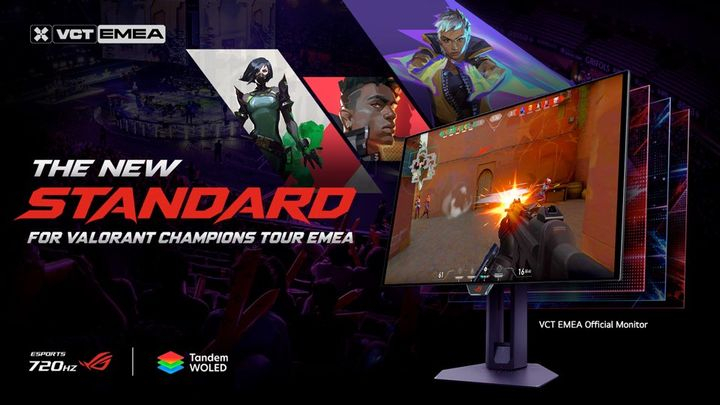
According to industry sources on Nov. 25, LG Display has partnered with the EMEA (Europe, Middle East, and Africa) esports league of "Valorant," a first-person shooter (FPS) game developed by global gaming company Riot Games, to showcase its tandem OLED panels.
The panel is a 24.5-inch model optimized for esports, featuring a world-class refresh rate of 720 Hz (Hertz) and a response time of 0.02 ms (milliseconds, one-thousandth of a second). By applying a proprietary algorithm, the panel ensures stable operation even with screen transitions occurring 720 times per second. The panel is scheduled to be installed in official competition monitors for next season.
As high-specification games become more prevalent, OLED adoption within the gaming monitor market is also expanding. This trend is driven by increasing demand for OLED products that offer fast response times and high refresh rates, as well as superior color reproduction and contrast ratios.
According to market research firm Omdia, shipments of OLED gaming monitors are projected to increase approximately 14-fold from 333,100 units in 2023 to 4.6627 million units this year. The compound annual growth rate reaches 141%.
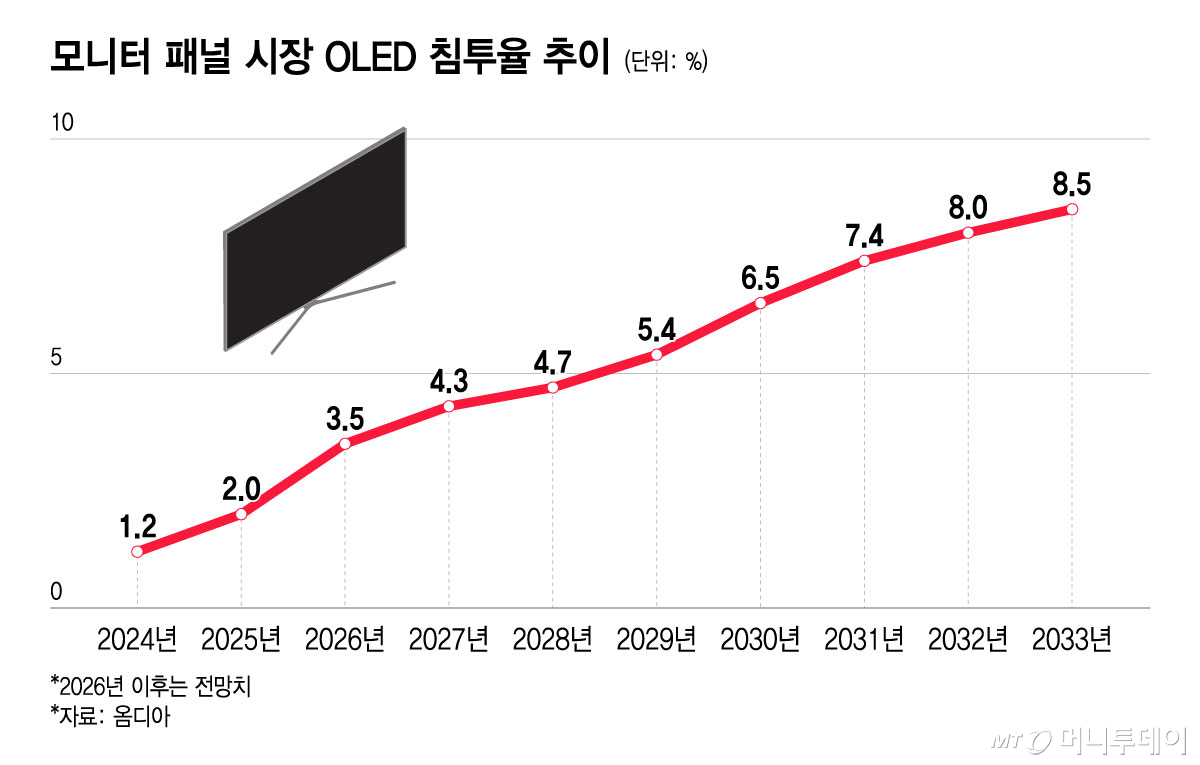
The OLED penetration rate in the monitor panel market is also expected to rise steadily. Omdia forecasts that the OLED penetration rate in the monitor panel market, which was only 1.2% in 2024, will increase to 3.5% this year.
It is estimated to reach 8.5% by 2033. Most notably, the expansion of OLED's revenue share in the gaming monitor market stands out. The OLED revenue share rose from 7.3% in 2023 to 15.6% in 2024 and 22.7% last year. It is projected to reach 31.9% this year.
LG Display aims to lead the market with a product lineup ranging from the 20th-inch class to the 40th-inch class, along with technological capabilities such as DFR (Dynamic Refresh Rate and Resolution).
An ASUS monitor equipped with LG Display's 24.5-inch OLED panel has been selected as the official monitor for the "PGL CS2 Major Singapore 2026." The Sony "INZONE M10S," which is known to be equipped with an LG Display panel, has also been consecutively adopted twice as the official monitor for the Apex Legends Global Series (ALGS) Championship.
Samsung Display is accelerating its push into the gaming OLED market through product line expansion and collaborations with global gaming companies. In addition to its existing core products of 27-inch and 31.5-inch models, it will release a 24.5-inch product suitable for FPS games by year-end.
Next year, the company plans to develop high-resolution products of 4K or higher, while also launching products that allow users to select combinations of refresh rates and resolutions depending on the game genre.
In the medium to long term, Samsung Display aims to accelerate the transition to OLED in the monitor market by targeting not only the gaming sector but also content viewing products and B2B (business-to-business) markets such as broadcasting and film production, and design.
The two domestic display companies hold a 100% share of the global monitor OLED panel market based on revenue.
Amid a slump in the display market caused by factors such as a sharp surge in memory semiconductor prices, the strategy is to boost profitability by leveraging gaming OLED, which has high growth potential.
An industry official noted, "As OLED panel adoption expands in the gaming monitor market, customer requirements regarding panel size, resolution, refresh rate, and response time are becoming more diverse," adding, "Business opportunities for domestic display companies will also increase."

 in INDUSTRY

