

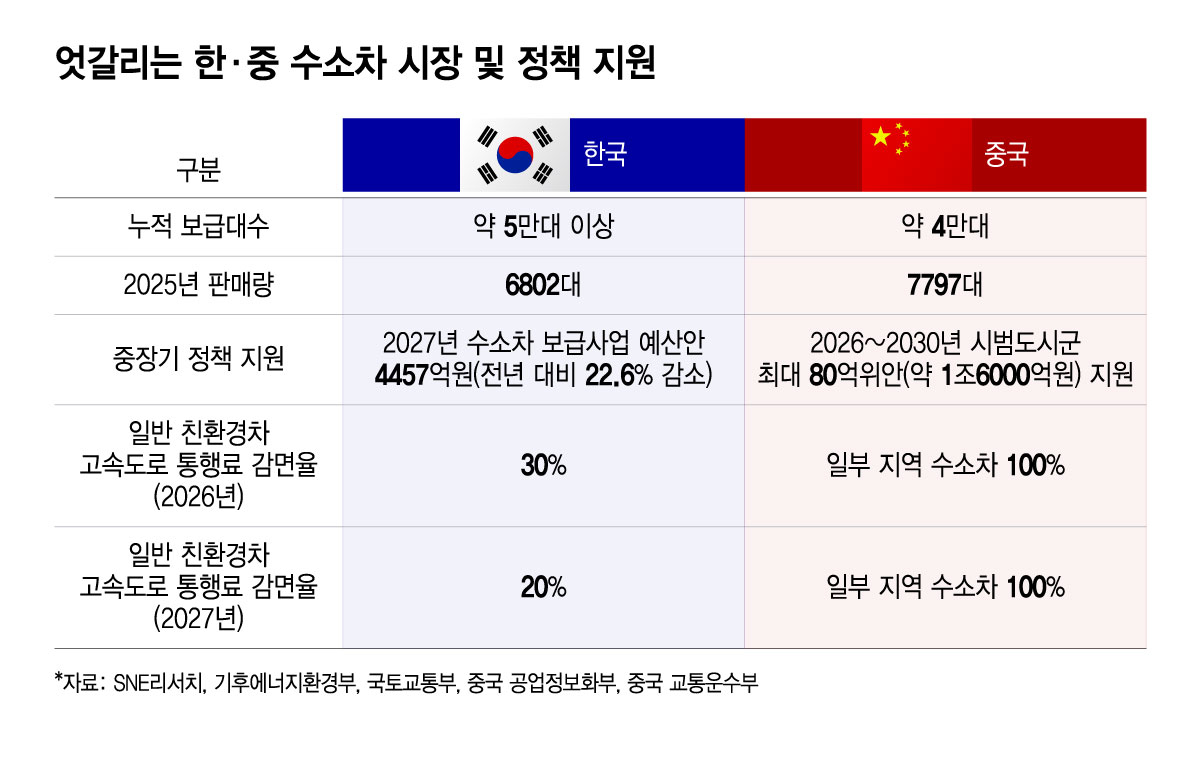
A sense of crisis is growing that China may seize the lead in the hydrogen vehicle market, following electric vehicles. Although Korea was the first country in the world to successfully promote 50,000 fuel cell electric vehicles, forecasts suggest that China may be the first to reach the milestone of 100,000 units. Unlike Korea, which has grown its market centered on passenger cars, China is accelerating hydrogen vehicle adoption by leading with commercial vehicles such as trucks and buses.
This sense of crisis was fully felt even at a domestic hydrogen company in Guangzhou, Guangdong Province, China, visited on the 25th. In fact, China is providing comprehensive support for hydrogen vehicles by establishing various economic incentives from vehicle purchase to operation. Some local governments are exempting highway tolls entirely for hydrogen trucks and easing traffic restrictions in urban areas. Beyond alleviating the burden of vehicle acquisition, they are also expanding practical support at the operational stage.
China extends its lead every four years… Support beyond vehicle purchase to operation
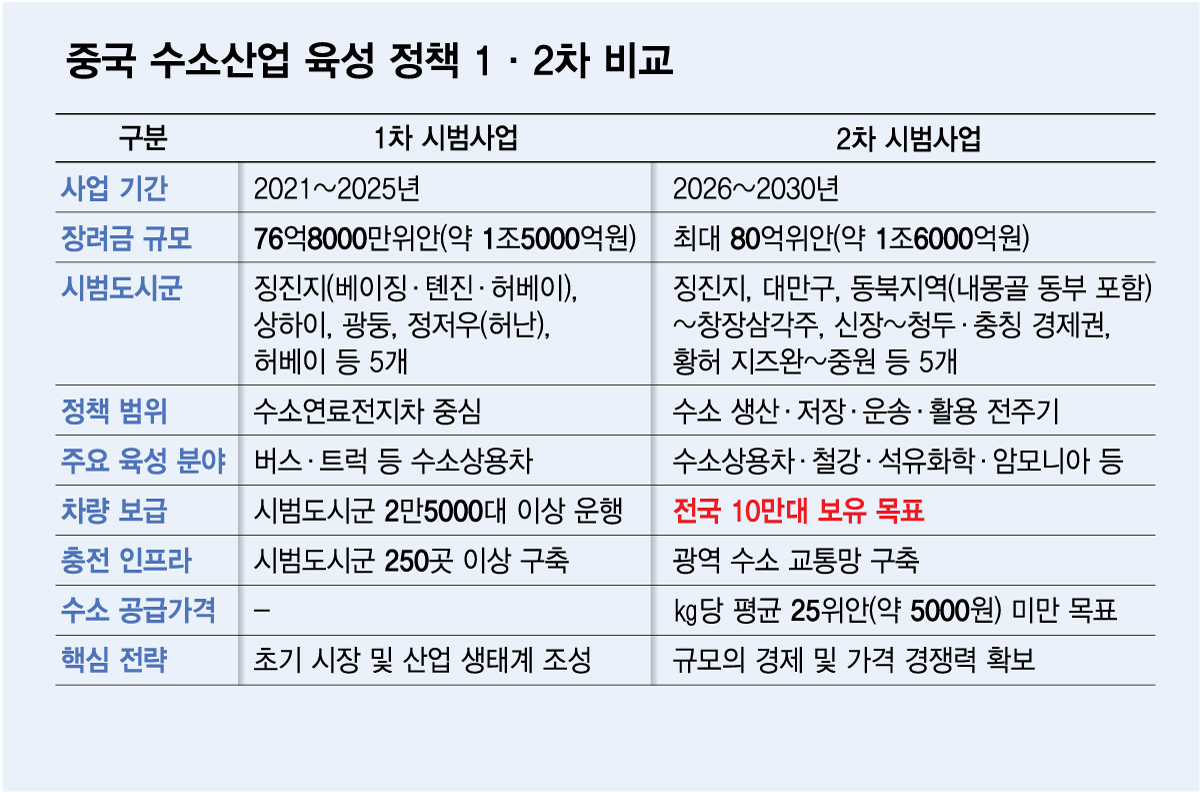
According to the automotive industry on the 26th, the Chinese government announced last month that five metropolitan areas, including the Jing-Jin-Ji region (Beijing, Tianjin, Hebei) and the Greater Bay Area, would be designated as the second phase of hydrogen demonstration zones. It set a goal of providing up to 8 billion yuan (approximately 1.6 trillion won) in incentives by 2030 and increasing the national fleet of fuel cell electric vehicles to 100,000 units.
Previously, China paid out 7.68 billion yuan (approximately 1.5 trillion won) in incentives for the first demonstration project conducted from 2021 through last year. More than 25,000 fuel cell electric vehicles were operated in the five demonstration metropolitan areas, and more than 250 charging stations were built.
While the first project focused on creating an initial market centered on hydrogen vehicles, the second project is characterized by expanding support to cover production, storage, transportation, and utilization Jeonju equipment. The strategy is to expand hydrogen demand across industries such as steel and petrochemicals to secure economies of scale.
Some local governments are also lifting time-based traffic restrictions. Nanhai District in Foshan City, Guangdong Province, allowed 24-hour urban access for hydrogen logistics vehicles under 12 tons registered during the first hydrogen vehicle promotion project period. Chongqing City also excluded some hydrogen freight trucks from urban traffic restrictions last year.
Guangzhou City also disclosed plans in September to fully exempt highway tolls for hydrogen vehicles meeting certain criteria and to ease urban traffic restrictions for hydrogen refrigerated and frozen logistics vehicles. The aim is not only to reduce transportation costs but also to increase vehicle operating hours, such as late-night deliveries, thereby enhancing the profitability of logistics companies. Sichuan Province is fully exempting in-province highway tolls for hydrogen vehicles. Since commercial vehicles are a means of revenue generation for businesses, total cost of ownership (TCO), including fuel and tolls in addition to vehicle price, is a key criterion determining adoption, leading to expanded operational support accordingly.
China lowers operating costs… Korea even sees a decrease in promotion budget
In contrast, Korea is gradually reducing the general highway toll discount rate for electric and hydrogen vehicles from 40% last year to 30% this year and 20% next year. It also operates operational support measures, such as providing a fuel subsidy of 5,000 won per kilogram (kg) for commercial hydrogen freight trucks and reducing late-night highway tolls by 30–50% for commercial freight vehicles. However, the late-night discount is not a benefit exclusive to hydrogen vehicles.
Differences also appear in vehicle-specific promotion policies. According to the Ministry of Climate, Energy and Environment, out of this year's domestic hydrogen vehicle promotion target of 7,820 units, 6,000 are passenger cars and 1,800 are buses. While a national purchase subsidy of 250 million won per unit is provided for hydrogen freight trucks, the promotion target is limited to just 10 units.
The budget proposal for next year's fuel cell electric vehicle promotion project is also 445.7 billion won, a 22.6% decrease from this year (576.2 billion won). The issue of local government cost-sharing based on fiscal conditions is also cited as a hurdle to expanding adoption.
According to market research firm SNE Research, China's fuel cell electric vehicle sales last year were 7,797 units, surpassing Korea (6,802 units). Forecasts suggest that the gap between China and Korea may narrow not only in terms of adoption scale but also in technological competitiveness. Industry experts predict that while Korea's current hydrogen fuel cell technology leads China in quality, Chinese companies are catching up rapidly and it will not take long for them to reach a similar level.
Lee Sang-soo, a researcher at iM Securities, said, "As things stand, hydrogen vehicles are not a high priority in domestic policy or the industrial sector," adding, "Interest in promoting hydrogen vehicles has dropped significantly, including efforts to expand hydrogen vehicle charging infrastructure."

 in INDUSTRY

