

As artificial intelligence (AI) rapidly penetrates factories and offices, competition to secure AI talent is spreading beyond large corporations to small and mid-sized companies. However, in the job market, applicants are concentrating on large firms, leaving SMEs facing an insurmountable challenge: a severe shortage of personnel for their AI transformation (AX).
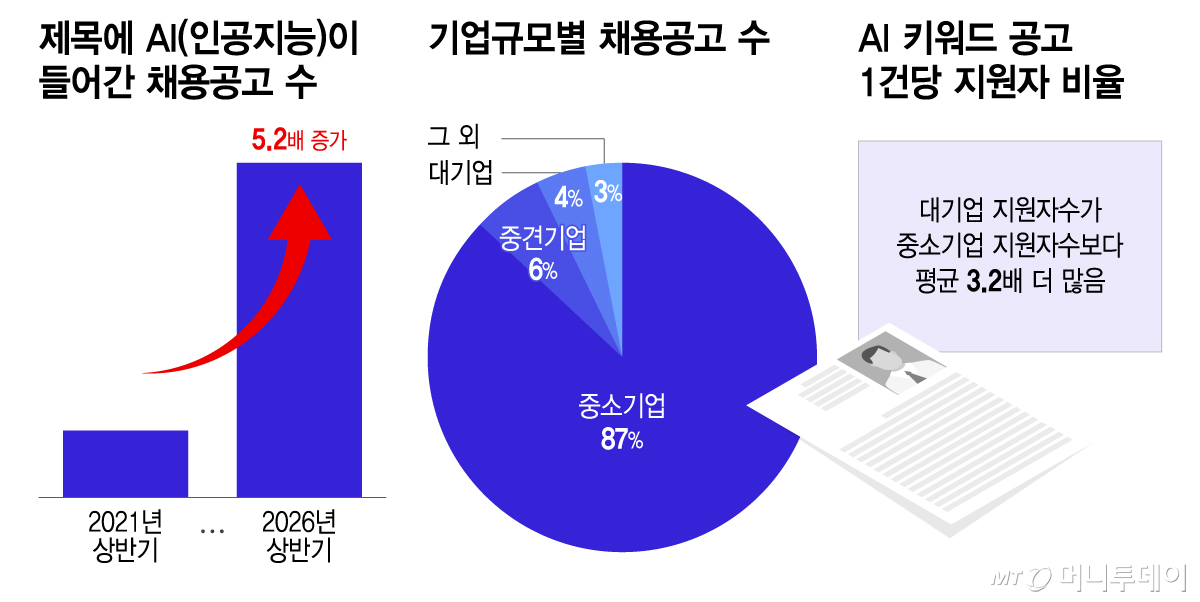
According to recruitment industry data released on the 3rd, the number of job postings with "AI" in the title on JobKorea during the first half of this year increased by 5.2 times compared to the same period in 2021. This surge reflects a rapid rise in companies seeking AI talent as its application has expanded beyond development roles—as it once did—to encompass manufacturing, production, quality control, marketing, planning, and other sectors across industries.
SMEs have led the AI talent job market. In the first half of this year, 87% of job postings containing the keyword "AI" were from SMEs, while mid-sized companies accounted for 6% and large corporations for 4%. Combined, small and mid-sized companies represent over 90%, indicating that competition to secure AI talent has spread beyond large firms to the entire industrial sector.
However, actual applicants are concentrated in large corporations. According to JobKorea, for every single job posting with the keyword "AI," the number of applicants to large corporations was on average 3.2 times higher than to SMEs, and even based on the median value, it was 2.8 times higher. Although the number of SMEs entering the AI recruitment arena is growing rapidly, a clear gap remains between them and large corporations in terms of salary and work environment when it comes to actually securing talent.
In recent years, AI utilization has become a core competitive advantage for SMEs. In manufacturing, there is a growing trend toward upgrading smart factories through AI-driven production process optimization and defect prediction. Similarly, in the service sector, active efforts are underway to restructure business systems around AI, including data analysis and customer response. The demand for talent capable of applying and operating AI not only among developers but also on actual work and production floors has increased accordingly.
The problem is that SMEs often lack the capacity to keep pace with these changes. Unlike large corporations, it is difficult for SMEs to establish dedicated AI organizations or build data and computing infrastructure, and few have internal education systems in place to cultivate AI talent. Even when external talent is sought, they tend to gravitate toward large firms, meaning that despite strong intentions, tangible results from AI transformation remain elusive.
In actual industrial settings, the shortage of AI personnel remains the most significant obstacle. At a meeting of the SME Committee held in June, the Korea Chamber of Commerce and Industry reported that SMEs are struggling due to a lack of specialized personnel and urged the government to expand support for establishing industry-specific AI foundations and training specialized talent. More than 70% of companies have not even developed an AI strategic roadmap.
A gap in AI utilization among SMEs is also evident. According to a survey by the Korea Federation of SMEs, only 5.3% of SMEs are utilizing AI, with manufacturing firms at just around 1%. The SME sector emphasized that since it is difficult to recruit AI talent from outside, there is an urgent need for on-the-ground support such as education programs to train current employees into AI talent and the establishment of industry-specific AI utilization foundations.
A JobKorea official stated, "What stands out in these statistics is that recruitment trends for AI-related jobs are not exclusive to large corporations." They added, "While companies seeking AI talent are overwhelmingly small and mid-sized companies, it has been confirmed that actual applicants remain concentrated in large corporations."

 in LIVING
