

Major food corporations are actively utilizing AI across all aspects of their operations, from creating new products to reducing work hours to one-tenth. In contrast, small and medium-sized food companies lack even the foundational data required for AI training, leading to concerns that the digital divide is deepening into an AI gap.
According to a survey by the Korea Rural Economic Institute (KREI) on the 9th, among 320 food and beverage manufacturing companies, only about 6.2% of production processes utilized digital technologies such as AI, big data, and the Internet of Things (IoT). The average automation rate for these processes was also just 56.1%, slightly above half.
Critics point out that the automation gap is evolving into a data gap, which in turn widens disparities in AI utilization capabilities. In June, then-Minister of SMEs and Startups Han Sung-sook (Hyeon (Prime Minister)) stated, "Only 16% of all food manufacturing companies receive smart factory support, and the adoption rate for AI is merely around 0.9%. This remains at a low level compared to other major manufacturing sectors."
To predict production volumes and quality and optimize processes using AI, information generated throughout the production process—from equipment operating hours to temperature, defect rates, and raw material conditions—must be accumulated as data. Considering the unique characteristics of the food industry, where production conditions vary based on factors such as the origin and seasonality of raw materials, as well as temperature and humidity, companies are already facing difficulties even at the stage of digitizing production information.
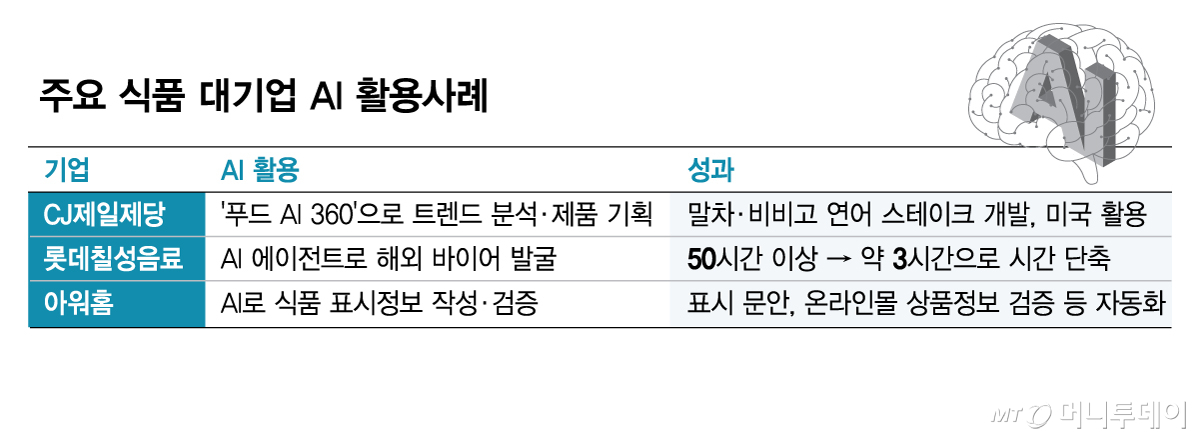
Large corporations are already expanding their use of AI from product development to penetrating overseas markets. CJ CheilJedang has built its own platform, 'Food AI 360,' which analyzes consumer responses and food trends in real time to review product concepts and market viability. This platform was first implemented in Korea and later applied to business operations in the United States. Using this system, 'Bibigo Salmon Steak' sold 1.4 million units within six months of its launch, and 'Matcha Hae-ban' has also been commercialized.
AI is also being used to reduce repetitive tasks. Lotte Chilsung Beverage established a global sales platform utilizing AI agents, shortening the time required to identify overseas buyers from over 50 hours to approximately three hours. Ourhome has also introduced an AI-based integrated management solution for food labeling information, connecting everything from drafting product label text to verifying online store product information.
In contrast, small and medium-sized food companies find it difficult even to decide on AI investments. According to the KREI survey, 47.8% of companies with fewer than five employees indicated they have no intention of adopting new technologies within the next ten years, while one in five companies with 50 or more employees hesitated to invest. The most common reason cited was insufficient profitability relative to investment costs at 36.4%, followed by lack of funds at 27.3% and insufficient information on facilities and new technologies at 13.6%.
Although the government, in collaboration with the Ministry of SMEs and Startups, the Ministry of Agriculture, Food and Rural Affairs, and the Ministry of Food and Drug Safety, launched the 'K-Food Smart Manufacturing Innovation Alliance,' it is expected to take time to narrow the gap across the industry. Currently, there are significant shortcomings in basic infrastructure such as digital equipment and specialized personnel required to apply AI models to actual production sites.
A representative from the SME Central Association stated, "While large corporations are at a stage where AI is replacing actual work, SMEs lack even the foundation to create data." They added, "To prevent the gap that emerged at the automation stage from solidifying into a difference in AI competitiveness, the government must support both infrastructure development and workforce training at the national level."

 in LIVING
