

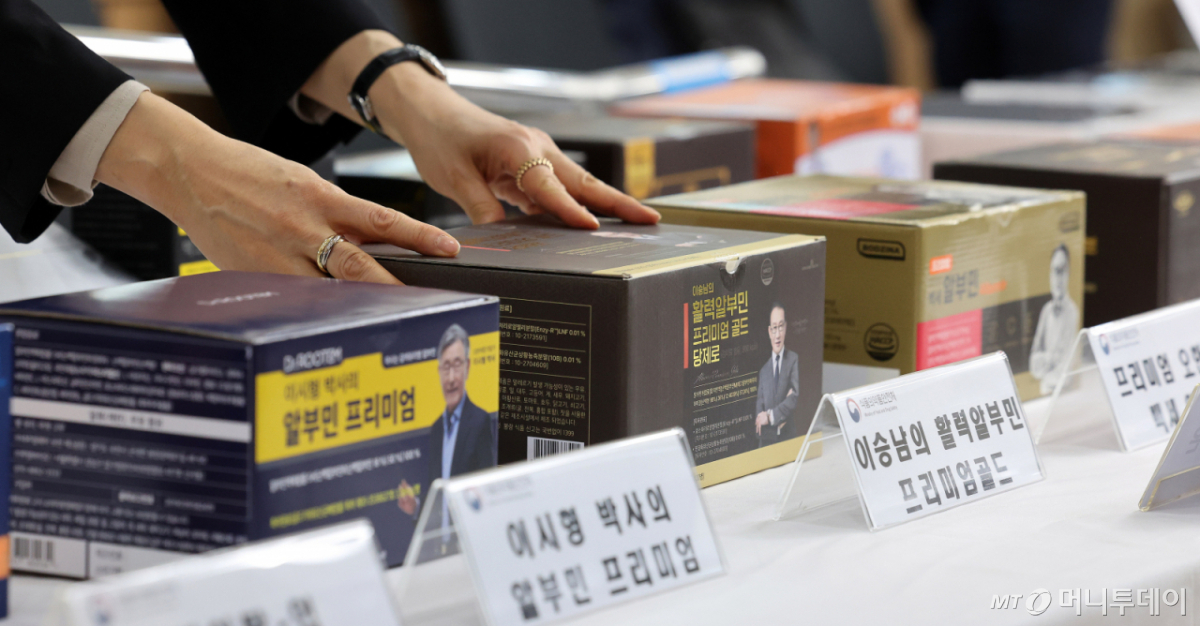
Sales companies that advertised albumin products, which are ordinary foods, as health functional foods helpful for liver health, fatigue improvement, or menopausal symptom relief were identified.
The Ministry of Food and Drug Safety said Tuesday that it inspected online albumin food advertisements and found five sales outlets violating the "Act on Labeling and Advertising of Foods," requesting administrative penalties from local governments and filing criminal complaints with law enforcement authorities. The products sold through improper advertising by these companies totaled 18,982 units, with sales amounting to approximately 518 million won.
The identified companies used phrases such as "for those worried about liver health or easily accumulating fatigue" and "menopausal nutritional supplement" on ordinary food products, misleading consumers into thinking they were health functional foods. Cases were also confirmed where expressions like "body swelling" or "face frequently swells" were used to imply improvements in physical symptoms. Advertisements that explained the role of albumin in the human body and the relationship between blood albumin levels and survival rates, then led consumers to believe they could achieve similar effects by consuming the product, were also included among the violations.
Most so-called "edible albumin" products on the market are ordinary foods made from raw materials such as egg whites. Albumin is a plasma protein synthesized in the liver that maintains blood osmotic pressure and transports various substances, but experts explain that these physiological functions do not imply the efficacy of albumin-containing foods. In particular, edible albumin differs entirely in nature and purpose from albumin injectables, which can only be purchased with a doctor's prescription.
The Korean Medical Association also expressed concern in March regarding advertisements about the efficacy of edible albumin. It stated that since edible albumin is broken down during digestion, consuming the product does not directly raise blood albumin levels, and there is no clinical evidence proving effects such as fatigue improvement, immune enhancement, or energy recovery in healthy general adults. The association also mentioned the possibility of referring cases to its Ethics Committee and recommending disciplinary actions against medical professionals who serve as advertising models for these products, promoting them as having medical efficacy.
Despite this, related improper advertisements continue to recur. In April, the Ministry of Food and Drug Safety identified nine companies that advertised albumin food as health functional foods, resulting in sales of approximately 1.8 billion won. A second inspection in June revealed that six albumin-selling companies using expressions such as "fatigue recovery nutritional supplement," "blood circulation improvement nutritional supplement," and "swelling care" sold about 10,000 units, generating revenue of 480 million won. Including this third inspection, the total number of identified outlets this year reaches 20, with sales amounting to approximately 2.798 billion won. Even after repeated seizures, marketing that combines the name "albumin" with the physiological functions of blood albumin continues in the market.
The Ministry of Food and Drug Safety stated, "We will strengthen monitoring of online albumin advertisements and take strict measures, including on-site inspections and criminal complaints, against repetitive and habitual improper advertising." It also urged consumers not to expect effects similar to those of pharmaceuticals or health functional foods simply because the product name contains the word "albumin."

 in LIVING
