

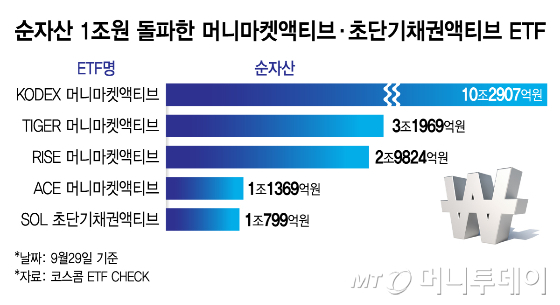
As the stock market struggles to find a clear direction and global government bond yields climb sharply, the net asset size of exchange-traded funds (ETFs) holding ultra-short-term bonds is expanding. Investors are parking their idle funds in products that minimize price volatility while securing interest income. As a result, two ETFs with net assets exceeding 1 trillion won were born last week alone (the 21-23).
According to KOSCOM ETF CHECK and other financial investment industry sources on the 30th, the 'ACE Money Market Active' ETF recorded net assets of 1.1849 trillion won on the 23rd, surpassing the 1st trillion won mark. On the 21st, the 'SOL Ultra-Short-Term Bond Active' ETF first entered the '1 trillion club' with net assets of 1.0411 trillion won. The '1Q Money Market Active' is also on the verge of breaking 1 trillion won, with net assets of 935.4 billion won as of the previous day. Money Market Active ETFs primarily hold short-term financial products such as bonds with short maturities and commercial paper (CP). Classified as 'parking-type' products, they aim to minimize price fluctuations due to interest rate changes while pursuing interest income at an annual level of 3-4%.
The same trend was observed in overseas-listed ETFs. According to the Korea Securities Depository's SaveRo, the most popular overseas stock among domestic investors over the past month as of the 29th was the 'iShares 0-3 Month Treasury Bond (SGOV)' ETF, with net purchases reaching $289.91 million. This is a product that constructs its portfolio solely with U.S. Treasuries having remaining maturities of three months or less.
As demand for ultra-short-term bond active products grew, new products targeting this segment were also launched. Midaus Asset Management listed the 'MIDAS Money Market Active' ETF on the 1st of this month. It recorded net assets of 259.2 billion won within about a month of listing.
The lack of direction in the stock market and the rising trend in global government bond yields are simultaneously behind the influx of funds into short-term fund-type ETFs. While volatility in the domestic stock market has decreased compared to the first half of the year, investors' fatigue continues as the KOSPI index slips each time it attempts to settle above the 7,000 line.
In addition, long-term global government bond yields are showing a simultaneous sharp rise, reaching their highest levels in years to decades. Consequently, the investment appeal of risk assets such as interest-rate-sensitive growth stocks has declined, and the risk of falling prices for long-term bonds has increased. This is because bond yields and prices move in opposite directions.
Heo Ik-seo, head of the Bond ETF Management Team at Shinhan Asset Management, said, "Recently, domestic and overseas stock markets have continued to fluctuate within a box range without a clear direction, and interest rate volatility is increasing. Investor demand for short-term fund-type ETFs, which offer significant utility as a refuge for idle funds, is rising again."
Jo Yik-hwan, head of the FI Management Division 1 at Korea Investment Management, explained, "The advantage of ultra-short-term bond products is their low sensitivity to interest rate volatility," adding, "In times like now, when interest rate and stock price volatility risks are high, it may be an efficient strategy to add short-term fund-type products to a portfolio to reduce volatility."
Forecasts suggest that investors will continue to focus on securing idle funds rather than aggressive investment for the time being. This judgment stems from the view that as the market moves sideways, investors will aim to secure relatively stable returns while considering timing for additional investments, rather than actively betting on index gains.
Park Yun-cheol, a researcher at iM Securities, predicted, "If the Middle East war settles down after November, when the U.S. midterm elections are scheduled, we can expect a stock market rally, and there is a possibility that the trend of conservative investment will reverse," while adding, "However, if high interest rates continue, the current situation will persist."

 in STOCK
