

As SK Hynix suspended its review of an initial public offering (IPO) for its U.S.-based semiconductor subsidiary, Solidigm, controversy has arisen over the impact that political pressure may have on corporate fundraising and the capital markets. Critics point out that despite the establishment of systems and procedures to protect shareholder value, public opposition from politicians and regulatory judgments by financial authorities have acted as a burden on the company’s listing efforts. Concerns are also being raised that companies may repeatedly abandon IPO reviews altogether in order to avoid political controversy.
Shareholder protection procedures exist… yet IPO withdrawn amid political pressure
According to the financial investment industry on the 25th, SK Hynix announced that it would suspend its review of pre-IPO fundraising and an IPO for Solidigm. The company explained that this was a decision made after comprehensively considering recent capital market conditions and stock price trends. However, it stated that there is no change in Solidigm’s growth potential or the need for investment, and that it will continue to consider future fundraising options.
Prior to this decision, criticism of Solidigm’s listing continued in the National Assembly from lawmakers across party lines. The main reasons cited were the dilution of existing shareholders’ equity value and the possibility of a corporate valuation discount due to cross-listing. Financial Supervisory Service Chairman Lee Chan-jin stated during a National Assembly audit on the 19th that Solidigm’s listing would violate the cross-listing guidelines, and Financial Services Commission Chairman Lee Eui-yeon confirmed on the 22nd that it falls under the scope of guideline application.
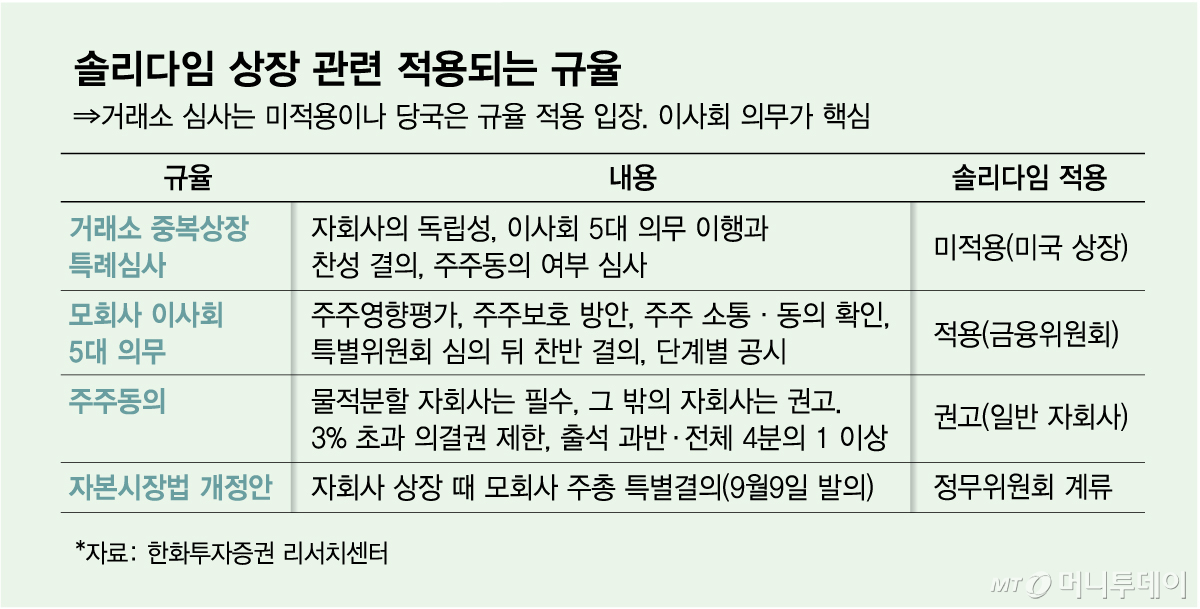
A notable point is that systems for determining whether shareholder protection is ensured in cross-listings have already been established. The Financial Services Commission and the Korea Exchange began implementing a system of principle-based prohibition of cross-listings with an exception-allowance mechanism on August 3. This system stipulates five key obligations, including requiring the parent company’s board of directors to assess the impact on shareholders, formulate protection measures, and confirm shareholder opinions.
This is not a system that uniformly prohibits all cross-listings. It is structured to allow exceptional listings if the impact on parent company shareholders is reviewed and shareholder protection requirements are met. In particular, considering the need for corporate operating funds, different shareholder approval standards were applied to subsidiaries formed through physical spin-offs versus those formed through acquisitions or new establishment.
Since Solidigm was considering a U.S. listing, it was not subject to the Korea Exchange’s domestic listing review. However, financial authorities determined that shareholder protection obligations apply to the parent company, SK Hynix, and others. In this situation, the company suspended its listing review before a final judgment could be made on specific listing conditions and shareholder protection measures. A financial investment industry official said, “Not all cross-listings lead to a decline in the parent company’s stock price,” adding, “It varies depending on the listing structure, fund utilization plans, and shareholder protection measures, so these factors need to be examined.”
Of course, it cannot be definitively stated that this withdrawal was due to political pressure. SK Hynix cited market conditions as the reason for its decision. Political questioning regarding the potential erosion of shareholder value could also be considered a legitimate supervisory activity. However, there is an argument that the impact of political intervention on corporate decision-making needs to be examined, given that public demands for re-examination of the listing were concentrated before institutional judgments had been completed.
Overseas studies also show IPO decline amid uncertainty… Concerns over shrinking market autonomy
If political pressure is repeated, a greater problem may arise: companies might abandon IPO efforts to avoid controversy itself, rather than verifying listing possibilities through established procedures. If companies must consider not only institutional criteria but also political reactions when deciding whether to list, the uncertainty surrounding their fundraising plans will inevitably increase from the company’s perspective.
The impact on shareholder value is also difficult to judge based solely on whether a listing occurs. Even if the parent company’s ownership ratio decreases due to new share issuance by a subsidiary, business value may increase through the attraction of external capital. Conversely, there is a possibility that the corporate valuation discount resulting from a separate listing could outweigh the fundraising effect. Ultimately, factors such as the public offering price, the scale of equity dilution, the use of raised funds, and profits from growth must be comprehensively evaluated.
The point that political and economic uncertainty can suppress initial public offerings is also confirmed in overseas empirical studies. A study published in 2023 in the international academic journal “Finance Research Letters” analyzed 77,600 IPOs conducted across 52 countries from 1990 to 2021. The results showed a tendency for both the number of IPOs and the amount of funds raised to decrease as uncertainty increased.
In particular, the study analyzed that the negative impact of uncertainty on IPOs is mitigated the stronger a country’s institutional capacity. This means that consistent and reliable institutions can support corporate fundraising even in uncertain environments.
The U.S. Securities and Exchange Commission (SEC) reviews whether a company’s securities registration statement meets disclosure and accounting requirements, but does not judge the economic validity of the transaction or whether it is a suitable investment for investors. This distinguishes supervision over information disclosure from economic judgments regarding investment.
Of course, in the U.S. as well, IPOs must comply with securities-related laws and exchange listing requirements. Domestic cross-listing regulations also have a separate purpose of protecting general shareholders. However, there are implications in allowing market participants to evaluate economic effects based on sufficient information and make judgments according to established criteria.
If companies avoid IPOs due to concerns over political controversy, the consequences will not be limited to a reduction in fundraising means. Investors may also lose the opportunity to assess a company’s growth potential and risks to decide whether to invest. The function of the capital market to allocate necessary capital to businesses with high growth potential could also be constrained.
Hwang Yong-sik, Gyeong Yeong-hak-gwa (Prof.) at Sejong University, said, “Domestic companies are not just exporting; they are leaping forward as global companies by directly investing in or listing overseas enterprises. I am concerned that this is being hindered by domestic standards and public opinion,” adding, “The authorities must establish clear guidelines on which aspects of companies seeking to expand overseas or list abroad would violate cross-listing criteria.”

 in STOCK
