

Brokerages are expected to continue their cautious approach to proprietary investment (PI) using their own capital. Analysts assess that, with the KOSPI recently trending downward, valuation losses have accumulated on stocks purchased directly through brokerages' own accounts. If market sentiment does not reverse before year-end financial settlement, second-half profits are likely to be sluggish compared to the first half.
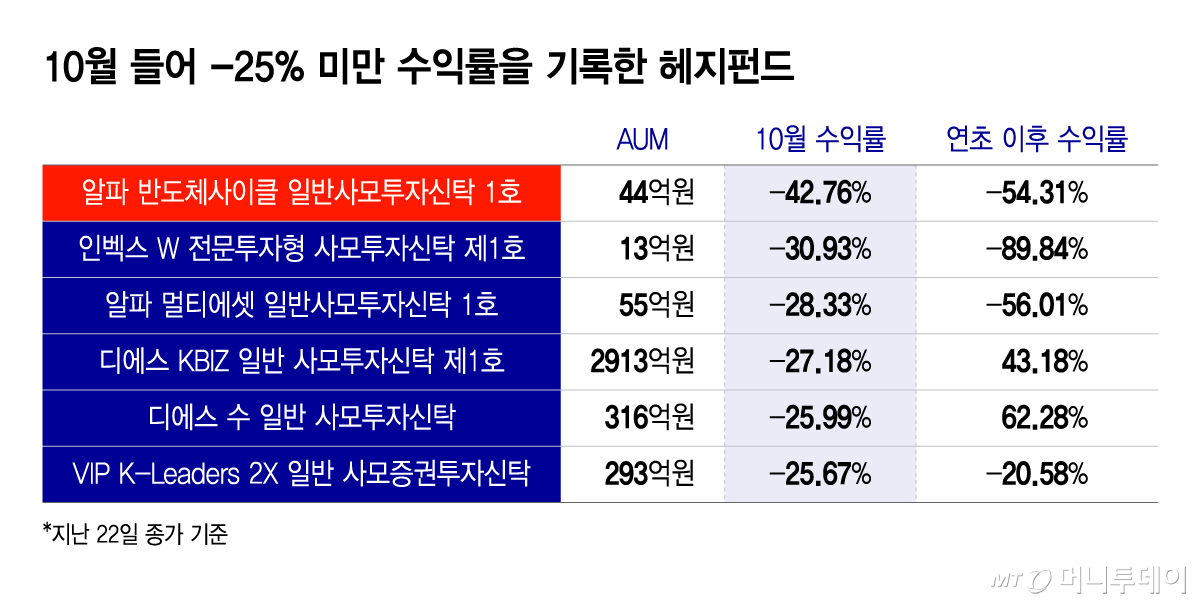
According to October hedge fund return data from a major brokerage obtained by Money Today on the 27th, nine out of 10 long-biased strategy hedge funds recorded negative returns from the start of this month through the 22nd. Among approximately 410 hedge funds utilizing long-biased strategies, only three funds exceeded a 1% return, while just 33 funds showed slight gains in the 0% range.
Long-biased hedge funds are investment products that employ a strategy of increasing equity holdings to offset risk. They are structured to deliver high returns in a rising market and give back gains in a falling market.
The lowest-performing long-biased hedge fund is the "Alpha Semiconductor Cycle Private Investment Trust No. 1." The fund recorded an October return of minus (-)42.76%. The fund holds semiconductor stocks that had fallen sharply this month in its portfolio.
Following this, the lower tier of long-biased hedge fund returns was occupied by the "Invesco W Professional Investment Private Investment Trust No. 1" (-30.93%), the "Alpha Multi-Asset General Private Investment Trust No. 1" (-28.33%), the "DS KBIZ General Private Investment Trust No. 1" (-27.18%), the "DS Su General Private Investment Trust" (-25.99%), and the "VIP K-Leaders 2X General Private Securities Investment Trust" (-25.67%).
Hedge fund returns reflected the state of the KOSPI in October. The KOSPI showed stable movement until early October, but fell for seven consecutive trading days starting from the 6th, dropping below the 5,500 mark. It rebounded on that day to recover the 5,600 line, but the decline since the start of this month has reached 17%.
In particular, the KOSPI plunged 7.57% (454.59 points) in a single day on the 15th, encountering a "Black Thursday." It recorded its largest drop since the double-digit plunge on July 28. Investor sentiment contracted sharply due to the shock to the KOSPI, and sell-offs rang out across both major markets, including the KOSPI and KOSDAQ.
Accordingly, brokerages' second-half performance is expected to contrast with the first half, which was driven by proprietary investment (PI). According to the Financial Supervisory Service, the net profit for the second quarter of 61 domestic brokerages was 5.1914 trillion won, an increase of 20% (864.8 billion won) from the previous quarter and 82.1% (2.3412 trillion won) year-on-year. The profit and loss from proprietary trading (direct investments in stocks, bonds, etc.) at brokerages alone increased by 45.8% compared to the previous quarter.
A financial investment industry official said, "With year-end settlement and personnel changes approaching, brokerages are finding it difficult to readily decide on investment destinations such as bonds, stocks, and real estate, and are considering stop-loss selling for their accounts, so they appear to have tentatively suspended all investments." The official added, "In the July crash, we responded with split stock purchases, but this crash was unforeseeable, so we will have to wait for the market to recover first."

 in STOCK
