

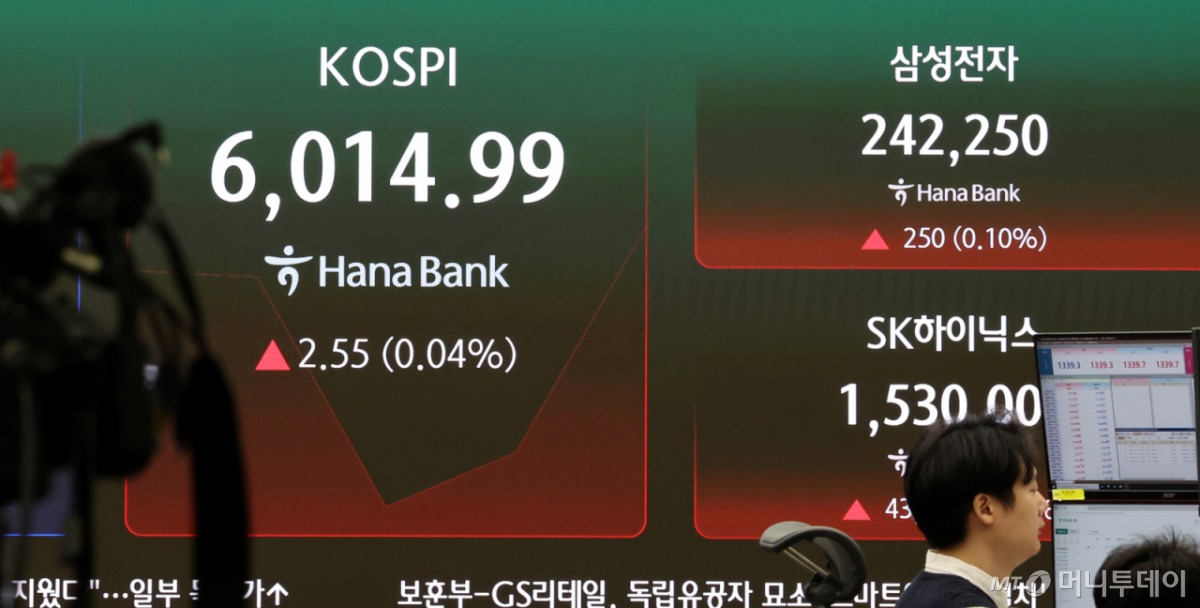
The KOSPI, which had risen above the 6,100 mark in early trading, sharply reversed course and fell below 5,900. Although SK hynix, which announced an additional shareholder return plan worth 6 trillion won on the previous day, supported the index along with its largest shareholder, SK Square, the number of declining stocks was about seven times that of rising stocks, influenced by factors such as LG Chem's sale of its stake in LG Energy Solution and the failure to secure construction contracts for the Czech nuclear power plant by Doosan Enerbility and Daewoo E&C.
As of 10:52 a.m. on Thursday, the KOSPI stood at 5,827.60, down 184.84 points (3.07%) from the previous trading day. The index opened at 6,017.22, up 4.78 points (0.08%) from the previous session, and briefly reached 6,100.11 during the day before slipping below the 5,900 line as a large number of stocks plunged. In the KOSPI market, 111 stocks rose, 775 fell, and 26 remained unchanged.
Foreign investors have been net buyers for three consecutive trading days, but simultaneous net selling by retail investors and institutional investors dragged the index down. At the same time, according to Korea Exchange data, foreign investors were buying a net 412.8 billion won in the KOSPI market, while retail investors and institutional investors were selling a net 195.4 billion won and 308 billion won, respectively.
The top two stocks for foreign net buying were SK hynix (435.9 billion won) and Samsung Electronics (42 billion won). Retail investors, who had been net buyers of about 200 billion won in early trading, switched to net selling after Samsung Electronics' earnings release.
LG Chem announced on the 28th that it would sell approximately 2.5 trillion won worth of its stake in LG Energy Solution to improve its financial structure and enhance shareholder value. Following news of the largest shareholder's stake sale, LG Energy Solution is plunging by over 9%, while LG Chem is also falling by more than 2%.
LG Chem plans to reduce its ownership ratio in LG Energy Solution from the current 79.38% to 76.59%, and has stated its policy of adjusting it to around 70% by 2030. It is analyzed that investor sentiment has been dampened by concerns over supply-demand burdens from potential additional sales.
Doosan Enerbility and Daewoo E&C, which failed to secure the construction contract for the Dukovany nuclear power plant in the Czech Republic, are plunging by more than 10% and 19%, respectively.
On this day, the Korea Hydro & Nuclear Power consortium announced that it had terminated negotiations with these companies regarding the Dukovany nuclear power plant construction contract. It is reported that the two sides failed to reach an agreement on the amount of increase in the construction cost as the scale of the nuclear power plant construction expanded from one unit to two.
Samsung Electronics is falling by more than 5% after its third-quarter earnings release, which had been highly anticipated, triggered a wave of sell-on (profit-taking selling following positive news) from retail investors. Samsung Electronics opened higher and briefly rose by more than 2% during the day, attempting to break above the 250,000 won mark for the first time in 13 trading days since the 12th, but reversed into a decline along with the earnings release.
Samsung Electronics announced that its third-quarter revenue this year was 195.2532 trillion won and operating profit was 107.4405 trillion won, representing increases of 126.9% and 783.1%, respectively, from the same period last year. While the operating profit met market expectations, it is interpreted that the revenue slightly falling short of the market consensus estimate (average forecast) presented before the preliminary earnings release weighed on the stock price. Samsung Electronics had previously indicated an annual shareholder return scale of 90 trillion to 110 trillion won for this year, and the absence of additional shareholder return measures in this announcement also negatively impacted investor sentiment.
Samsung Electro-Mechanics is also falling by 6%. This is partly due to Alphabet (Google), which released its earnings overnight, reporting revenue that fell short of market expectations, and a deepening trend of negative free cash flow (FCF) due to large-scale investments, raising questions about the sustainability of AI (artificial intelligence) infrastructure investment.
Kim Seok-hwan, a researcher at Mirae Asset Securities, explained, "Samsung Electronics opened higher, but volatility expanded as it reversed after confirming third-quarter semiconductor division operating profit that fell short of heightened expectations."

 in STOCK
