

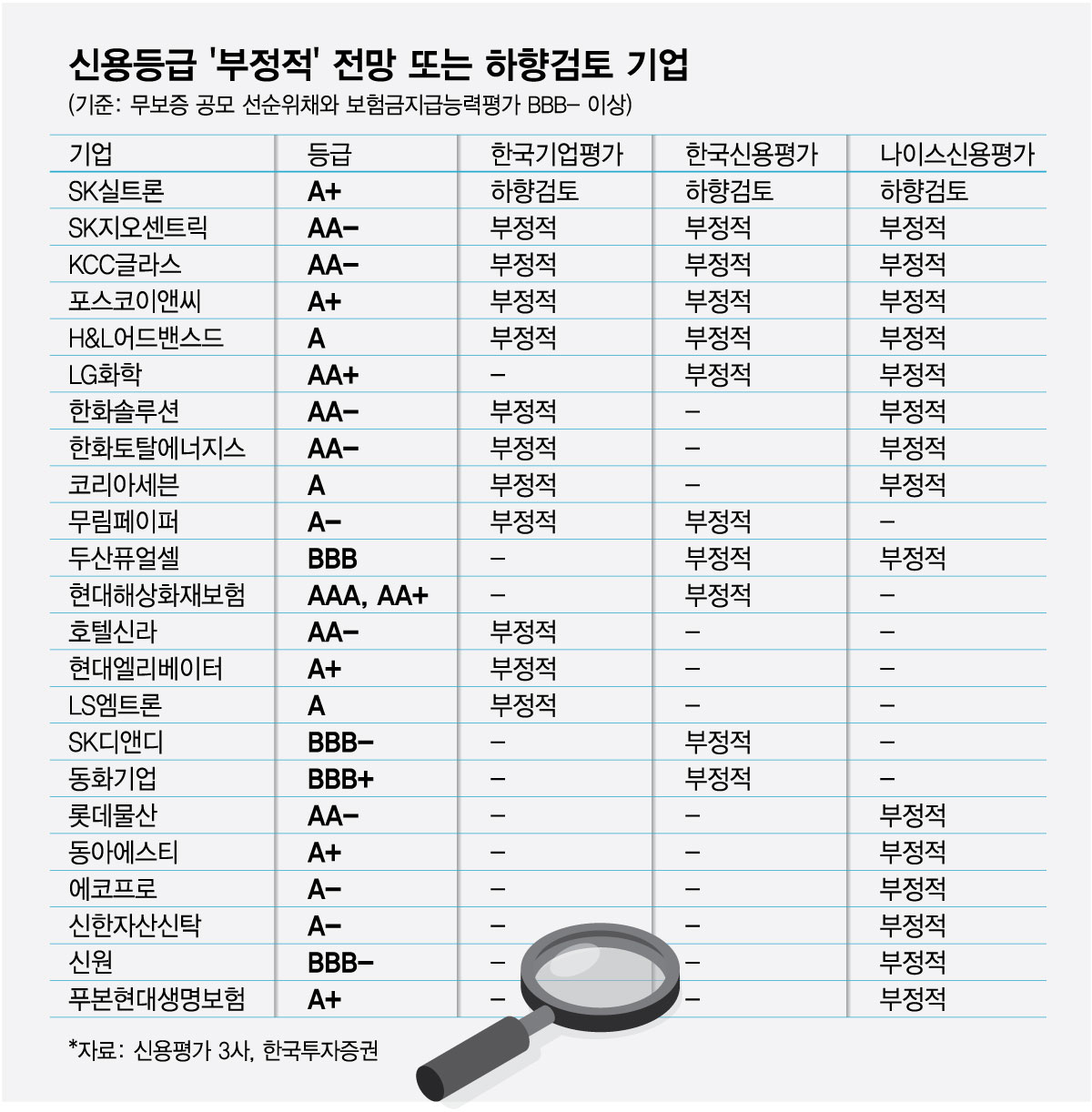
As it is highly likely that both South Korea and the United States will raise their base rates in succession, approximately 20 domestic companies rated BBB- or above have received negative assessments from credit rating agencies regarding the sustainability of their credit ratings. The sectors with the highest proportion among these negatively assessed firms were petrochemicals and construction-related industries.
According to South Korea's three major credit rating agencies (Korea Ratings, Korea Credit Rating, and NICE Credit Rating) and Korea Investment & Securities, 23 companies with unsecured public senior debt and insurance claim-paying ability rated BBB- or above have received a 'negative' rating outlook or an opinion of 'under review for downgrade' from at least one of the three major agencies. Four companies received negative outlooks from all three major agencies: SK Geo Centric (AA-) in petrochemicals, H&L Advanced (A), POSCO E&C (A+) in construction, and KCC Glass (AA-) in building materials.
In the petrochemical sector, LG Chem (AA+), Hanwha Solutions (AA-), and Hanwha TotalEnergies (AA-) also received negative assessments from at least one rating agency. In construction and real estate, SK D&D (BBB-), Lotte Chemical (AA-), and Shinhan Asset Trust (A-) were included, along with Donghwa Enterprise (BBB+) in building materials.
Among all sectors, petrochemicals had the highest proportion of negatively assessed firms at 21.7%. Construction and real estate followed at 17.4%. Including building materials (8.7%), 47.8% (11 companies) of the firms receiving negative assessments from rating agencies were in the petrochemical or construction-related sectors.
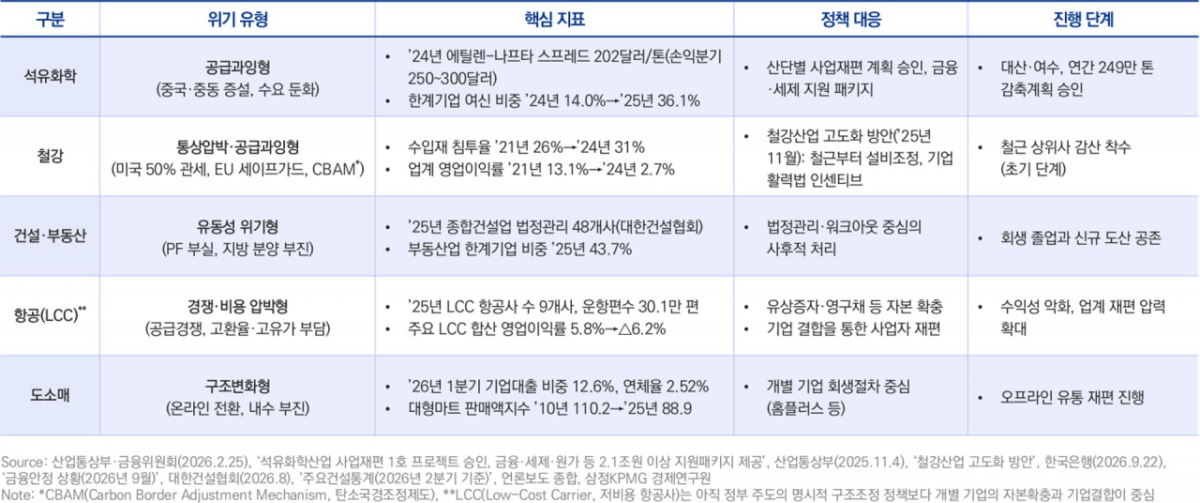
Petrochemical companies saw their rating outlooks deteriorate as prolonged sluggishness in the industry due to oversupply continued. S&P Global forecasts that global ethylene production capacity (a basic material for plastics, synthetic fibers, etc.) will increase by an average of 11.48 million tons annually from 2026 to 2027. This is 1.7 times the average annual demand growth over the same period. The construction industry has been affected by a decline in new starts due to high construction costs and accumulated unsold units in regional areas. NICE Credit Rating analyzed in September that the construction industry is in a state of structural delays in recovering construction payments due to the backlog of unsold units.
Industry sluggishness drives up the interest rates demanded by institutional investors when issuing corporate bonds. SK Geo Centric issued 150 billion won worth of three-year private placement bonds at an annual interest rate of 5.434% in August. This was 67.1 basis points (1bp = 0.01 percentage point) higher than the average interest rate for AA-rated unsecured private placement bonds at the time (4.763% annually). Due to industry outlook concerns, it was effectively required to pay a premium over other firms in the same rating group.
In May, Donghwa Enterprise conducted a demand forecast for issuing 40 billion won worth of 1.5-year bonds but received not a single order, resulting in the entire amount remaining unsold. In retail and hotels, Korea Seven (A) and Hotel Shilla (AA-) were found to be receiving negative assessments. Among insurance companies, Hyundai Marine & Fire Insurance (AAA) and Fubon Hyundai Life Insurance (A+) were included.
According to investment banking (IB) industry sources, some companies are diversifying their funding methods through bank loans or commercial paper (CP), a short-term financing tool, due to the burden of corporate bond issuance rates. However, an increase in CP issuance could also put upward pressure on CP interest rates.
An executive in the IB industry stated, "Companies have been deliberating over whether to issue corporate bonds throughout this year, mindful of monetary policy uncertainty," while adding, "Some may choose to issue corporate bonds as rising rates materialize and uncertainty is resolved, but others may focus more on diversifying refinancing options."
Pressure for interest rate hikes is expected to continue for the time being. According to securities industry sources, the consensus estimate (average forecast by securities firms) is that the Bank of Korea will raise its base rate from 3.00% to 3.25%, a 0.25 percentage point increase, on the 26th. A December rate hike is also likely in the United States. Rate hikes are expected to increase the number of companies struggling with funding for refinancing and other purposes within South Korea's industrial sector, where the proportion of marginal firms has risen.
According to Samjong KPMG, among domestic listed companies with more than seven years of operating history, the proportion of marginal firms increased to 26.5% in 2025, roughly double that of 2019 (13.8%). The number of marginal firms was 579. A marginal firm is defined as a company whose interest coverage ratio (operating profit divided by interest expense) has been below 100% for three consecutive years. Samjong KPMG identified petrochemicals, steel, construction and real estate, low-cost carriers, and retail/wholesale as sectors requiring proactive restructuring.

 in STOCK

