

The government is accelerating the operation of the Securities Market Stabilization Fund (Stabilization Fund). Following the Investment Management Committee’s move to revise operational guidelines on the 29th, details are expected to emerge at an emergency market situation review meeting chaired by Financial Services Commission Chairman Lee Eui-won on the morning of the 30th. This meeting, which will bring together the chairs of the five major financial holding companies and the Korea Development Bank, is seen as a turning point for the stock market.
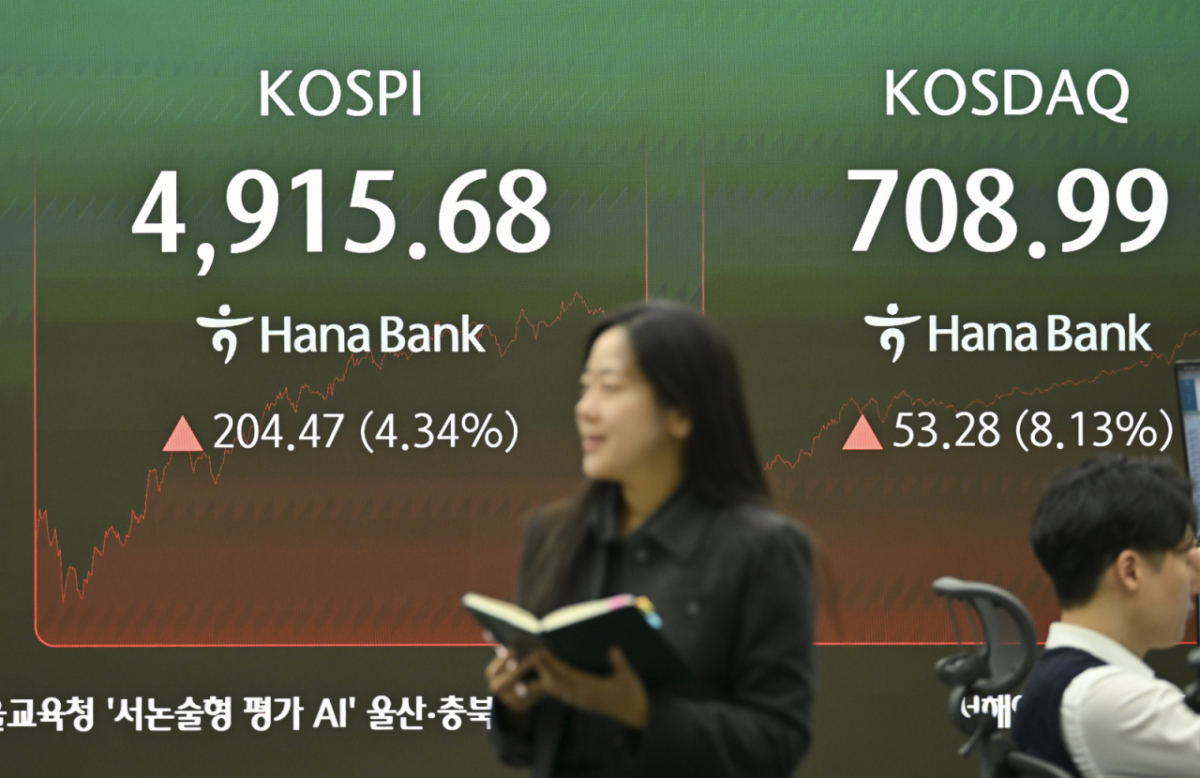
The domestic stock market is closely watching whether authorities can deliver messages commensurate with expectations in a timely manner. Expectations regarding the activation of the Stabilization Fund have already been reflected in stock prices. On the 27th alone, ahead of the weekend, the KOSPI index surged by 204.47 points (4.34%) and the KOSDAQ index rose by 53.26 points (8.13%) compared to the previous day.
The KOSPI market capitalization, which was 998 trillion won on March 23, the day before the Stabilization Fund was established in 2020, has more than quadrupled to 4,030 trillion won as of the 27th. Given that the size of the stock market has expanded rapidly, centered on semiconductor stocks since last year, the consensus among securities firms is that the key effect lies not in directly lifting the index with Stabilization Fund funds alone, but in stabilizing sentiment by declaring a firm response.
Jeong Da-un, a research analyst at LS Securities, stated, "Even if the Stabilization Fund increases to a maximum of 2 trillion won, it represents only 0.46% of the stock market’s total capitalization and is not a direct driver for lifting the index." However, he added, "It is highly likely to function as a psychological safety net preventing panic selling, coinciding with the period when supply and demand for dividend reinvestment flows in, starting with Samsung Electronics’ quarterly dividend payment around year-end."
The banking sector, a major contributor, is in a difficult position. Ahead of year-end accounting settlements, banks must meet their BIS (Bank for International Settlements) capital adequacy ratios while also considering funding needs of 1 to 2 trillion won and the possibility of additional capital injections. The Korea Development Bank also has a precedent where its BIS ratio declined when the Stabilization Fund was established in 2020, requiring capital replenishment through a supplementary budget.
Although the stock market has fallen sharply in the short term, it is at a level twice as high as two years ago on a long-term basis. Consequently, concerns over losses from further declines are significant amid the emergence of major variables related to AI (artificial intelligence) stocks. The situation differs markedly from March 2020, when the KOSPI, which had fluctuated in a box range around 2,000 for several years, dropped to the 1st,400s due to the impact of the coronavirus pandemic. In the stock market, bank stock prices have fallen, partially reflecting such concerns.
Choi Jung-uk, a research analyst at Hana Securities, stated, "If the Stabilization Fund is actually deployed in the stock market, gains and losses from stock price fluctuations will be reflected in the quarterly consolidated earnings of financial groups, likely increasing earnings volatility." He added, "A risk-weighted asset (RWA) ratio of 40% applies merely upon agreement, but if actually used, it rises to 100%. If the agreed amount doubles, RWA increases further with just the additional agreement."
He continued, "It is difficult to predict the actual deployment scale and its impact on earnings. While it could act favorably on earnings, given that the market dislikes uncertainty, it is highly likely to be perceived as a negative factor for bank stock investment sentiment for the time being."
There are also observations that if banks reduce bond purchases to secure capital injection capacity, and if the stock market rises, the recently increasing preference for safe assets may weaken, potentially spilling over into the bond market.
Lim Jae-gyun, a research analyst at KB Securities, stated, "The current decline in bond yields is driven by foreign purchases of government bond futures, so the perceived impact on supply and demand will not be large." However, he added, "Depending on the scale of additional contributions to the Stabilization Fund, banks will purchase bonds more conservatively to manage their Common Equity Tier 1 (CET1) ratios."
Suggestions are also emerging that instead of mechanically buying representative indices such as KOSPI 200, the weight of purchases for stocks included in the value-up program index should be increased. The aim is to set a precedent favoring shareholder-friendly companies during crisis situations.
Park Se-yeon, a research analyst at Hanwha Investment & Securities, said, "There are precedents such as the Bank of Japan’s purchase of JPX-Nikkei 400 tracking exchange-traded funds (ETFs) in 2014 and the Korea Exchange’s establishment of a value-up program fund in 2024." She added, "While balance with deep-liquidity representative indices and fairness in stock selection are issues, if policy funds buy companies that pay dividends or conduct share buybacks, it gives companies one more reason to increase shareholder returns."

 in STOCK
