

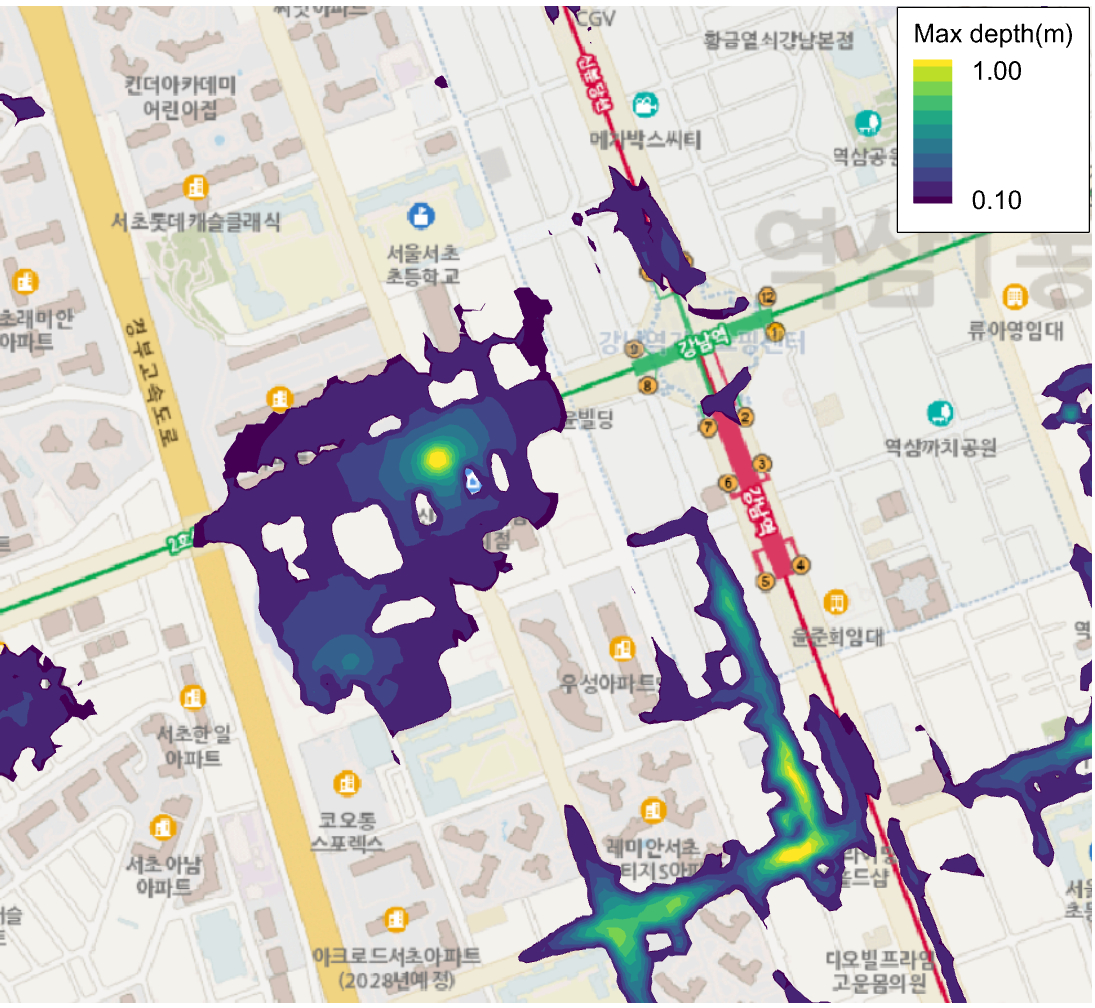
Analysis indicates that if a concentrated downpour exceeding 100mm per hour occurs near Seoul Gangnam Station, flooding with a depth of up to 1 meter could occur. A depth of 1 meter is enough to submerge an average-height adult woman up to her waist.
KICT announced on the 29th that it obtained these results by conducting urban flood simulations and full-scale hydraulic experiments in the urban area near Gangnam Station.
The River Experiment Center of KICT's Water Resources and River Research Division is developing urban flood prediction and response technologies to cope with increasing localized heavy rains due to climate change. It verified the occurrence process and spread patterns of urban floods by linking numerical model experiments reflecting actual road and drainage system characteristics with full-scale hydraulic experiments conducted at KICT's Andong River Experiment Center.
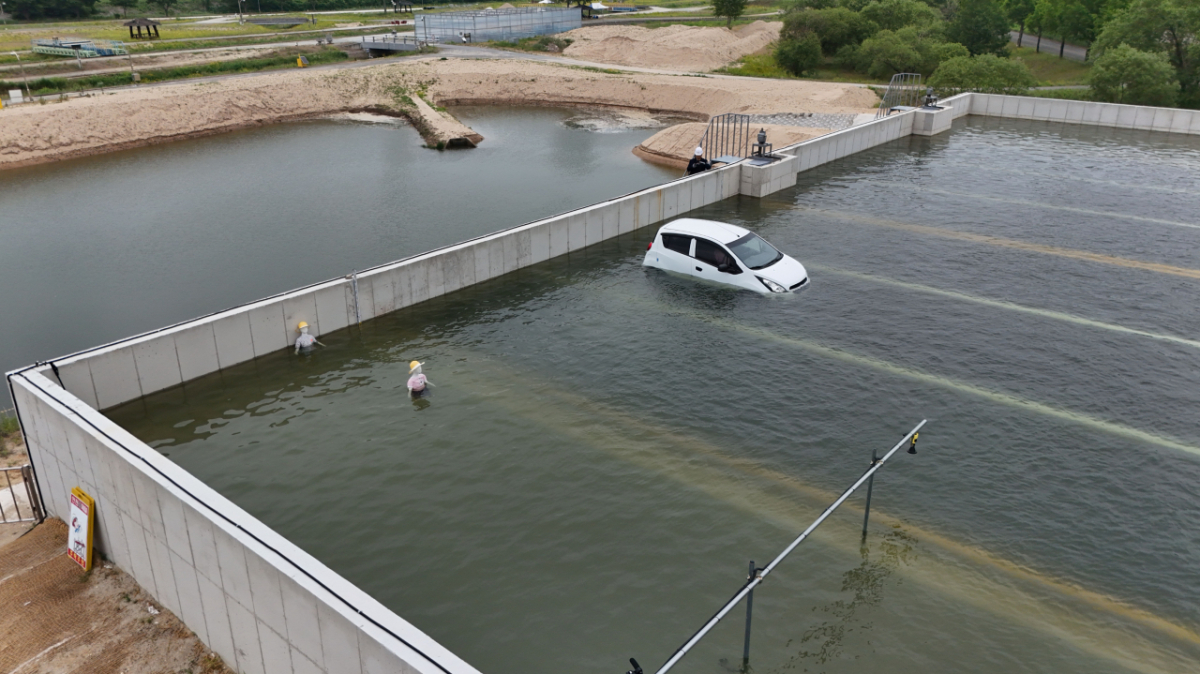
The research team built a computer simulation reflecting key drainage facilities such as the terrain of the Banpocheon watershed, stormwater pipe networks, longitudinal and transverse slopes of roads, and catch basins. They applied rainfall and runoff conditions to a simulated section of the Gangnam Station intersection that implemented actual roads and drainage facilities, analyzing road overtopping, the drainage capacity of catch basins, and the process of flooding occurrence and rising flood depth.
As a result, when rainfall of 100mm per hour occurs, it is expected to exceed existing drainage capacity limits, causing flooding ranging from several tens of centimeters up to a maximum of 1 meter. Similar results were also obtained from full-scale hydraulic experiments conducted at the urban flood pilot test site of KICT's Andong River Experiment Center.
The research team stated, "These results can be utilized to improve the accuracy of urban flood warning systems and to manage flood-vulnerable areas in advance." Through follow-up research, they plan to develop digital twin-based technologies that can quickly predict the expected range and depth of flooding when extreme rainfall occurs.
Park Seon-gyu (Director) said, "This study is significant in that it enhanced the reliability of urban flood prediction technology by cross-validating computer simulations with full-scale experiments."
Meanwhile, Seoul City is jointly controlling vehicle traffic in advance on three major roads with high flooding concerns, such as the Gangnam Station intersection, together with the National Police Agency. It is currently constructing a 'deep-level stormwater drainage tunnel' aimed at preventing flooding even when rainfall reaches 110mm per hour, with the goal of achieving this by 2030.

 in TECH

