

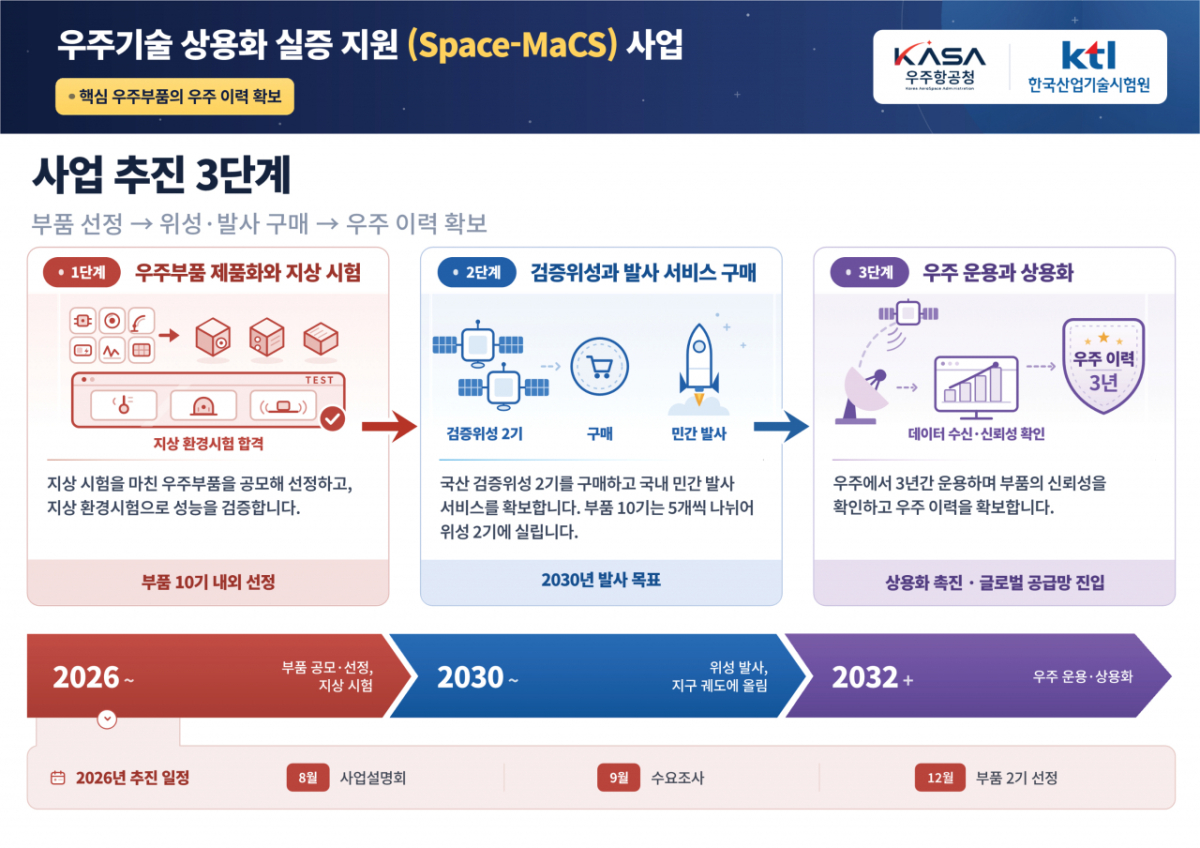
The Korea Space Administration will invest a total of 495 billion won over five years to support the 'space heritage' of domestic space components, satellites, and launch vehicles.
On the 3rd, the Space Administration announced it has launched the 'Space Technology Commercialization Demonstration Support' (Space-MaCS) project.
The Space Technology Commercialization Demonstration Support project aims to enable domestic companies to validate their products in space environments, with a total investment of 495 billion won by 2030. The goal is for domestic companies to accumulate 'space heritage,' meaning verification records from actual space environment testing.
The plan includes building demonstration platforms that support the design and manufacturing of domestic satellites, launch support, and mission operations, as well as launching satellites equipped with domestically developed space components using private launch vehicles. The government will guarantee corporate demand by purchasing verified satellites and launch services.
First, 10 domestic satellite payloads with 'Technology Readiness Level' (TRL) 6 or higher that have completed ground-based verification in environments similar to space will be selected for productization and additional ground testing support.
Next, two verification satellites and system integration services will be procured from the private sector to secure a space verification platform. The plan is to mount each of the previously selected 10 payloads onto the two satellites, five per satellite.
Furthermore, by 2030, small and medium-sized launch services from domestic private launch vehicle companies will be purchased to place the two verification satellites into low Earth orbit. This will also create initial launch demand for domestic launch vehicle companies.
The Space Administration plans to hold a project briefing in August targeting satellite payloads, platforms, and private launch vehicle companies. Following demand surveys and evaluations, two of the 10th payloads will be selected first this year. The remaining eight are planned to be selected gradually according to the project implementation schedule.
Oh Tae-seok (Commissioner) stated, "We aim to promote the commercialization of core space technologies, create a virtuous cycle for the space economy, and inject significant vitality into the space industry ecosystem."

 in TECH
