

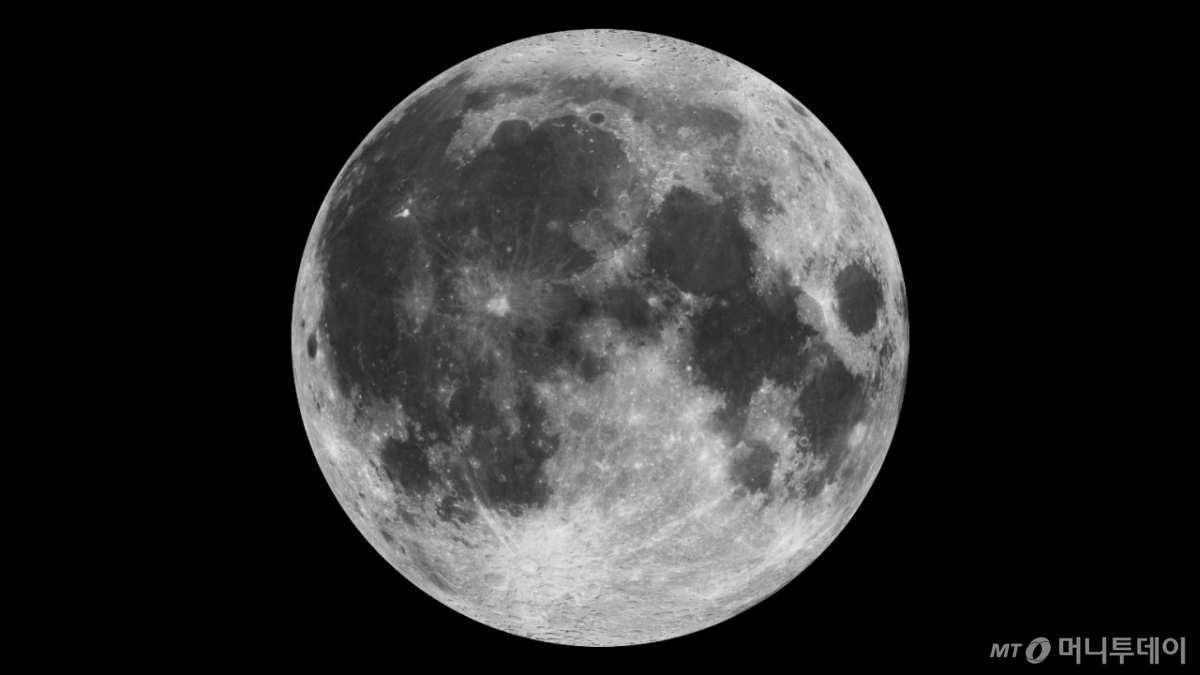
As debris from SpaceX's Falcon 9 launch vehicle is expected to crash onto the lunar surface on the 5th, Korea's lunar orbiter DaeNuri is anticipated to be the first to capture images of the moon before and after the collision.
According to the Space Administration on the 4th, the upper stage of the Falcon 9 rocket, weighing approximately 4,900 kg, will collide near the 'Einstein crater' on the western side of the moon at 3:34 p.m. (Korean time) on the 5th. DaeNuri (KPLO) plans to observe the collision before and after it occurs. DaeNuri is Korea's first lunar probe, launched in August 2022.
The rocket will hurtle toward the moon at a high speed of 8,700 km/h. A crater with a diameter of 20 to 30 meters is expected to form after the collision. The rocket was part of a Falcon 9 launched by SpaceX in January last year; after deploying two lunar landers into their target orbits, it drifted in the gravitational field between Earth and the moon. It is believed that the rocket will gradually approach the moon due to lunar gravity before colliding with its surface.
DaeNuri is expected to be the first to observe the scene before and after the collision. While orbiting the moon and observing it, DaeNuri is scheduled to pass over the area above the predicted impact site on the day of the collision. Among several probes orbiting the moon, it will be the one closest to the impact time and location.
It will not capture the exact 'moment of collision.' The rocket is expected to hit the moon around 3:34 p.m. on the 5th; at that moment, DaeNuri will pass near the lunar south pole, hundreds of kilometers away from the impact site. It will then gradually approach the western impact site along its orbit. Considering DaeNuri's flight trajectory and the moon's rotation speed, it appears that DaeNuri can photograph the impact site approximately once every two hours. Kim Eun-hyuk, a senior researcher at the Lunar Lander System Team of the Korea Aerospace Research Institute's Satellite and Space Exploration Research Center, said, "It will take about 2 to 3 minutes per shot, occurring once every two hours," adding, "The goal is to capture as many images as possible to collect diverse data."
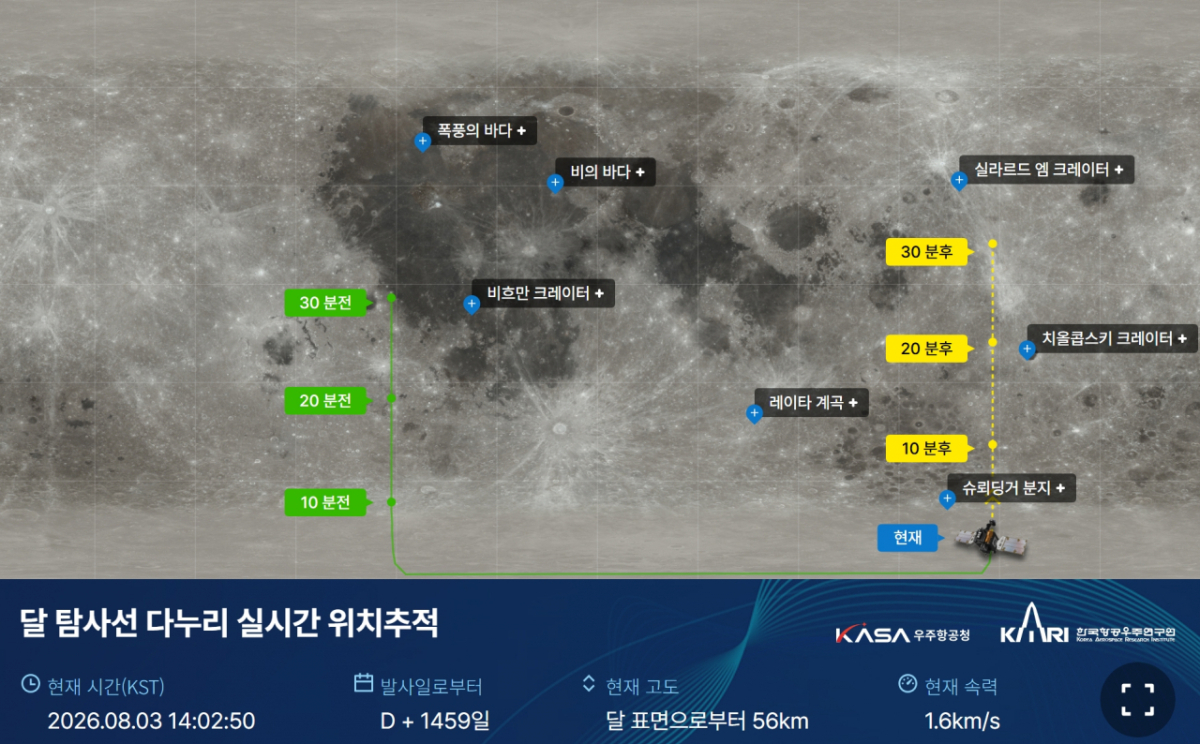
However, this process is not easy. The movement of the rocket debris cannot be predicted with precision. Senior researcher Kim stated, "Unlike satellites that transmit location signals, rocket debris cannot emit its own signals, so its position must be roughly estimated through optical observations. Due to low positional accuracy, the error margin can reach tens of kilometers."
Consequently, KARI has been calculating and tracking the predicted impact site together with NASA (U.S. National Aeronautics and Space Administration) and other entities over the past month. The photography plan is being revised repeatedly. Senior researcher Kim said, "We are exploring various methods to collect data, such as analyzing images actually captured by LUTI to pre-verify the location of the predicted impact site." LUTI is a high-resolution camera capable of distinguishing terrain features with a size of 2.5 meters above the surface. The research team plans to conduct continuous observations from the afternoon of the collision day until early morning the following day without rest.
If the photography is successful, the research team will immediately begin analyzing the results. It is expected to take at least two days after the shooting. After review, the data will be shared with NASA and international research teams. The Space Administration explained, "The data obtained by DaeNuri is of high scientific value as it represents the first case of predicting and observing an artificial lunar collision in advance."

 in TECH

