

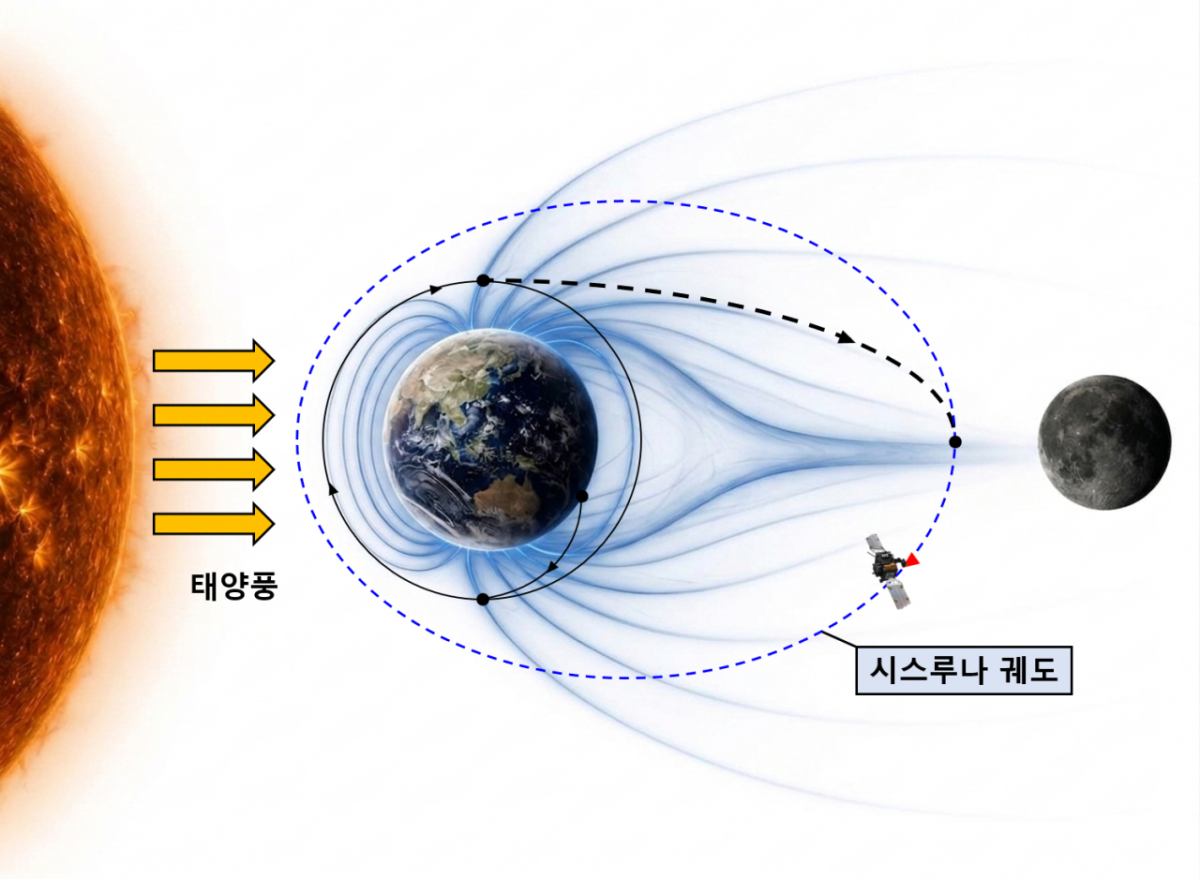
The Korea Aerospace Administration will announce its plan to develop a probe for observing the 'Cislunar' region—the space between Earth and the Moon—at the Committee on Space Research (COSPAR). The target launch date is 2031.
On the 4th, the Administration announced that it would present its heliospheric exploration plan at the COSPAR 2026 Academic Conference, held in Florence, Italy, until the 9th of this month, and discuss cooperation frameworks with eight institutional investors, including NASA (U.S. National Aeronautics and Space Administration) and ESA (European Space Agency).
The COSPAR Academic Conference is an international event where space agencies from major countries gather to discuss exploration plans. This year's theme was "Sustainable Space Research for Earth."
The Korea Aerospace Administration plans to present South Korea's heliospheric exploration roadmap on the 7th. It will introduce concepts such as the 'Earth-Moon Science Probe' and outline international cooperation strategies.
The probe envisioned by the Korea Aerospace Administration is designed to observe the 'Cislunar' orbit—the space between Earth and the Moon. It aims to collect data on solar activity and changes in Earth's magnetosphere by observing phenomena such as the "magnetotail" in the Cislunar region exposed to solar activity. The magnetotail refers to the elongated region of Earth's magnetic field stretched opposite to the Sun by the solar wind. High-energy particles generated in this area can cause malfunctions in artificial satellites.
During the conference, the Administration plans to hold bilateral meetings with space agencies from various countries to discuss cooperation across all exploration fields, including heliospheric exploration, lunar exploration, and space telescopes.
Oh Tae-seok (Commissioner) stated, "We will expand our observation scope beyond Earth's low orbit to enable solar activity monitoring in the Earth-Moon region."

 in TECH
