


For the first time in the 21st century, Korea’s lunar orbiter 'Danuri' (KPLO) captured a total solar eclipse that crossed the European continent from space.
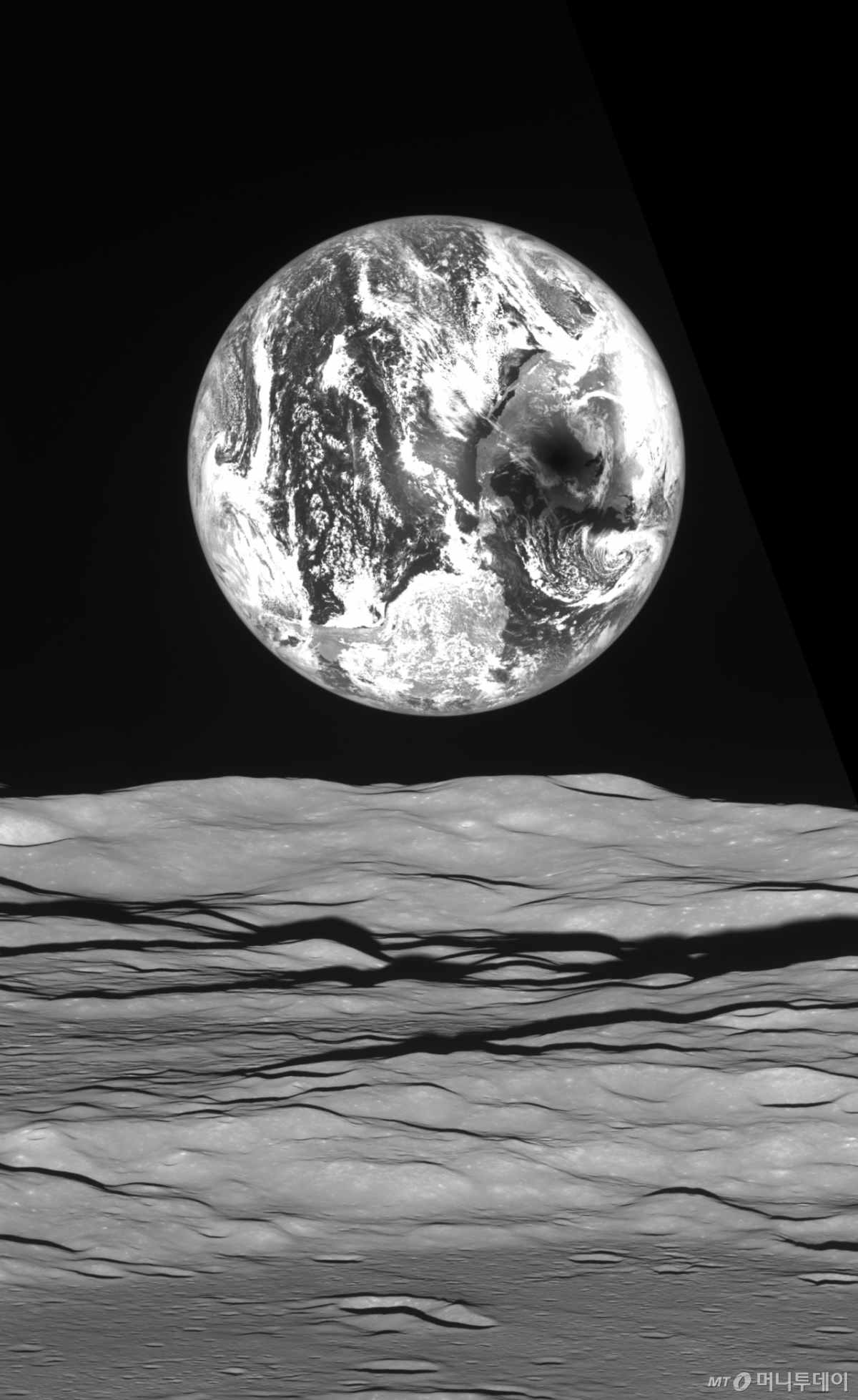
According to the science and technology community on the 13th, the KARI Danuri Mission Operations Center successfully photographed a total solar eclipse observed over Europe at around 5:42 p.m. local time (2:42 a.m. Korean time on the 13th) from the Moon.
A total solar eclipse occurs when the Moon is positioned exactly in a straight line between the Sun and Earth, completely blocking the Sun. When a total solar eclipse occurs, daytime becomes as dark as night.

This total solar eclipse lasted for about two minutes over Iceland and northern Spain. In particular, in Madrid and Barcelona, it was observed that more than 99% of the Sun was covered by shadow. This is the first time since 1905 that a total solar eclipse of this scale has been observed in Spain. It is reported that approximately 8 million tourists visited Spain to view the total solar eclipse. In the United Kingdom and France, phenomena where up to 96% of the Sun was covered were also observed.
A total solar eclipse covering all of Europe is expected to occur again in about 50 years. This is why this total solar eclipse is called the 'Eclipse of the Century.'
The KARI research team maneuvered Danuri on the 12th to capture the moment of the total solar eclipse. This is the first time a total solar eclipse has been photographed from the Moon’s perspective rather than from an Earth observer. Danuri, South Korea’s first lunar exploration spacecraft launched in 2022, orbits the Moon once every two hours at a speed of approximately 1.6 km per second. It is equipped with instruments such as a high-resolution camera (LUTI) and a wide-field polarimetric camera (PolCam).
As Danuri moved from the far side to the near side of the Moon while approaching the lunar south pole, it captured the moment when Earth rose above the lunar surface. The photograph captured the 'Moon’s shadow' covering the Greenland region. Some parts of the shadow area were obscured by the Moon.
Danuri previously photographed a total solar eclipse that crossed the North American continent in 2024. On the 5th, it also succeeded in capturing footage of SpaceX's 'Falcon 9' rocket colliding near the 'Einstein Crater' on the western side of the Moon.

 in TECH


