

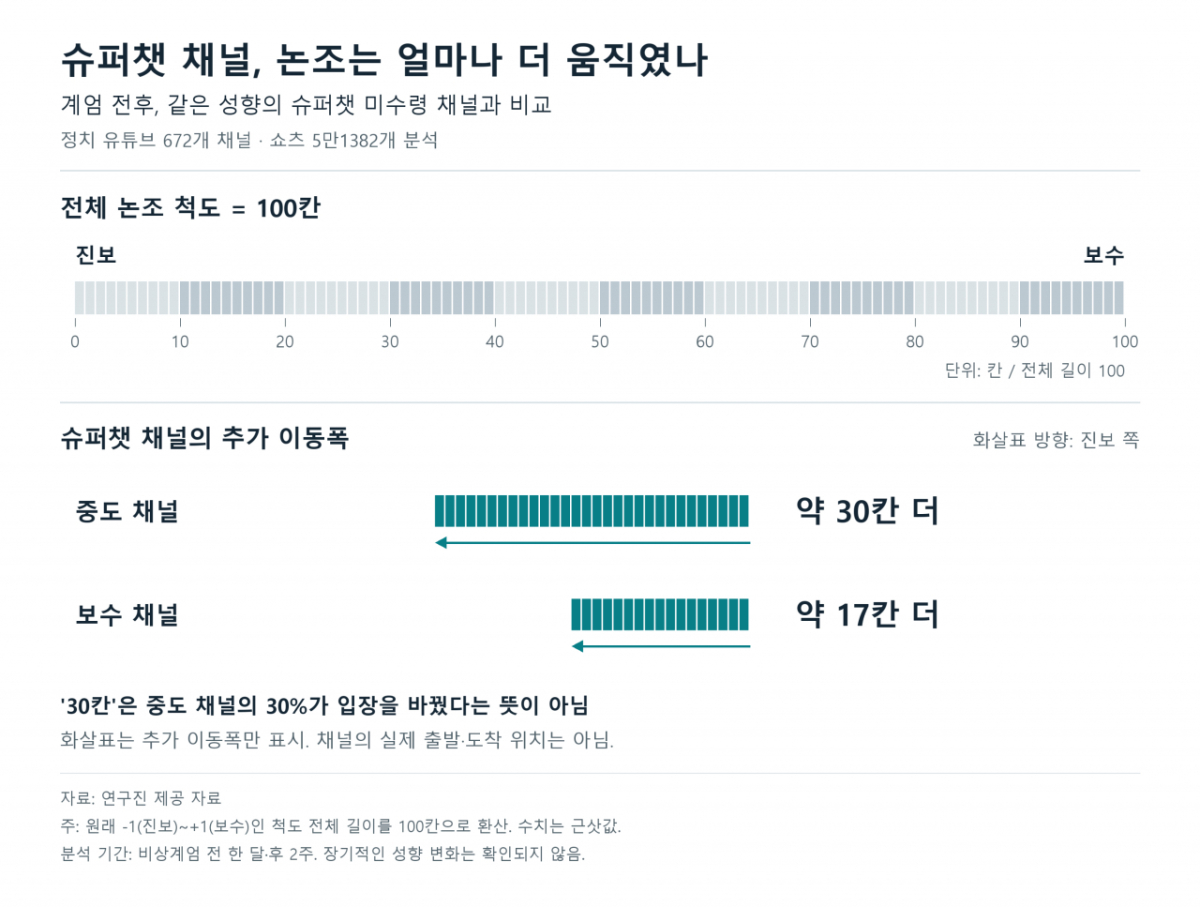
A study has found that after Yoon Suk-yeol Jeon (President) declared emergency martial law in December 2024, the editorial stance of political YouTube channels varied depending on whether they received viewer support. Moderate and conservative channels that had been receiving "Super Chats" prior to martial law shifted more significantly toward the progressive side compared to those that did not receive such support. The analysis suggests that viewer support not only reinforces a YouTuber's hardline positions but can also serve as a conduit for delivering criticism directed at members of the same political camp.
According to the research report titled "YouTube Super Chats and Ideological Shifts in Political YouTube" released on the 22nd by a joint team from KAIST, the Chinese University of Hong Kong, and the University of Hong Kong, an analysis of 51,382 Shorts across 672 YouTube channels revealed these differences. The research team used AI to analyze statements made in videos from one month before the declaration of emergency martial law and the two weeks following it. They evaluated each channel's editorial stance by scoring how they framed the same event from different perspectives.
The divergence was most pronounced among moderate and conservative channels. When converting the full range of scores from progressive to conservative into a "100-unit ruler," moderate channels receiving Super Chats shifted approximately 30 units further toward the progressive side compared to moderate channels that did not receive such support. Among conservative channels, the shift in those receiving support was about 17 units larger than in those that did not.
This indicates a significant difference in the magnitude of editorial shifts between two groups when channels with similar tendencies are divided based on whether they received viewer support. A trend also emerged showing that channels with higher prior donation amounts experienced greater changes. However, this effect was not observed among progressive channels.
The overall editorial stance of political channels also shifted after martial law was declared. In an analysis comparing political channels with stock market channels as a control group, political channels moved approximately 9 units toward the progressive side on the same 100-unit scale. The change became apparent on the day martial law was declared and peaked at about 13.5 units two days later. By the end of the two-week observation period following martial law, the stance had not returned to pre-martial law levels. However, hardline channels at both extremes showed minimal shifts.
The research team also examined which donation messages were read during live broadcasts. After dividing broadcast audio into 30-second segments for comparison, they found that after the host read Super Chats, the speaking score shifted toward the progressive side. The explanation noted that changes were particularly pronounced when conservative viewers sent messages criticizing the president.
Super Chat is a feature allowing viewers to pay money to make their comments stand out prominently in the chat window. While it serves as a means of supporting YouTubers, it is also used to convey dissatisfaction or criticism.
This is interpreted as meaning that when understanding political content, one must examine not only recommendation algorithms but also the platform's donation structure. It highlights that what videos are shown is important, but equally crucial is whose opinions are highlighted within broadcasts and how hosts respond.
However, it cannot be concluded that a YouTuber's political beliefs have changed simply because criticism of specific events or the president has increased. This analysis was limited to six weeks before and after martial law, so whether these changes persisted over the long term remains unconfirmed. The research team is now expanding the scope of their analysis to include all live broadcasts.
Social media has faced criticism for reinforcing political polarization. There were assessments that donation features like Super Chats functioned solely as mechanisms amplifying the voices of hardline supporters. However, this study confirms that in situations of political shock, these features also serve functions for conveying internal dissent and criticism.
The research team stated, "To understand changes in political YouTube, one must examine not only recommendation algorithms but also the interactive structure where viewer support, real-time chat, and host responses converge." They added, "These results suggest that a platform's monetization features can influence how political content creators speak and shift their editorial stances."

 in TECH
