

The most exhausted people at a family gathering during Chuseok are the driver and the person taking on the "logistics coordinator" role. They must find restaurants suitable for elderly relatives, check outing routes that won't bore children, verify parking availability, wait times, whether establishments remain open during the holiday, and budget alignment. The process involves repeatedly opening search bars, launching map apps, and sifting through blog reviews.
This year, I entrusted this task to AI. I input identical conditions into Naver (NAVER), Kakao, and ChatGPT. The conditions were kept simple: "Plan a lunch outing for six people, including a 90-year-old grandmother, during the Chuseok holiday, followed by a light 2-3 hour tour. The location should be in Seoul's northwest region, with a budget of 20,000 to 30,000 won per person. Recommend routes that allow parking and involve minimal walking."
All three services responded quickly. They provided restaurant candidates, travel routes, and follow-up options like cafes or parks within seconds. In the past, this would have required separately opening portal searches, map searches, blog reviews, and reservation apps. AI at least reduced the time spent deciding "where to start looking."
Recommendation methods differed
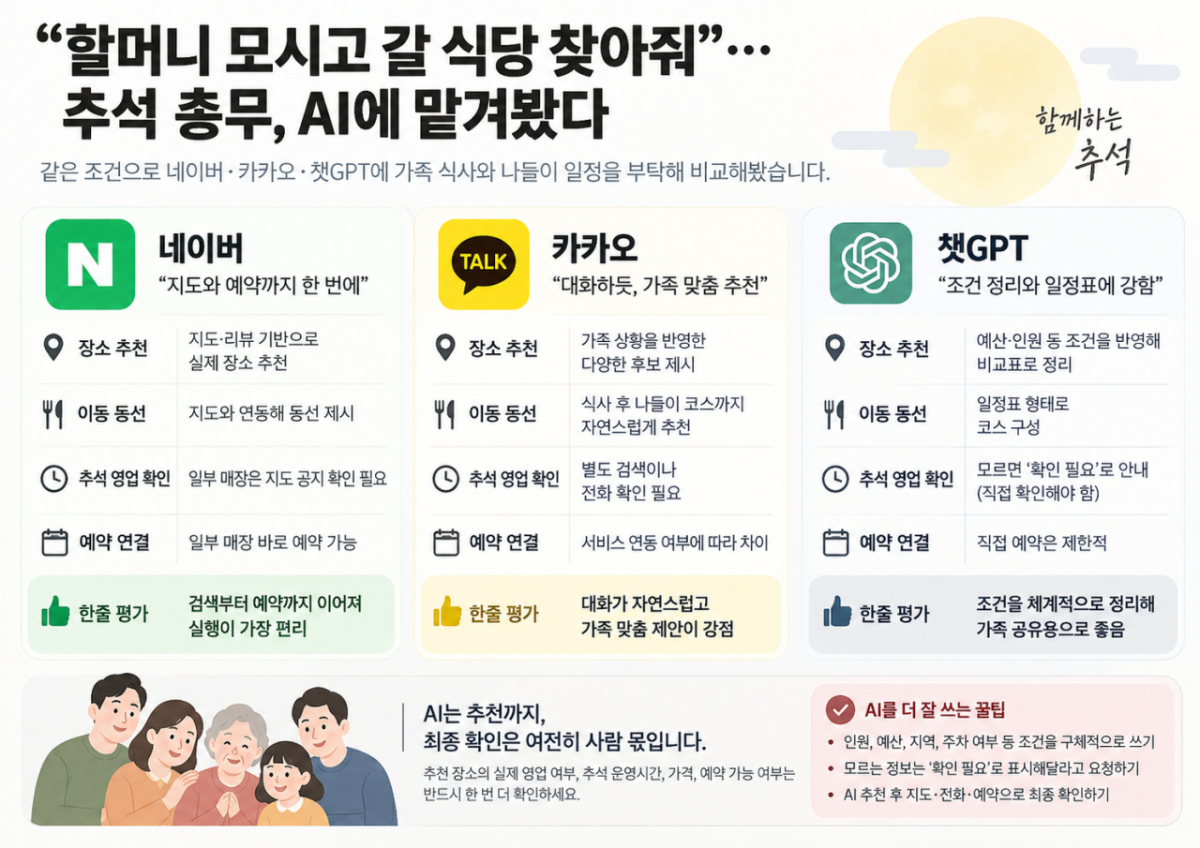
Differences emerged in recommendation methods. Naver excelled in location-based and map-driven recommendations. Restaurant names, locations, reviews, and distances were presented relatively naturally. Some results even linked directly to Naver Maps and reservation information, making it easy to take action. However, since recommendations were primarily based on information within Naver, there was a tendency to favor well-known restaurants or places with many reviews.
Kakao had strengths in conversational guidance and explanations of travel routes. Its expressions reflecting family composition and atmosphere felt natural. It even offered advice such as "For outings with elderly relatives, a nearby cafe or indoor exhibition space after the meal is better than a long walking route." However, verifying the latest operating hours or reservation availability for recommended locations required separate searches.
ChatGPT excelled at structuring conditions. It organized comparisons in tables by group size (six people), budget, travel distance, elderly accompaniment, and parking availability, while also summarizing "items to confirm via phone," "conditions to avoid," and "alternative routes." For a logistics coordinator, this was an answer easy to paste directly into a family group chat. However, users still needed to verify whether actual restaurants were open on Chuseok, if same-day reservations were possible, and if current prices matched expectations.
Caution regarding variables such as holiday operating hours, family-group pricing, and reservation availability
The biggest variable was holiday operating hours. Even when AI accurately retrieved regular operating hours, reflecting shortened hours or closures specifically on Chuseok day or during the holiday period remained a separate issue. Some responses indicated "available" based on regular operating hours. Verifying actual holiday operations required checking store announcements, latest map app notifications, and phone confirmations.
The same applied to pricing. While AI-provided per-person budgets were usable as rough benchmarks, they sometimes failed to reflect family-group ordering patterns. Relying solely on an answer like "around 30,000 won per person" could lead to budget discrepancies at the venue.
Differences in reservation availability were even more pronounced across services. Services linked with maps and reservations allowed direct access to booking screens, offering convenience. In contrast, general conversational AI often stopped at advising "reservation is recommended" rather than identifying specific available candidates. Unless recommendations extended to the stages of "confirmation calls" and "actual reservations," AI answers remained merely reference materials.
Recommended approach: Divide AI roles... Start with ChatGPT → Follow with Kakao → Verify with establishments
AI can quickly narrow down candidates when multiple conditions are input simultaneously, such as whether children or elderly relatives are present, how far they can walk, the number of vehicles, and whether a cafe visit after the meal is desired. It also proposes compromises when family members' needs conflict, such as "parents prefer Korean food, children want desserts, and the driver needs parking."
In practice, the most effective approach was not relying on a single AI but dividing roles. First, use conversational AI like ChatGPT to organize conditions and create candidate lists. Next, verify actual locations, reviews, parking, and operating hours via Naver or Kakao Maps. Finally, confirm holiday operations by calling the establishment or checking reservation apps.
The way questions were posed to AI also mattered. Answers improved when conditions were specified concretely rather than simply asking "Recommend a family restaurant." For example: "Six people total, including one person in their 70s and two elementary school students; two vehicles; budget under 30,000 won per person; walking distance under 500 meters; indicate that holiday operating hours need verification."
For a Chuseok logistics coordinator, tasks entrusted to AI extend only to "drafting the initial plan." The final confirmation button must still be pressed by a human.

 in TECH
