

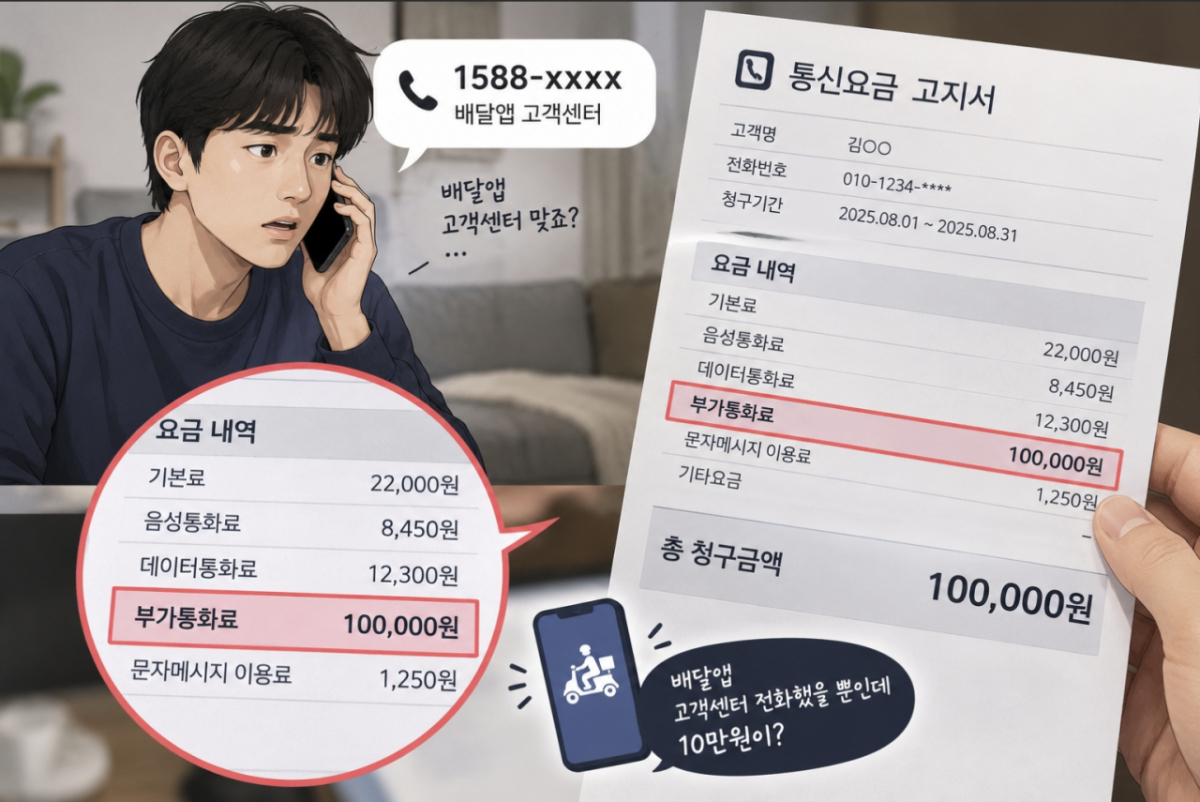
"Rrrr…". Please hold on, you will be connected shortly."
This is a message frequently heard when calling national representative numbers of corporate call centers starting with 1588 or 1688. If a user has an unlimited voice plan, would calls to call centers like 1588 and 1688 also be free? No.
Calls to representative numbers such as 1588 and 1688 are classified as "value-added calls," unlike regular voice calls. Value-added calls include communications not covered under the standard voice call category (home or mobile phones), such as video calls and value-added calls. Therefore, they are deducted from a separate monthly allowance of approximately 300 minutes, just like video calls. Assuming daily use of value-added calls, the daily limit is 10 minutes; exceeding this incurs additional charges of around 8 won per minute.
The problem is that call waiting time is also included in the allowance limit. When contacting financial and securities company call centers, or when placing or canceling orders via Baemin or Coupang, or making hospital appointment reservations, users may wait up to 20 minutes — sometimes as long as one hour — for an agent to connect. In such cases, the 300th-minute monthly limit can be easily exceeded, triggering additional communication charges.
The reason representative numbers starting with 1588 are not covered under unlimited voice plans is due to the "connection fee" burden shared between mobile carriers. According to the telecommunications industry, the standard landline incoming connection fee ranges from 7 to 9 won per minute. For representative numbers, an additional "value-added call charge" of 8 won per minute — a fee for using intelligent network services — is imposed on top of that. This means that every time a call is made to Ko Gaek-i (CEO) numbers, the cost that mobile carriers must pay to other carriers doubles.
Although these are corporate call centers and it might seem logical for companies to bear responsibility, there is currently no reason for them to do so. Even if call waiting times become longer, the communication charges remain the consumer's responsibility. In fact, longer wait times lead to increased call volumes, which in turn raises connection fees — a structure that benefits the revenue of representative number operators.
The telecommunications industry has raised concerns about the need to update value-added call charges to reflect current realities. An industry insider stated, "The current connection fee of around 8 won per minute was set during the early days when intelligent network investments were being made and has remained unchanged for several years. Given that the cost of intelligent network infrastructure has significantly decreased, fees could reasonably be reduced to as low as 1 to 2 won per minute." If the costs of intelligent network facilities are adjusted to reflect reality, mobile carriers' connection fee burdens would decrease, potentially allowing representative numbers to be included in unlimited voice plans, according to the same source.
Another option discussed is for companies to bear the communication charges for their call center representative numbers. This could involve mandating the adoption of "receiver-pays" representative numbers such as "080" and "14xx" for large corporations, financial institutions, and public agencies above a certain size. In a structure where longer wait times lead to higher costs, companies would be more likely to take action to improve their call centers, such as expanding customer service staffing. Additionally, there is a need to clearly inform callers that they will bear the cost when connecting via Yoo Ryo (CEO) numbers.
Lee Seong-yeop, a professor at Korea University, remarked, "Mobile communication fees have continued to decline, yet value-added call charges have remained unchanged for several years." He added, "Value-added call charges are subject to a reporting system, meaning the government cannot intervene directly. It is necessary to verify hidden fee burdens on customers as well."

 in TECH
