

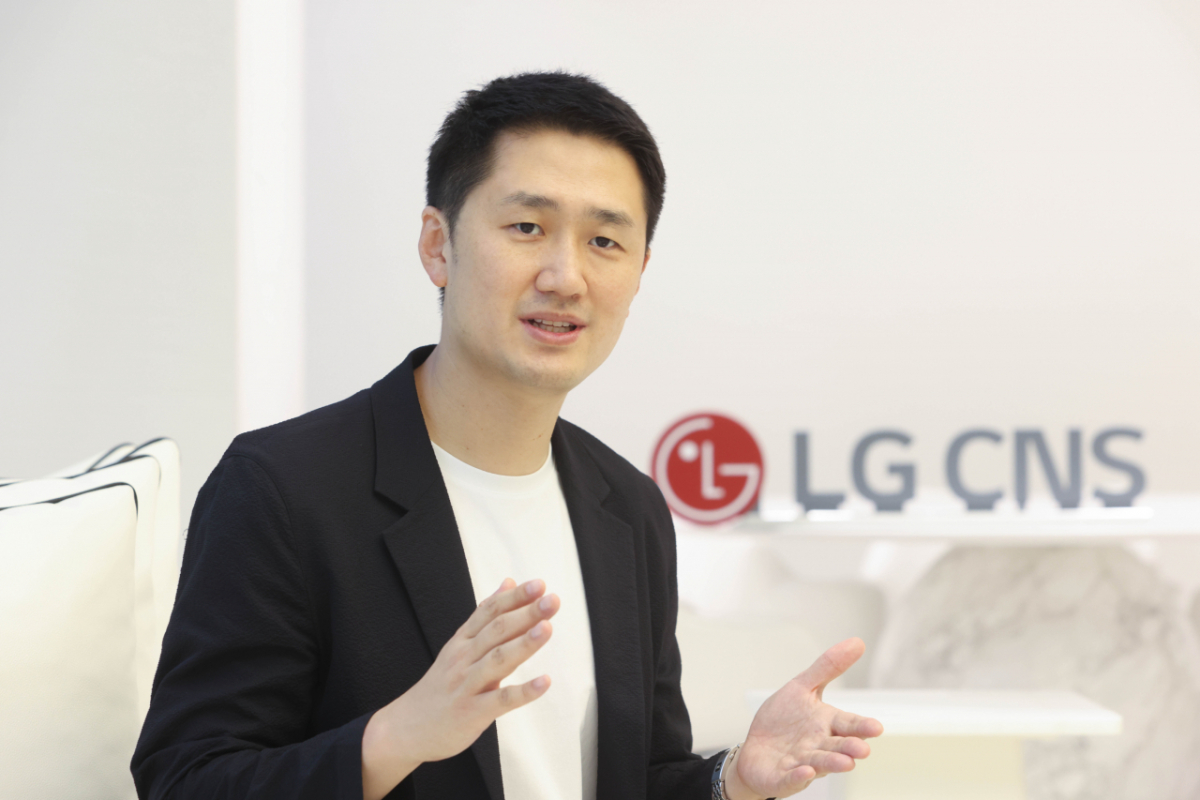
"DBO (Design·Build·Operation) is now considered 'old-fashioned.' We must keep seeking the next."
LG CNS (LG CNS) is expanding the boundaries of its data center business in the AI era. Starting with DBO, where it designs, builds, and operates data centers on behalf of clients, LG CNS has sequentially commercialized overseas AI data centers, modular data centers, and liquid cooling solutions. Its next business model is now positioned as an 'AI Factory' that simultaneously provides data centers, GPUs, AI platforms, models, and services.
Cho Heon-hyuk, Executive Vice President in Charge of Data Center Business at LG CNS, recently told MoneyToday, "The lifespan of technological trends has become extremely short," adding, "It is crucial to quickly identify new markets and make decisions."
LG CNS was the first in South Korea to introduce the data center DBO business model in 2019. Rather than merely owning data centers itself, it handles everything from design to construction and operation for clients such as financial institutions and cloud companies that have invested in these facilities. LG CNS is expanding its DBO business by managing the design, construction, and operation of external client data centers at Samseong and Jukjeon.
The scale of operations has grown larger than ownership alone. According to Executive Vice President Cho, LG CNS’s own data centers are under 100MW, while externally operated data centers total approximately 350MW.
The expertise gained from DBO led to overseas contracts. Last year, LG CNS became the first South Korean company to secure an AI data center construction project abroad. It is currently building a facility in Indonesia valued at 100 billion won. The first phase, with a capacity of 30MW, was already fully sold out before completion, and designs for phases 2 and 3 are underway. New projects are also being negotiated in Malaysia, Thailand, and Japan.
Executive Vice President Cho stated, "In the long term, overseas revenue from data center business could exceed domestic revenue," noting that "Southeast Asia has a large market size and still offers many undeveloped areas."
As AI adoption spreads, LG CNS is also transforming data center formats. It has launched Modular AI Data Centers called AI HAUS, which integrate GPUs, power, and cooling systems into containers. The existing public model can house up to 576 GPUs and support an IT load of 1.2MW within a single 40-foot container, with construction completed in about six months.
Executive Vice President Cho remarked, "The lifecycle of GPUs is 3–5 years; if it takes three years to build a facility, the GPUs may already be outdated upon completion." He added, "A structure that allows modules to be removed and replaced with new ones when technology changes is necessary."
To address heat issues from high-performance GPUs, liquid cooling is employed. LG CNS applies direct-to-chip (DTC) liquid cooling at its Samseong data center in collaboration with Naver Cloud. The Samseong facility is designed to handle ultra-high-density racks exceeding 200kW.
The market LG CNS ultimately envisions extends beyond data centers alone. It aims to create an 'AI Factory' that connects power and cooling systems, GPUs, AI platforms and models, and actual AX services.
Executive Vice President Cho emphasized, "Data centers and IT equipment can no longer be viewed separately," stating, "Optimizing only facilities or only IT equipment has its limits."
He explained that what will matter more is not the size of data centers or the number of servers, but how many AI results can be generated per unit of power input.
He further stated, "Ultimately, it comes down to how many tokens or IT services can be produced per 1kWh," adding, "Optimizing the entire layer—from power generation to chips, data centers, platforms, and AI services—is the direction of the AI Factory." He continued, "Clients do not want to select centers, servers, and models individually; they seek desired outcomes. The competitiveness in the future will belong to companies that provide the full suite of technologies needed to deliver those results."

 in TECH
