

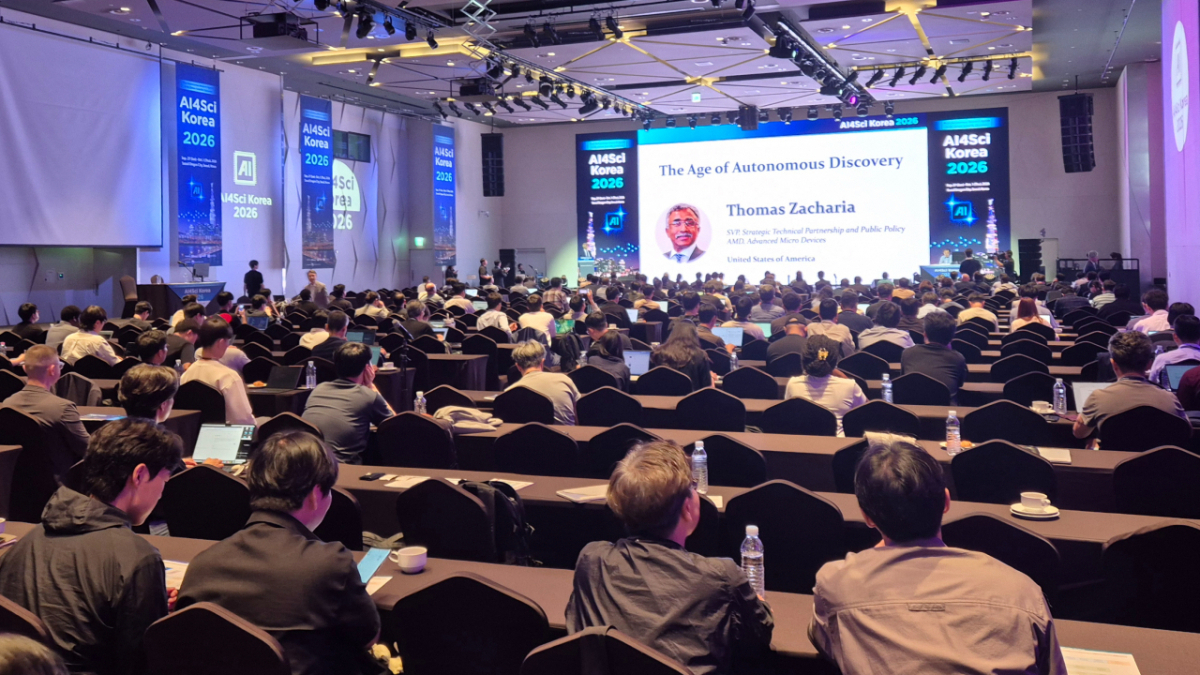
"Our core goal is to increase the productivity of scientific research by tens of times through advanced computing resources and technologies. The cycle for scientists to formulate hypotheses and derive experimental results will be drastically shortened, and research outcomes will return as intellectual property (IP)."
Thomas Zakrajsek, Senior Vice President of AMD, made these remarks on the 28th at 'AI4Sci Korea 2026' (International Academic Conference on AI for Science) held in Yongsan-gu, Seoul. AI4Sci is the first academic conference in Korea dedicated to the field of AI in science and technology. It introduces research on 'autonomous AI agents' that plan and execute research processes independently, as well as achievements from integrating AI into various scientific fields. Among the 600th researchers and industry experts who attended, 75 came from overseas.
Zakrajsek, Senior Vice President of AMD, who took the stage as a keynote speaker today, said, "GPUs (graphics processing units) have become an essential computing resource supporting cutting-edge scientific research today, but in the early days of research, there was much skepticism about how GPUs, originally used only for graphics processing, could be applied to scientific calculations."
He also shared anecdotes of struggling with Jensen Huang, CEO of NVIDIA, during the early stages of research. Zakrajsek said, "Jensen and I built GPU systems to support tens of thousands of scientists together, but the systems often stopped due to insufficient cooling infrastructure and technical capabilities. We experienced countless painful trial and error, but what is important is that scientific innovation occurs when we take risks and boldly challenge the unknown."
He continued, "In the current era, maximizing the productivity of scientific research by introducing advanced computing has become the top priority for the research community, and there are even recent reports indicating that AI has reached the level of scientific agents that autonomously create hypotheses and design experiments. Therefore, building infrastructure to allow the latest AI models to immediately digest the massive research assets (data) accumulated over the past few decades is a key challenge." He also suggested, "While carefully managing errors and risk factors of autonomous agents, it is necessary to create an open infrastructure ecosystem for all researchers on the infrastructure side so that no specific institutional investor monopolizes resources."
Zakrajsek said, "Is it not every scientist's dream to make a discovery never before seen in the world and adorn the cover of 'NATURE' or 'Science'? Breaking existing frameworks and changing the world always accompanies great uncertainty, but the courage to endure risks propels science forward. 'Scientific leadership' in an era where AI and science intersect requires the decisiveness to pursue bold goals."
Koo Hyuk-chae, First Vice Minister of the Ministry of Science and ICT, who delivered a congratulatory message, stated, "We will continuously expand researchers' access to core research infrastructure such as scientific data, computing resources, and AI models. Based on this, we will achieve 12 missions of K-Shot projects in fields such as biotechnology and future energy."

 in TECH
