

Following its recent addition of AI summary and personalization features to its Knowledge Encyclopedia, Naver (NAVER) has also updated its English-English dictionary. The company is continuously strengthening its dictionary functions to obtain high-quality learning data essential for the AI era.
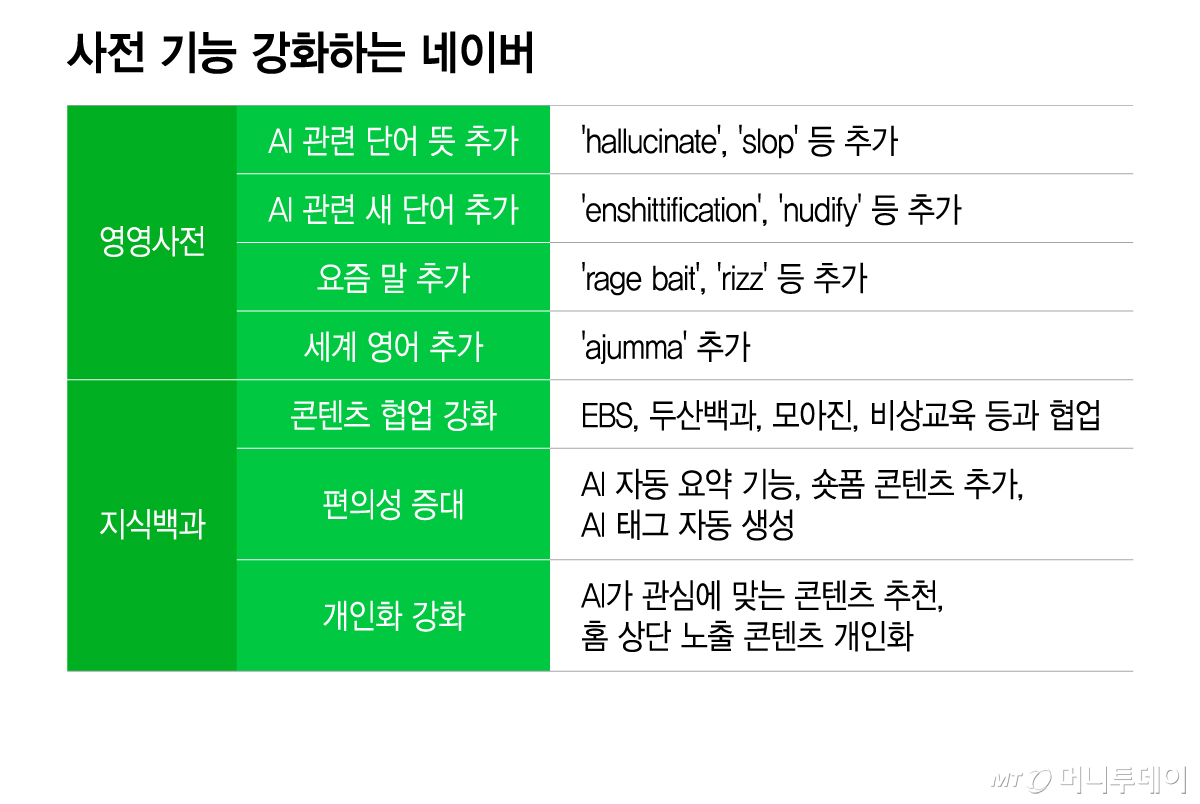
According to IT industry sources on the 29th, Naver recently updated its English-English dictionary based on the 2026 edition of the Oxford English-English Dictionary. It added 1,680 new headwords and revised over 17,000 words. The update reflects newly coined terms from the generative AI era, as well as words frequently used on social media platforms such as YouTube and TikTok.
The most notable change is the emergence of new AI-related words and meanings. For instance, 'hallucinate' has been assigned a new definition: "to produce an answer that appears plausible but is inaccurate or misleading, by artificial intelligence." The term 'slop' has also been added with the meaning "low-quality, unoriginal online content mass-produced by artificial intelligence."
Other newly listed AI-related terms include 'enshittification,' which refers to the process of declining quality in digital platforms or services over time. 'Nudify' describes the act of manipulating photos of clothed people to make them appear nude using artificial intelligence, while 'extended reality' has been defined as augmented reality, mixed reality, virtual reality, or a combination thereof.
Among recent slang terms, 'rage bait' was added with the meaning "online content deliberately designed to provoke anger," and 'rizz,' believed to be derived from charisma, was included with the definition "the charm and style that attracts others."
English words from around the world have also been newly added. From Korea, 'ajumma' has been included, defined as a middle-aged or older woman in Korea, particularly one who is married. It is the third English word to be incorporated into the Oxford Dictionary, following 'chaebol' and 'hallyu.'
Naver is continuously strengthening its dictionary feature, which was launched 20 years ago, in response to the AI era. Last month, it comprehensively revamped its Knowledge Encyclopedia and agreed to collaborate with specialized content providers such as EBS, Doosan Encyclopedia, Moajin, and Bongsang Education. The strategy aims to fill gaps with specialized knowledge that cannot be obtained through general searches.
The company has also enhanced user convenience. First, it introduced a beta service feature where AI analyzes the main text and automatically summarizes key content. To eliminate boredom, it newly added short-form and long-form video content as well as the latest magazine content. Additionally, AI analyzes content to automatically generate related tags; clicking on a tag allows users to view other content covering the same topic all at once.
Furthermore, based on the Knowledge Encyclopedia and Naver user experience, AI selects content tailored to individual interests. Topics displayed at the top of the home page, the recommended order in each list, and 'Content You May Also Like' at the bottom of the article body are all customized to match each user's preferences.
A Naver official stated, "We will continue to strive to deliver more accurate and reliable knowledge in a more convenient way going forward."

 in TECH
