

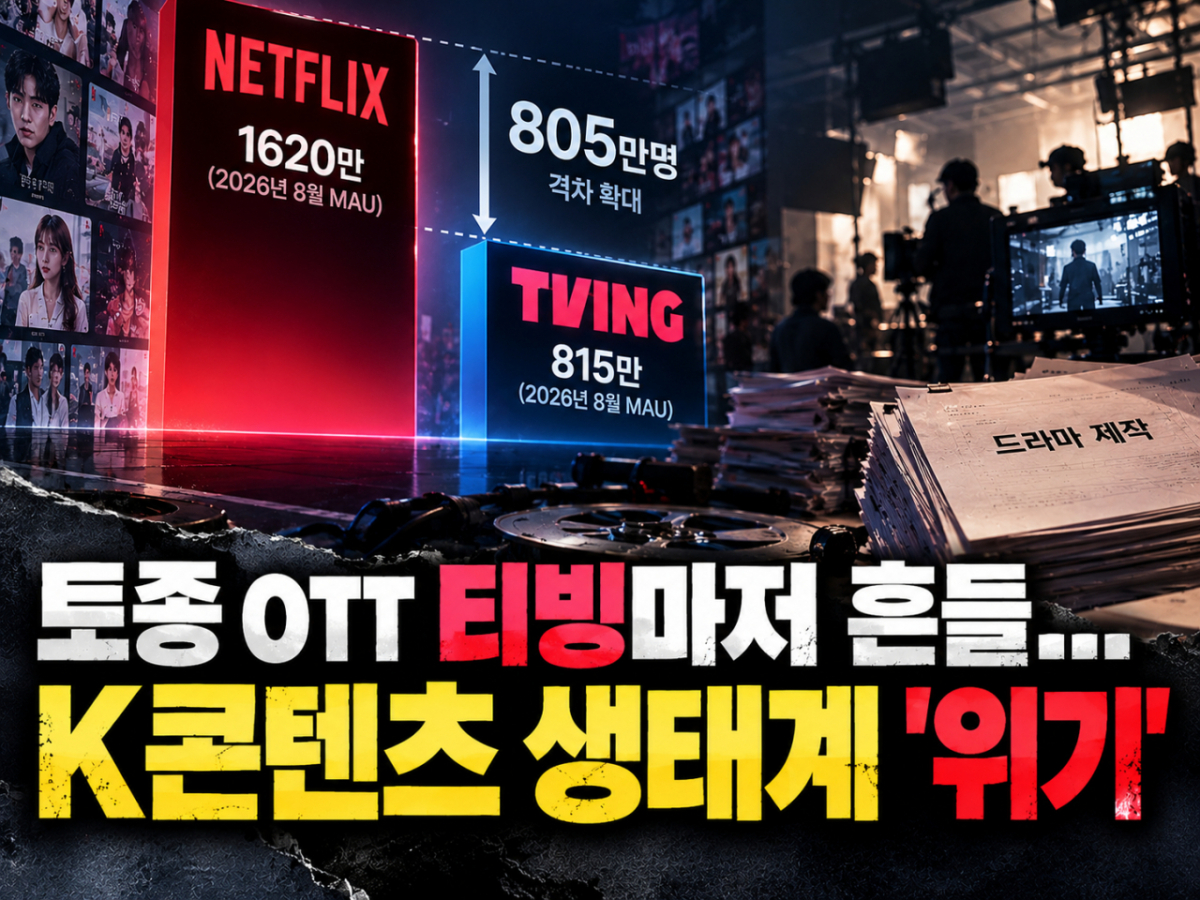
TVING, a leading domestic OTT (Online Video Service) player, has failed to narrow the gap with Netflix despite an increase in its user base. Concerns are emerging that the weakening competitiveness of domestic platforms, compounded by a decline in the number of drama productions and soaring production costs, could escalate into a crisis across the entire K-content production and distribution ecosystem.
According to mobile analytics firm iGAWorks' Mobile Index on the 29th, TVING's MAU (Monthly Active Users) in August was approximately 8.15 million, reaching only half the level of Netflix (approximately 16.20 million). Compared with August of last year, when TVING had 7.56 million users and Netflix had 14.75 million, both platforms saw an increase in users, but the gap widened from approximately 7.19 million to 8.05 million.
The domestic content production base needed to fill the platform is also weakening. According to data presented by Associate Professor Jo Young-shin of Dongguk University at a seminar held on the 10th by the office of Democratic Party of Korea lawmaker Han Jun-ho and the Korean Broadcasting Academy, the number of domestic drama productions decreased by approximately 30%, from 141 in 2022 to around 100 in 2024. In contrast, it was analyzed that the release of domestic originals by Netflix and Disney+ during the same period was maintained or increased.
The burden of production costs is growing increasingly heavy. According to data revealed at a special session of the '2026 International Broadcasting & Content Market (BCWW)' on the 14th, the per-episode production cost for domestic dramas surged more than six-fold from 550 million won in 2018 to 3.5 billion won in 2024. Meanwhile, the proportion of broadcasting rights fees within production costs dropped from the 40th–70% range to the 20th–30% range. It is analyzed that even when combining domestic and overseas sales, the cost recovery rate remains at a level of only 75–80%.
TVING is also bearing additional burdens following a recent personal information leak incident. Following user compensation, there is a high possibility of fines being imposed due to regulatory sanctions from authorities. While the company must continue investing in content to compete with global OTTs, industry insiders are concerned that its investment capacity will inevitably be squeezed by the occurrence of additional costs such as compensation and fines.
The industry's concern stems from the fact that the weakening competitiveness of domestic OTTs could impact not only K-content but also related industries. According to the Korea Creative Content Agency, it was analyzed that for every 100 million dollar increase in Hallyu industry exports, exports of related industries such as cosmetics, food, clothing, and IT devices increase by 220 million dollars. The domestic production ripple effect reached 782.4 billion won, and the employment ripple effect amounted to 3,389 people.
Ultimately, the key lies in the stamina of domestic platforms to engage in a content acquisition competition with global OTTs while bearing the soaring production costs. It is pointed out that if the competitiveness of domestic OTTs weakens further, the distribution options and bargaining power of production companies could also decrease, making it a challenge how to secure the domestic distribution foundation that supports the K-content ecosystem.

 in TECH
