

Deputy Prime Minister and Minister of Science and ICT, Bae Kyung-hoon, directly refuted rumors that the "Independent AI (Artificial Intelligence) Foundation Model Development" (Dokpamo) project would be halted. This is an unusual move to quell the rumors, which emerged from industry circles claiming that "the government is conducting a full review of the project," at a time when the government and participating companies are currently in discussions over the criteria for the third round of evaluation. It appears that how to resolve various controversies, including the fairness of the evaluations that have continued since the first round and the effectiveness of the project, will be the main focus of the Dokpamo third-round evaluation criteria.
Deputy Prime Minister Bae posted on social media (SNS) late on the 29th, stating, "Korea's Dokpamo will continue." Previously, the Ministry of Science and ICT issued an explanatory document regarding reports of a "Dokpamo halt," stating that "there is no decision yet regarding the project's suspension or the establishment of an SPC (Special Purpose Vehicle) related to top-tier AI development," but it is assessed as unusual for the Deputy Prime Minister to directly deny the content of the reports.
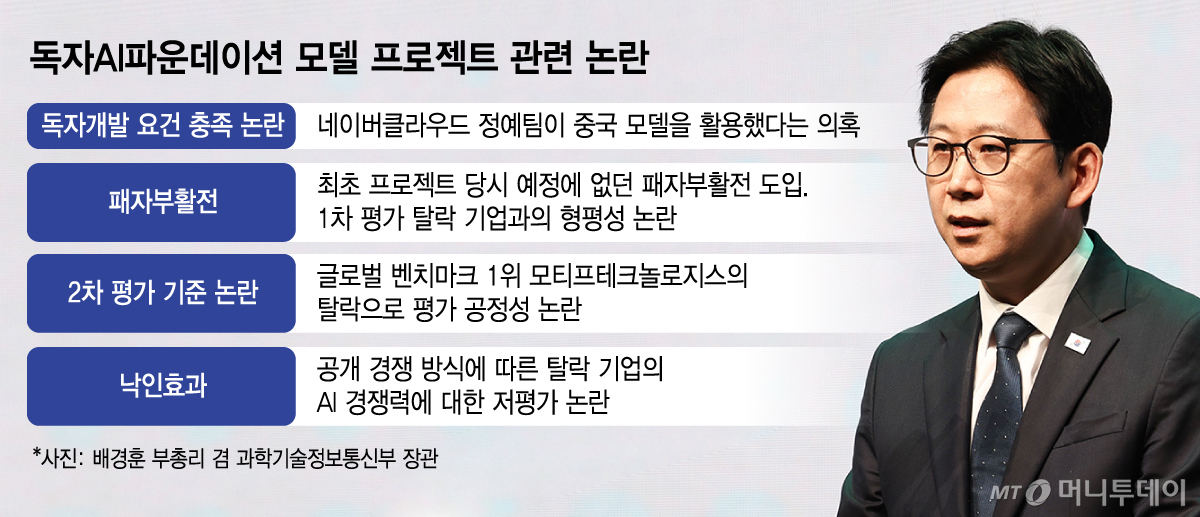
The noise surrounding the Dokpamo project is not new. In the initial first-round evaluation, controversy arose over allegations that Naver Cloud's elite team utilized a Chinese model, failing to meet the "independent development" requirement. Additionally, fairness issues emerged when the government introduced an unannounced "comeback match."
Controversies over the fairness of the evaluation criteria also arose after Motif Technologies (Motif), which had received the highest score on the Intelligence Index (AAII) of the global evaluation institutional investor 'Artificial Analysis,' was eliminated in the second-round evaluation.
Deputy Prime Minister Bae's decision to personally post late at night to refute the Dokpamo halt rumors is interpreted as an intention to quickly put an end to such noise. The government, mindful of controversies related to Dokpamo, had foreshadowed a revision of the third-round evaluation criteria when announcing the second-round results and is considering operating the project through an SPC, taking into account the characteristics of AI development projects that require large capital investment. Nevertheless, as rumors of a "Dokpamo halt" spread in the industry, it means they moved quickly to quell them with a statement from the top responsible official.
Deputy Prime Minister Bae emphasized, "In each field such as manufacturing, finance, healthcare, public services, and physical AI, optimal AI considering cost, speed, security, and expertise is needed." He added, "To not rely solely on foreign models for the AX (AI Transformation) of our industries and public sector, our competitive models must actually be used in various parts of the industry. The next goal of Dokpamo should be to create AI that is chosen in the field, going beyond simply gaining more points on benchmarks."
Previously, Motif was eliminated in the second-round evaluation despite receiving the highest score on AAII, as it received the lowest scores in △NIA (National Intelligence Defense Command Agency) benchmark, △expert evaluation, and △user evaluation. This led to a clash between the "benchmarking" controversy—allegations that AI was trained targeting specific benchmarks—and the controversy over the fairness of the Dokpamo evaluation. Deputy Prime Minister Bae's remarks on this day are interpreted as targeting the existing fairness controversies in the evaluation process, with the intent that simple benchmark scores do not signify the AI performance we need.
The "stigma effect" controversy arising for eliminated companies due to government-led public evaluations continuing for a long time has also emerged as an issue. This is because even though each company possesses competitiveness, failing the evaluation can lead to the perception in the market that they "lack competitiveness." There are also points raised that opportunities are limited for startups with relatively lower capital strength, as the SPC project under consideration for top-tier AI development involves a government equity stake of about 30%. It is reported that the government, aware of such dissatisfaction in the market, is considering an SME (small and medium-sized enterprise)·startup GPU (Graphics Processing Unit) support program by investing part of the 2027 AI budget.
Deputy Prime Minister Bae stated, "The currently ongoing Dokpamo third round will be properly completed as planned," explaining, "It must evolve in a way that allows more companies to challenge, be used more in the field, and grow into larger enterprises. On this foundation, we will also challenge for world-class frontier AI under the name of Korea."

 in TECH
