

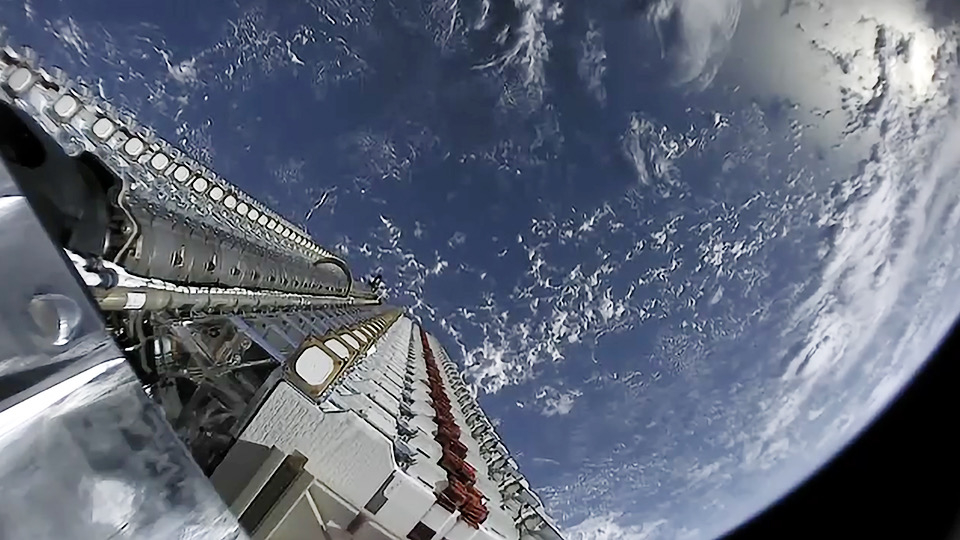
As the government plans to build a low-orbit satellite communication network called the "Korean version of Starlink" by 2035, the outline of construction scenarios is expected to emerge as early as the first half of next year.
According to science and technology officials on the 19th, a task force (TF) composed of officials from the Ministry of Science and ICT, the Korea Aerospace Administration, the Ministry of National Defense, and the Defense Acquisition Program Administration is currently consulting on plans to build a Korean low-orbit satellite communication network in accordance with the aerospace industry promotion strategy announced at the National Space Committee chaired by the President last July.
According to an official, the TF is examining various possibilities, including international cooperation, centered on the scenarios previously disclosed in the promotion strategy.
There are three leading scenarios. Assuming a five-year lifespan for low-orbit communication satellites, satellites of a specific scale would be launched every five years, with the number of satellites varying depending on the target altitude and required communication capacity.
Scenario 1 involves launching 128 satellites at an altitude of 1,280 kilometers above Earth. In this case, a budget of 3.9982 trillion won would be invested every five years. As it has the fewest satellites among the scenarios, it is a form that saves on network construction costs.
Scenario 2 prioritizes the use of domestically produced launch vehicles to launch 256 satellites at an altitude of 888 kilometers. The 888-kilometer altitude was set considering the technological development level of Korean launch vehicles. In this case, it is estimated that 7.4184 trillion won would need to be invested every five years.
The final Scenario 3 significantly increases the number of satellites. It assumes that civilian demand for low-orbit satellite communication will grow substantially in the future. It involves launching 512 satellites at an altitude of 1,280 kilometers. In this case, 14.2586 trillion won would be invested every five years.
The launch of the first communication satellite is expected in 2030, and the completion of the satellite network is expected by 2035.
However, given that the low-orbit satellite communication market is rapidly expanding centered on SpaceX's "Starlink," voices are emerging calling for advancing the project start date.
Another TF official said, "It will be necessary to start the project quickly with minimal costs as much as possible and then add (satellites) sequentially," adding, "We expect some outline to emerge by the first half of 2027." Additionally, international cooperation in the form of gathering countries with high demand for satellite communication networks centered on Korea is also under consideration.
Prior to this, one set of the 6G low-orbit communication satellite system is scheduled to be launched in 2030. It is a type of verification system composed of two communication satellites, ground stations, and terminal stations. The plan is to apply the communication technology verified through this to the Korean low-orbit communication satellite network.
A ministry official said, "Establishing a system that can cheaply Yangsan communication satellites will be the first step," adding, "Although inter-ministerial discussions and detailed planning are still needed, we will ensure it proceeds without any issues."

 in TECH
