

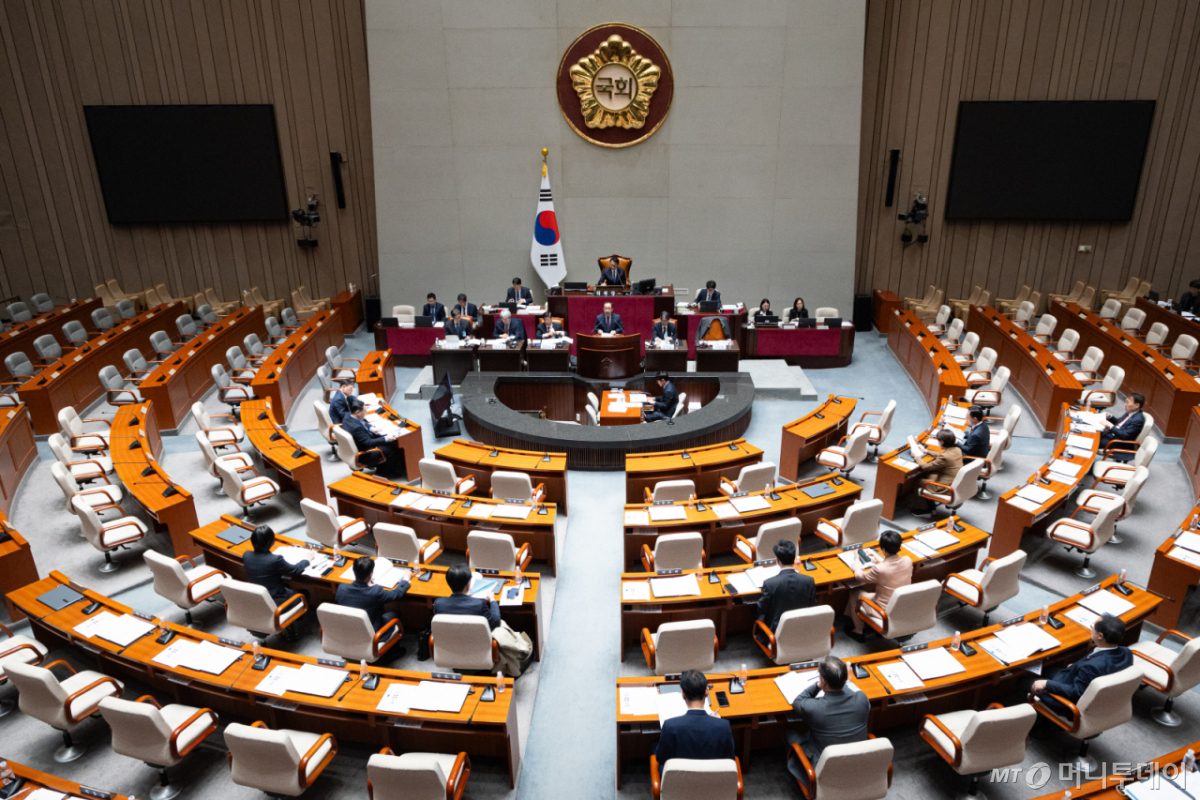
The National Assembly is set to begin its review of a "record-high" R&D (research and development) budget bill approaching 4 trillion won.
The National Assembly will commence budget reviews on the 4th. This includes deliberation on the largest-ever national R&D budget bill drafted by the Ministry of Science and ICT.
The total scale of next year's national R&D submitted by the government is 3.95 trillion won. This represents an increase of 400 billion won (11.2%) from the previous year's 3.55 trillion won, marking a record high.
The "Three Mega Projects" and the "Seven SEED (Seed) Projects" are central to this budget. Approximately 950 billion won, roughly one-quarter of the total R&D budget, is allocated to these initiatives. The budget for the Three Mega Projects is earmarked for developing and building foundational technologies and infrastructure in physical AI, semiconductors, and AI data centers (AIDC). The Seven SEED projects invest in seven advanced technology areas: △SMR (Small Modular Reactor) △nuclear fusion △breakthrough renewable energy △quantum technology △space and aviation △advanced bio, and △advanced supply chains.
The Ministry of Science and ICT's budget bill also increased by 24.5% from the previous year to 2.96476 trillion won. Of this, the budget allocated to AI projects is 940 billion won, accounting for 57% of the government's total AI budget. AI-related budgets have risen significantly compared to 150 billion won in 2025 and 510 billion won in 2026.
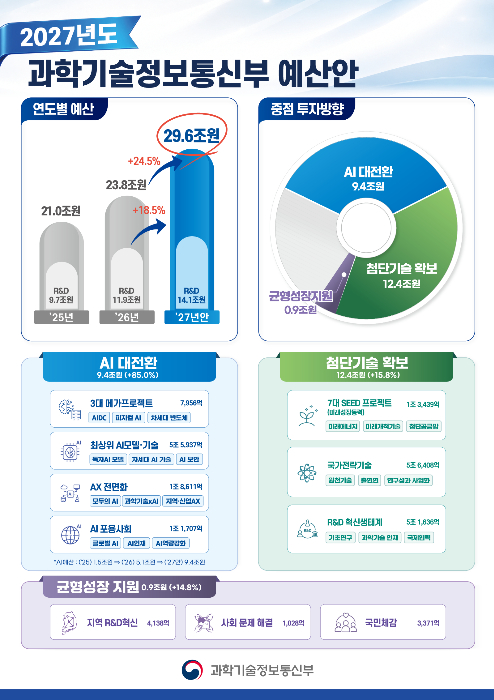
Given the massive investment, the National Assembly is expected to scrutinize AI projects in depth. In particular, attention is focused on the "Frontier AI Model" project. This initiative aims to develop a world-class independent AI model, going beyond the "Independent AI Foundation Model" developed through competition among companies. The Ministry of Science and ICT has allocated 385 billion won for GPU (Graphics Processing Unit) purchases, representing the minimum budget required for development.
However, a burden remains as repeated fiscal costs associated with GPU leasing and rental were pointed out during this year's national audit. Key issues also include the market competitiveness of state-led AI models, duplication of AI projects across ministries, and "AI washing." AI washing refers to cases where a project name includes "AI," but upon closer inspection, its actual content has little relevance to real AI development or infrastructure construction.
A key issue will be whether budgets related to improving the treatment of researchers at government-funded research institutes are expanded during the review process. The research operation costs for the National Research Foundation (NST) and 23 government-funded research institutes, as allocated by the Ministry of Science and ICT for next year, have increased slightly from 256.13 billion won in the previous year to 314.76 billion won. This includes a newly reflected performance bonus of 1.67 billion won based on institutional investor evaluations for government-funded research institutes. This takes the form of paying researchers who contributed to representative research outcomes a performance bonus worth several million won, depending on evaluation results.
Critics in the research community point out that providing performance-linked incentives only to some researchers is insufficient for substantive improvement in treatment. This is because research allowances previously funded through external contracts are affected by the abolition of the Project-Based System (PBS).
Meanwhile, the National Assembly will conduct comprehensive policy questions on the budget bill from the 4th to the 5th. Committee-by-committee reviews will proceed from the 9th to the 12th. The statutory deadline for processing the 2027 budget bill is December 2.

 in TECH

