

Convincing local communities is essential to successfully building AI (artificial intelligence) infrastructure. The key lies in persuading local communities based on the production and employment-inducing effects of infrastructure such as AI data centers (AIDCs), and creating a virtuous cycle in which infrastructure revenue translates into local tax revenue and economic revitalization.
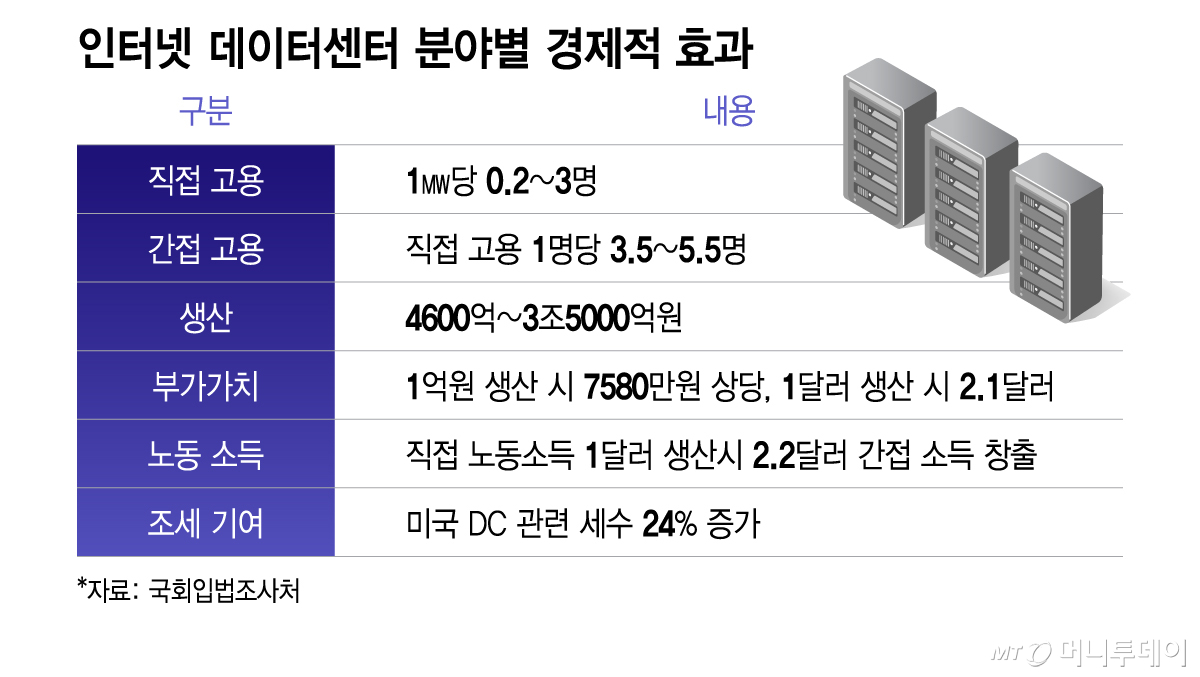
According to a report titled "Employment, Production, and Value-Added Creation Effects of Data Centers," prepared by the National Assembly Research Service in response to an inquiry from Democratic Party of Korea lawmaker Hwang Jung-a, the production creation effect of AIDCs (AI data centers) is estimated at 460 billion to 3.5 trillion won.
Cushman & Wakefield, a U.S. real estate firm that presented the most conservative effects, stated in its report "From Megawatts to Multipliers," released this July, that "the construction of a new 100-MW (megawatt)-class AIDC will generate an annual production-inducing effect of $344 million (approximately 466 billion won), including not only the data center's own production but also rental demand and ripple effects on employment, income, and the local economy."
The Goyang Institute also explained in its report "Economic Effects of the Data Center Industry in Goyang Special City" that when 10 billion won worth of data center demand arises, a production-inducing effect of 18.97 billion won will occur within the Gyeonggi Goyang area. Busan city, which is promoting the construction of an AIDC worth 1.8 trillion won with Equis Asset Management last year, stated that "the construction of a 100-MW-class AIDC generates a production effect of approximately 3.492 trillion won." Although there are significant differences in each analysis, the production effects are considerable.
Value-added inducing effects are also expected. The Goyang Institute analyzed the value-added inducing coefficient of AIDCs at 0.75779, meaning that when 10 billion won worth of demand arises, 7.578 billion won in value added will be generated for the region. PwC, a global accounting and management consulting firm, stated in its 2023-2024 report that "when the U.S. data center industry creates $1 of value, it has a value-added inducing effect of $2.1 on the entire U.S. industry."
In the employment sector, it was found that 0.2 to 3 direct jobs are created per 1 MW of data center capacity, and one direct job generates an indirect employment effect of 3.5 to 5.5 people. Meta, a global social media company, expects to directly employ over 1,000 people, including electrical engineers, heating, ventilation, and air conditioning (HVAC) specialists, server and network technicians, and engineers, upon completing a 5-GW (gigawatt-class) AIDC in Richland Parish, Louisiana, U.S. PwC analyzed that "as of 2024, direct employment in the AIDC industry is 1,005,080 people, with indirect and derivative employment effects of 4,490,200."
[Production Support: Ministry of Culture, Sports and Tourism Citizen-Centered Communication Activation Project]

 in TECH
