

How should one respond if a problem occurs in a hot rolling plant, where slabs—semi-finished steel products—are heated to over 1,100 degrees Celsius and passed through rollers to form coils? Due to the nature of the process, it is difficult to halt operations immediately, and the high-temperature working environment can easily lead to safety accidents.
Hyundai Steel and the National Information Society Agency (NIA) took on this challenge with the 'AI-RAN-based Physical AI Service Demonstration Project,' which combines next-generation wireless network AI-RAN (Artificial Intelligence Radio Access Network) with physical AI.
While typical physical AI operates in an on-device manner where robots are equipped with GPUs (Graphics Processing Units) to learn and function directly, this project uses a method of controlling robots via AI-RAN, which integrates GPU-based AI computing functions into communication base stations. Since the robots deployed on-site do not contain GPUs, they can be lightweighted and miniaturized, and are free from heat generation issues and battery performance constraints.
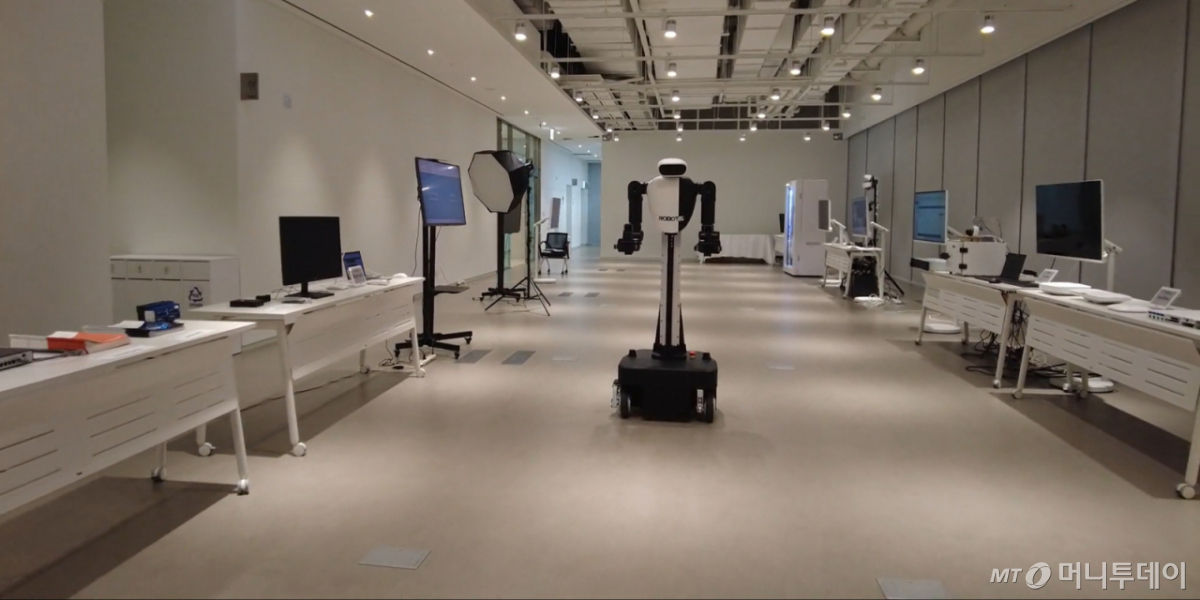
It is explained that this network approach is advantageous in cases where the working environment is narrow, high-temperature, or dangerous, such as in steel mills. The robot deployed at Hyundai Steel is also a robot of approximately 162.3 cm in height. It moves on wheels instead of legs, and its robotic hands are in the form of grippers. This was a choice focused on 'cost-performance' (performance relative to price).
Na Seong-uk, Head of the Intelligent Network Division at NIA (photo), who is in charge of the project, stated, "The idea is that robots handle movement, while learning and inference are processed by edge (base stations) equipped with AI and the cloud," adding, "It is advantageous in terms of heat generation, robot size, and maintenance compared to embedding AI directly into the robot."
The hot rolling plant was chosen as the demonstration site considering the specific characteristics of the process. Due to the nature of the 24th-hour operation, losses are significant if operations stop even once. If people forcibly try to solve problems in a high-temperature, narrow environment, safety accidents may occur. The concept is to create an environment where robots handle monitoring and initial response in dangerous sites, while humans analyze and resolve issues.
Division Head Na said, "The plan is to start by developing parts that can immediately solve problems, even if simple, and turn them into standards," explaining, "If we quickly create technologies usable on-site and achieve demonstration results at Hyundai Steel, it will be possible to expand to other industries."
A Hyundai Steel official stated, "This is an attempt to verify the possibility of applying humanoid robots to steel mill sites and their operating environment," adding, "For low-skilled workers, AI-based work support can reduce safety accidents, and the experience and know-how of highly skilled workers can be learned by physical AI and transferred."

[Production Support: Ministry of Culture, Sports and Tourism Citizen-Centered Communication Activation Project]

 in TECH

