

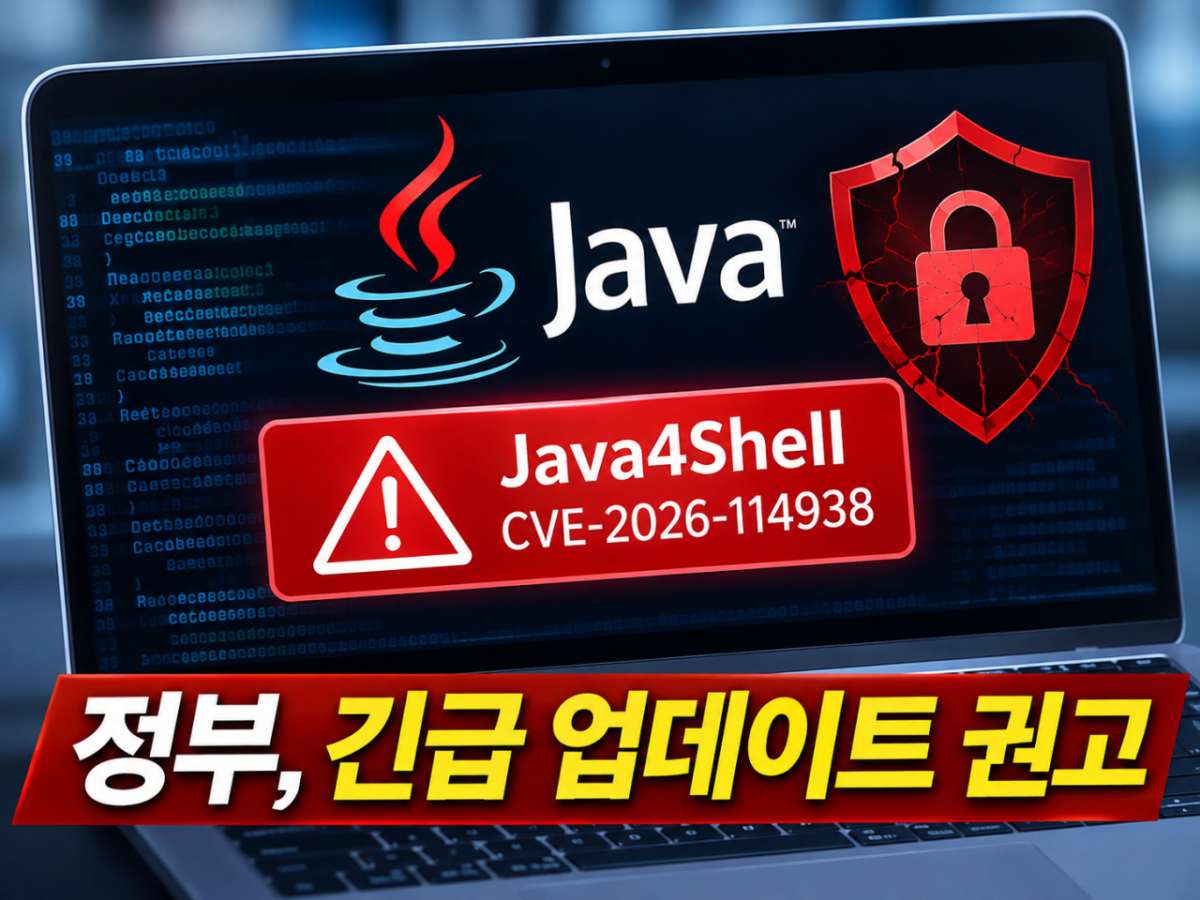
Following the discovery of a serious security vulnerability in the web development language PHP, a critical-level vulnerability has also been confirmed in Java, which is widely used in information systems of corporations and public institutions. The government warned that damage such as the execution of malicious code could occur, and recommended that companies and institutional investors conduct emergency inspections and apply security updates.
The Ministry of Science and ICT and the Korea Internet & Security Agency (KISA) announced on the 18th that prompt security measures are necessary due to the discovery of a security vulnerability in OpenJDK, the Java runtime environment.
The vulnerabilities discovered this time include 'CVE-2026-114938,' known as 'Java4Shell.' The issue involves memory corruption during the processing of abnormal inputs, allowing attackers to remotely execute arbitrary code without separate authentication in some programs.
U.S. security firm Kalipha named the vulnerability Java4Shell and assessed its risk level at 9.2 out of 10 under the CVSS (Common Vulnerability Scoring System) 4.0 standard. This corresponds to the 'Critical' grade, the highest risk level.
According to Kalipha, the vulnerability occurs in OpenJDK's Base64 decoder. The Base64 decoder is a function that restores data converted into character format back to its original form. If memory is mishandled during this process, it can affect the normal operation or security of the program.
However, Oracle assessed the risk level of the vulnerability at 8.1 under the CVSS 3.1 standard. While there is a possibility that an attacker could exploit it over the network without account privileges, the attack complexity was classified as high. There are differences in the scores because the two institutional investors applied different CVSS evaluation systems.
On the 17th (local time), Oracle released a patch fixing 11 vulnerabilities in Java Standard Edition (Java SE) through an important security patch update. Affected products include Oracle Java SE 17.0.21.0.3 and GraalVM, a Java development and runtime environment.
Java is widely used not only in web services but also in core business systems such as corporate groupware and ERP (Enterprise Resource Planning). Even if companies did not install it directly, it may be included in other software or equipment, so it is necessary to check usage status and versions.
The Ministry of Science and ICT and KISA urged users to prioritize inspecting internet-exposed services and core business systems such as groupware and ERP, and to promptly apply security updates provided by manufacturers. They emphasized the need to verify whether the updates have been reflected in services actually in operation after the update.
The government posted a security notice on the Protect Korea homepage and informed major information and communication infrastructure facilities, ISMS (Information Security Management System) certified companies, CISO (Chief Information Security Officer) registered companies, and others of the relevant content. Major industries such as telecommunications/internet services, security monitoring, hosting, defense, and shipbuilding were also included in the target scope.

 in TECH
