

The government is set to revise guidelines, including an explanatory manual for network neutrality guidelines and service quality assessment indicators, in line with the full-scale launch of standalone 5G (5th generation) mobile communication services by the three major telecom carriers (SK Telecom, KT, and LG Uplus).
The Ministry of Science and ICT announced this plan on the afternoon of the 26th at a joint public-private event titled "Commercialization of Nationwide 5G SA Networks and Innovation in Telecommunications Services," held at the International Conference Hall of the Korea Chamber of Commerce & Industry in Jung-gu, Seoul, together with the three major telecom carriers.
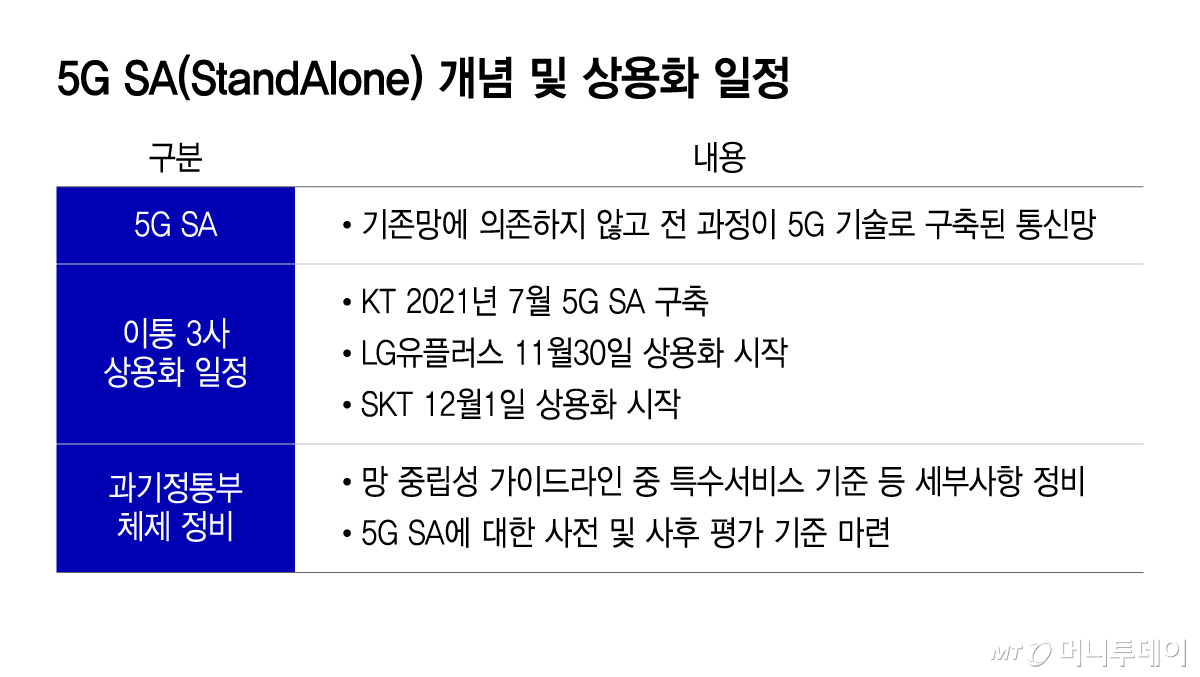
5G SA (StandAlone / standalone mode) is a communication network built entirely with 5G technology, from base stations that transmit and receive radio waves to the core network that processes signals, without relying on existing LTE (Long Term Evolution / 4th generation) networks.
KT completed its 5G SA network construction in July 2021, while LG Uplus and SK Telecom are set to begin commercialization on the 30th of this month and the 1st of next month, respectively. With no latency and faster transmission speeds compared to existing services, it is expected to be used in real-time control fields such as autonomous driving and smart factories, and to improve device battery efficiency.
On the same day, ahead of the nationwide commercialization of 5G SA services, the Ministry of Science and ICT announced plans to supplement the "Network Neutrality Guidelines Explanatory Manual" and a draft of assessment indicators.
A Ministry of Science and ICT official explained, "5G SA can provide diverse customized quality services tailored to the characteristics of users, services, regions, and time slots," adding, "When revising the 'Network Neutrality Guidelines' in connection with the introduction of 5G in 2020, we maintained the principle of equal treatment for all traffic while introducing separate regulations for special service areas such as autonomous vehicles and telemedicine."
The supplementation of the network neutrality guidelines explanatory manual is described as focusing on specifying whether to allow diversification of general internet quality rather than for specific uses, and establishing criteria for recognizing special services.
The government plans to allow reasonable diversification of general internet quality under the premise of protecting general internet quality and not favoring specific apps (applications) or content, while also concretizing standards to promote special services that require special quality assurance.
To facilitate rapid service launches and strengthen user protection, criteria for pre- and post-launch inspections by telecom carriers will be established, including specifying conditions for providing quality services and clarifying standards for protecting general internet quality. The government will also operate an inspection system, including checks on the status of quality management.
Assessment indicators for 5G SA will also be established. First, network quality indicators will include △SA connection retention rate, △latency time, and △transmission speed, enabling verification of △whether SA has been commercialized, △independence from LTE networks, and △the effect of latency improvement.
Additionally, the quality of voice calls using VoNR (voice and data transmission technology utilizing 5G networks) and network slicing (network optimization technology) will be evaluated to support the early establishment of 5G SA services and the maintenance of service quality.
Choi Woo-hyuk, a senior official at the Ministry of Science and ICT, said, "The construction of a nationwide 5G SA network is not an end but a new beginning; discovering services that citizens can feel and creating practical value in industrial fields are of utmost importance," adding, "We ask the telecommunications industry and manufacturers to strive for meticulous network operation and investment."

 in TECH
