

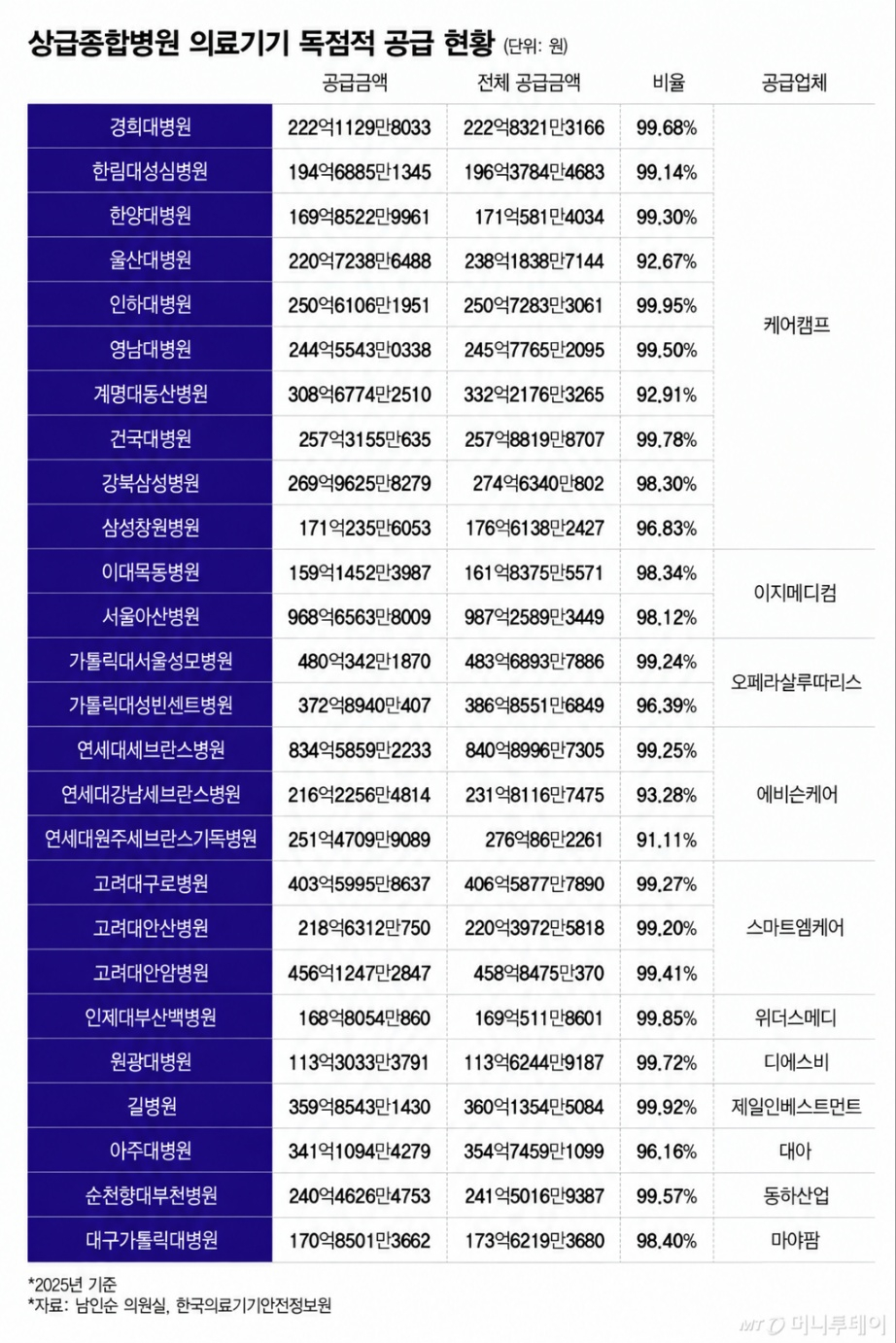
It was confirmed that 26 out of the 47th top-tier general hospitals in South Korea, which are the largest in scale and consequently use the most surgical and treatment materials, receive more than 90% of their products from a specific medical device sales company (indirect supplier, hereinafter referred to as "indirect supplier"). All of these are private university hospitals, and among them were cases where a hospital received 99% of its products from an indirect supplier owned by the school foundation that operates the university hospital.
According to the "Supply Status of Medical Device Sales Companies for Covered Benefits" provided by the Korea Medical Device Safety Information Service to Democratic Party of Korea lawmaker Nam In-soon, a member of the National Assembly's Health and Welfare Committee, on the 7th, it was found that a significant number of indirect suppliers with special relationships to school foundations supplied medical devices to their affiliated hospitals in an overwhelming proportion last year.
Avision Care is an indirect supplier established in 2021 through full capital contribution by Yonsei University's school foundation. Last year, the company supplied 83.5 billion won worth of medical devices to Severance Hospital, accounting for 99.25% of the total supply amount. It also supplied 21.6 billion won (93.28%) and 25.1 billion won (91.11%) to Gangnam Severance Hospital and Wonju Severance Christian Hospital, respectively.
Opera Salute, in which Catholic Academy is the ultimate controlling shareholder, sold products worth 52.6 billion won, accounting for 99.72% of the medical device supply amount to Seoul St. Mary's Hospital in 2023. In 2024, it recorded 69.5 billion won (99.43%), and in 2025, it supplied 48 billion won (99.24%). St. Vincent Hospital also accounted for 96% of the total supply amount with 37.3 billion won.
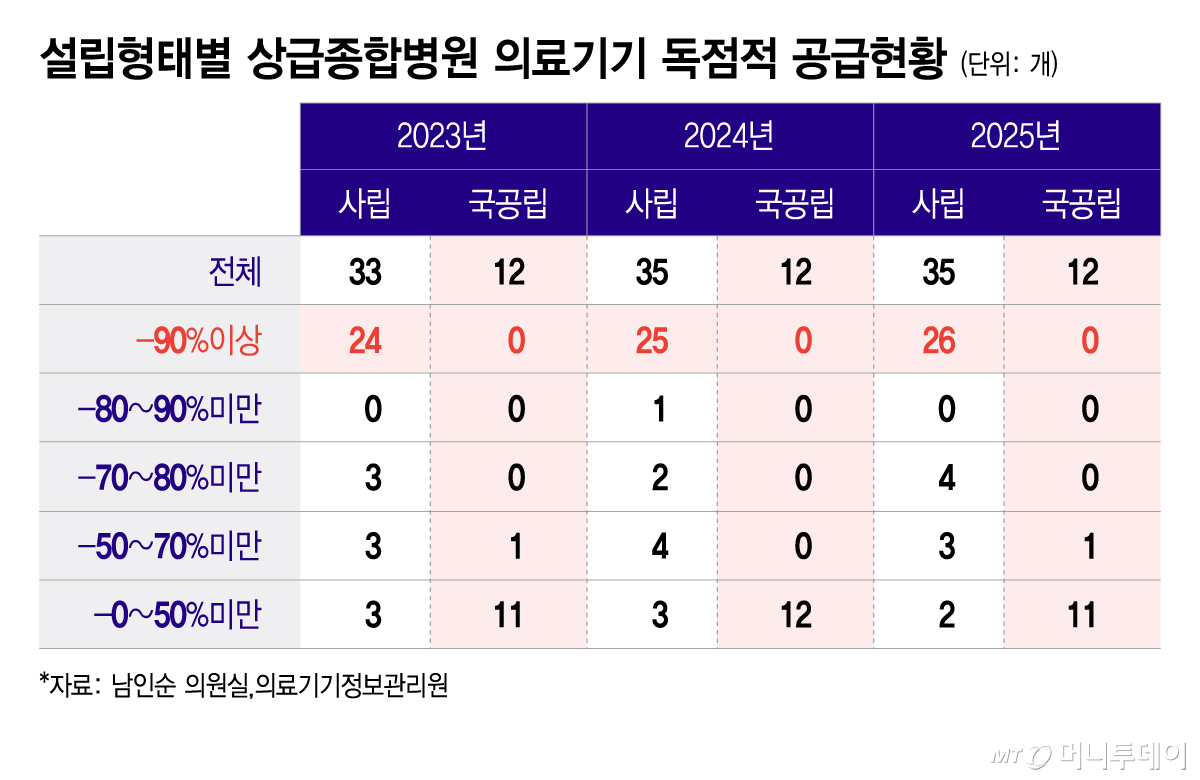
Suncheon Hyangdae Bucheon Hospital also had a high dependence on an indirect supplier with special relationships. Dongha Industrial, in which Dong-eun Academy holds a 100% stake, supplied products worth 24 billion won to Suncheon Hyangdae Bucheon Hospital last year, accounting for 99.57% of the total amount. Daeha, owned 100% by Daewoo Academy's school foundation, also supplied 96.16% (34.1 billion won) of the total medical device amount to Ajou University Hospital, an affiliated hospital of the school foundation. Gil Hospital (Jeil Investment) and Inje University Busan Paik Hospital (Withers Medi), in which school foundations (foundations) hold direct or indirect stakes, also conducted transactions with indirect suppliers worth 36 billion won (99.92%) and 16.9 billion won (99.85%), respectively.
Indirect suppliers with special relationships donated a significant portion of their operating profit to school foundations. As of last year, Avision Care made a donation of 21.9 billion won to Yonsei University's school foundation. Opera Salute donated 9 billion won to Catholic Academy, while Dong-eun Academy and Daeha also donated 5 billion won and 8.7 billion won, respectively, to their respective school foundations.
Yonsei University's school foundation side explained regarding transactions with Avision Care that they were "the result of concluding contracts through multi-faceted evaluation based on bidding in compliance with relevant regulations, followed by delivery." They stated that the donations were not payments made under pressure from the university or as consideration for medical device sales, but rather normal and reasonable management procedures where a subsidiary returns profits to its parent foundation in accordance with laws such as the Tax Special Measures Act. They also revealed that, following amendments to the Medical Device Act limiting the stake of indirect suppliers established by related parties to less than 50%, 51% of Avision Care's shares were sold to independent institutional investor E-Medicom in February.
Nam In-sun (Rep.) pointed out, "The presence of indirect suppliers between hospitals and supply companies for medical devices such as medical consumables and treatment materials has fostered various unreasonable practices, including transactions without contracts, delayed payment settlements, excessive discount rate demands, and the shifting of responsibility for losses and missing items." They added, "While it cannot be definitively concluded that there were unfair price transactions solely based on the fact that a specific indirect supplier effectively monopolized supply to affiliated hospitals, given that medical device purchases worth hundreds of billions of won have been concentrated among indirect suppliers with special relationships, the actual purchase prices, hospital supply prices, and indirect supplier margins must be examined together."
The Ministry of Health and Welfare stated, "We are promoting a survey on the status of special relationships of indirect suppliers and unfair practices," adding, "However, in cases where there is no violation under the current Medical Device Act, separate measures are difficult, so institutional improvements and sanction regulations must be established in the future."
※ Indirect Supplier (Indirect Supplier) = A company that receives medical devices from medical device suppliers and delivers them to medical institutions. Transactions are only possible through an indirect supplier designated by the hospital. The definition is not explicitly stated in the Medical Device Act, and they are often registered as medical device sales companies.

 in THEBIO

