

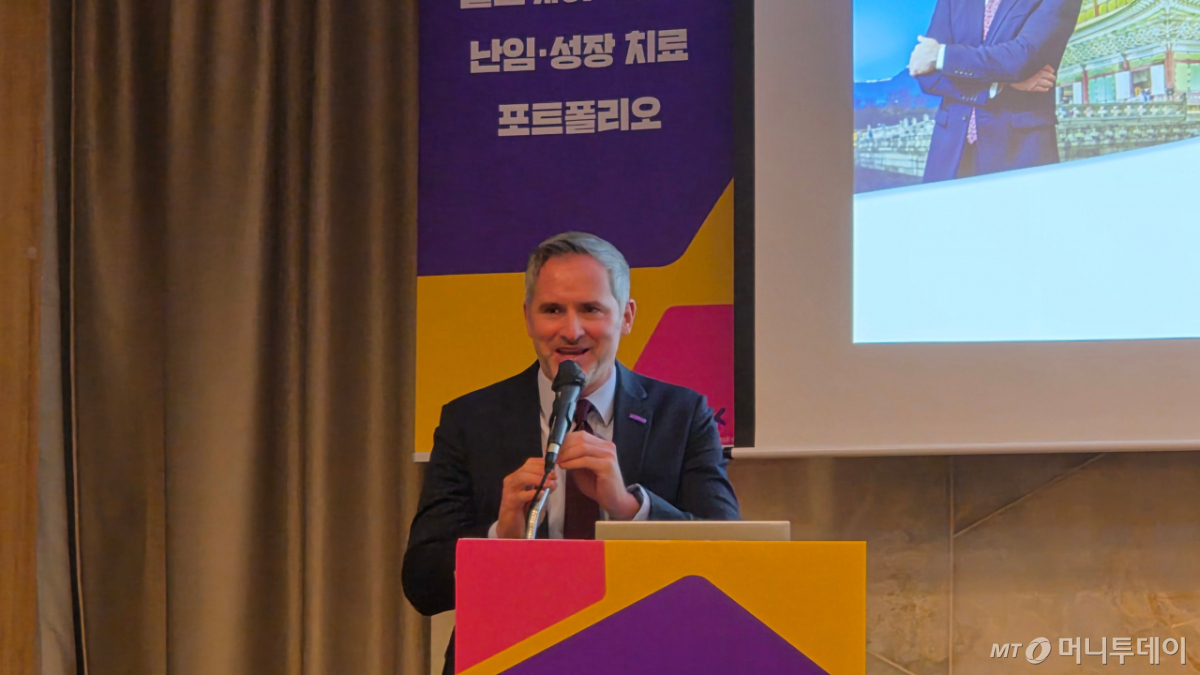
"Korea is experiencing an unprecedented demographic crisis and low birth rate problem, with the number of first-grade elementary school enrollees falling below 300,000 for the first time in history. We aim to contribute to solving the birth challenges facing Korean society."
Christoph Harman, President of Merck Healthcare Korea, stated this at a media seminar jointly held with the Korea Science Journalists Association on the 11th, marking "Infertility Day," at the Korea Science and Technology Center in Seoul Gangnam-gu.
President Harman said, "Merck's most unique mission is not only to extend and improve patients' lives but also to bring new life into the world," adding, "We will do our utmost to supply innovative treatments for areas with high unmet needs, including infertility drugs as well as rare tumors and immune diseases, to Korean patients as quickly as possible."
He also emphasized the need for institutional improvements to enable early initiation of infertility treatment. President Harman proposed including anti-Mullerian hormone (AMH) tests, which estimate the number of remaining eggs in the ovaries, as an optional item in corporate health checkups, suggesting, "Since infertility is a race against time, accessibility must also be expanded so that fertility can be preserved at a younger age."
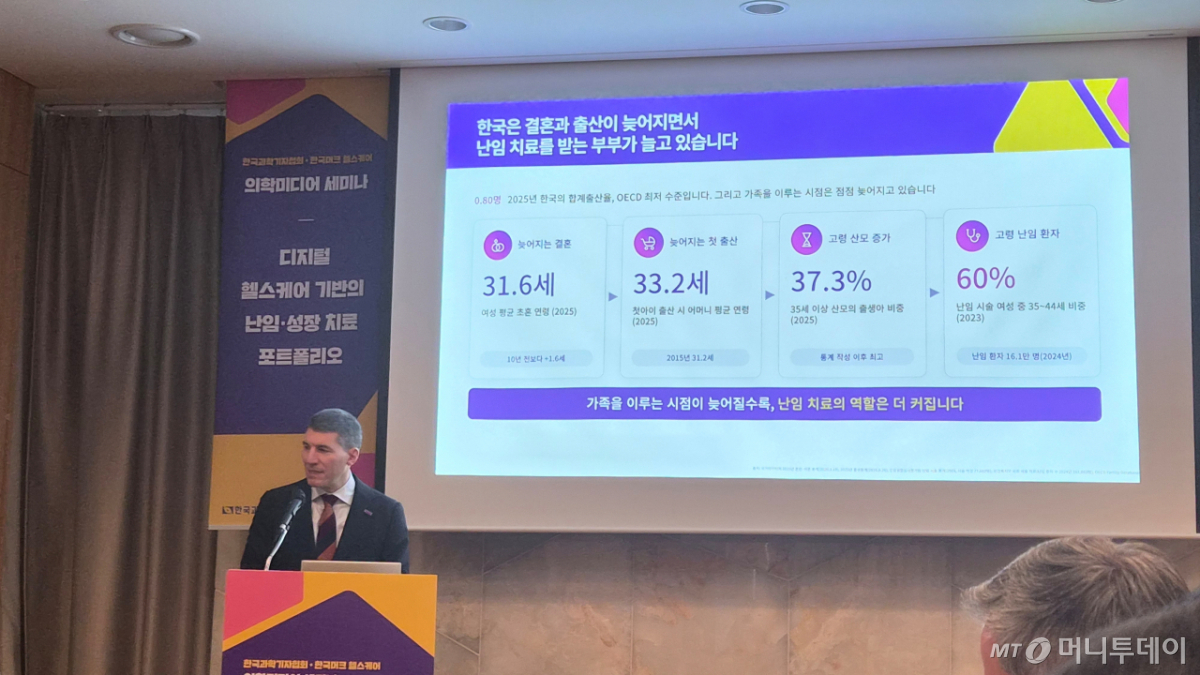
Alexander Steinbach, Senior Vice President and Head of Global Infertility and Endocrinology Business at Merck Healthcare, noted, "Korea is one of the countries with the highest average maternal age at first birth, at 33.2 years as of 2025," and observed that Asian cultural norms favoring childbirth after marriage also contribute to low birth rates, unlike major European countries where the proportion of non-marital births ranges from 30% to 50%.
Head Steinbach emphasized, "Currently, one in five babies born in Korea is delivered with the help of assisted reproductive technology such as in vitro fertilization (IVF). Overcoming infertility is impossible for a pharmaceutical company alone. The government, healthcare experts, patient groups, and companies must join hands to create a birth-friendly environment."
Merck, the parent company of Merck Korea, is a global pharmaceutical company founded in Darmstadt, Germany, in 1668. It operates in three business areas: Healthcare, Electronics, and Life Science. The Healthcare division sells products such as infertility treatments, growth hormone therapies, and anticancer drugs. Since January 2024, Merck has also operated a fertility program that supports employees with infertility treatment costs of up to 100,000 euros (approximately 170 million won).
Merck Korea was established in 1989. Currently, approximately 1,900 employees work at 12 facilities nationwide. Last month, the company opened the "Merck Asia-Pacific Bioprocessing Manufacturing Center" in Daejeon. The total investment is over 300 million euros (approximately 450 billion won), making it the largest investment ever by Merck's Asia-Pacific Life Science division. The facility covers an area of 44,500 square meters and supplies core materials necessary for biopharmaceutical manufacturing.

 in THEBIO

