

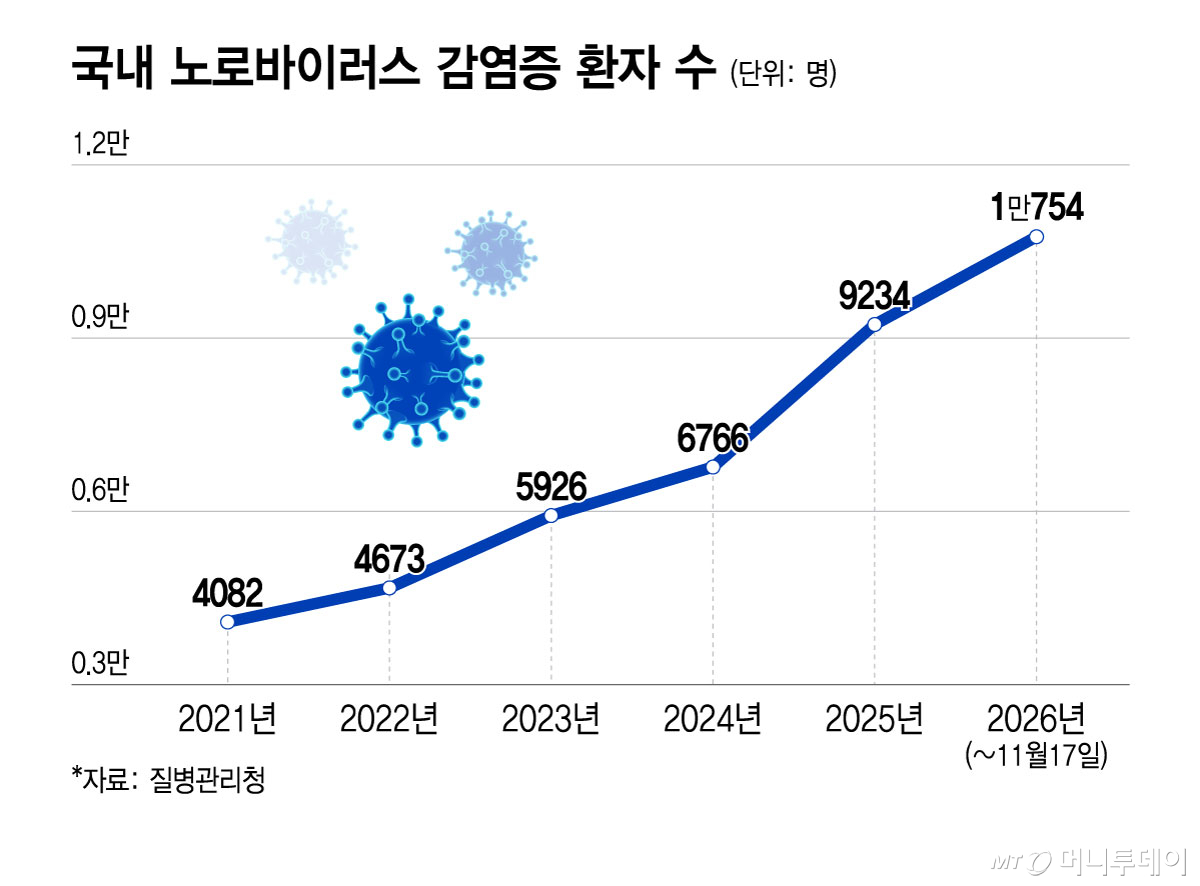
The number of domestic norovirus infection patients has more than doubled over the past five years. In particular, as the rate of cluster outbreaks in kindergartens and daycare centers has risen, authorities have urged enhanced hygiene management within infant and toddler facilities, as well as improved personal hygiene practices.
According to the Korea Disease Control and Prevention Agency’s (KDCA) sample surveillance system on Tuesday, the total number of norovirus infection patients reported this year through that date stood at 10,754, an increase of approximately 2.6 times compared with 2021 (4,082 cases).
Notably, cluster outbreaks are occurring at high rates among infants and young children, who have recently emerged as a key vulnerable group for infection. According to KDCA statistics, the number of norovirus patients aged 0 to 6 rose by 89%, from 2,431 in 2021 to 4,601 as of Week 45 (the 1st–7) of 2026.
A KDCA official stated, “Analysis of outbreak causes revealed that person-to-person transmission occurred in 88.5% of infant and toddler facilities between 2023 and 2025, identifying this as a major risk factor.”
The official added, “Alongside public awareness campaigns on preventive guidelines, we plan to produce promotional videos explaining transmission routes and disinfection methods to guide childcare facilities. We also intend to coordinate with relevant government ministries to utilize these materials in training for childcare facility staff.”
Norovirus is a leading cause of acute gastrointestinal infections during the winter season. The primary infection routes include consuming raw seafood or food prepared by contaminated hands.
Person-to-person transmission through direct contact with infected individuals is also possible, with the highest infectivity occurring 2 to 5 days after symptom onset. Infants and young children, who have weakened immunity, may experience repeated vomiting and diarrhea upon infection, leading to a rapid loss of body fluids. If a significant portion of body fluids is lost, the heart and kidneys can be damaged.
Among infectious disease experts, there are also indications that infection transmission is not being properly controlled.
Professor Eom Jung-sik, an infectious disease specialist at Gachon University Gil Hospital, said, “Given that a steady increase has been confirmed among infants and young children, who have relatively little exposure to shellfish consumption, it appears that issues are recurring in food distribution channels related to daycare or school meals.”
He added, “It seems there is a problem within the traditional (transmission) chain of foodborne infectious diseases, such as contamination occurring during the supply and preparation of ingredients. In effect, infection control is not functioning.”
Choi Yong-jae, president of the Korean Association of Pediatric and Adolescent Hospitals, said, “Even from our perspective in medical practice, we are seeing an increase in norovirus infection cases among children recently.”
He added, “To block transmission, the best course of action is to strictly adhere to relevant hygiene guidelines, such as handwashing and thoroughly cooking food.”
Norovirus is highly transmissible, capable of causing infection with even a small amount of the virus, and exhibits high resistance, surviving at temperatures as low as -20°C.
It does not easily die off under standard cooking temperatures, tap water chlorine concentrations, or surface cleaning agents. The virus can be excreted through feces for up to two weeks after symptoms disappear, necessitating caution even after recovery.
To prevent infection, food should be cooked until it reaches a core temperature of 85°C for at least one minute before consumption, and hygiene guidelines such as handwashing and disinfecting kitchen utensils must be strictly followed.
If symptoms have already appeared, patients should seek diagnosis from a specialist to accurately assess their condition and receive intravenous fluid treatment if dehydration is severe. Antidiarrheal medications that suppress diarrhea should be avoided as much as possible, as they can hinder the elimination of toxins.
A KDCA official said, “Since infants and young children find it difficult to maintain personal hygiene on their own, we ask parents and teachers to guide them in practicing proper handwashing in daily life.”
The official added, “We also urge attention to hygiene management, including disinfection within infant and toddler facilities.”

 in THEBIO
