

BreezeBio (formerly Jin Edit) is challenging for an IPO (initial public offering). The company aims to list on the KOSDAQ market, leveraging the competitiveness of its gene therapy development platform that was selected by global big pharma Roche. However, given the absence of clinical-stage pipelines, whether it can overcome this weakness will be a key point to watch.
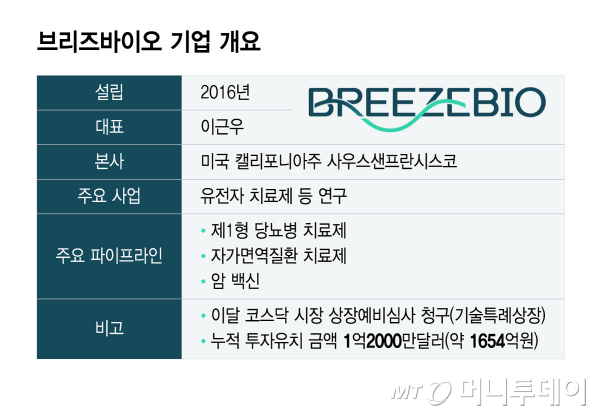
U.S.-based biotech firm BreezeBio announced on the 24th that it will enhance the value of its gene therapy platform through a KOSDAQ listing and proceed with clinical research for major pipelines. The company recently filed for preliminary review for a KOSDAQ listing, officially entering the IPO process.
Previously, in the technical evaluation required for a KOSDAQ special listing based on technology, BreezeBio received 'AA' and 'A' grades from two specialized institutions, respectively, meeting the necessary conditions.
BreezeBio is a biotech (biotechnology company) co-founded in 2016 by Dr. Lee Geon-woo and Dr. Park Hyo-min, both alumni of UC Berkeley, in South San Francisco, California, U.S. The company developed 'NanoGalaxy,' a gene delivery platform based on hydrophilic nanoparticles (HNPs), which can efficiently deliver various therapeutic agents selectively to tissues within the body.
It explained that it has demonstrated targeted delivery efficacy to specific tissues, including immune cells, the heart, lungs, and the central nervous system.
Through NanoGalaxy, BreezeBio has discovered new drug pipelines, such as 'BRZ-101,' a treatment for Type 1 diabetes. The company has signed joint research and development and technology transfer agreements with multiple domestic and international firms.
In particular, it gained attention for the joint research and technology transfer agreement signed in 2024 with Genentech, a subsidiary of the Roche Group. The total scale of this contract is up to $630 million (approximately 845.9 billion won).
Last June, the company also signed a joint research agreement for the development of a new cancer vaccine drug with LigaChem Biotech, a domestic ADC (antibody-drug conjugate) developer.
Based on the competitiveness of its NanoGalaxy platform, BreezeBio has secured investment from numerous institutional investors. The cumulative amount of investment raised since its establishment is approximately $120 million (approximately 161.1 billion won).
Domestic and international financial and strategic investors, including DSC Investment, Daily Partners, Passway-Loftrock Investment, Woori Venture Partners, Korea Investment Partners, Sequoia Capital, and Eli Lilly, have participated as shareholders.
However, BreezeBio has not yet secured any new drug pipelines that have entered the clinical stage. Pipelines for diabetes treatments, autoimmune disease treatments, and cancer vaccines are all in the preclinical stage.
The pipeline with the fastest progress toward clinical research is planned to enter clinical trials in 2028. It remains uncertain when the relevant pipeline from the joint research with Genentech will enter the clinical phase.
The unfavorable environment for evaluating new drug development biotech companies in the IPO market, influenced by recent deteriorating investment sentiment in the domestic stock market's bio sector, could also act as a burden.
Of course, since the company has just begun its listing review process, there is still some time before it proceeds to the actual public offering procedures.
Kang Jeong-won, Vice President (CFO, Chief Financial Officer) of BreezeBio, said, "NanoGalaxy is a proprietary platform capable of efficiently delivering gene therapies to various tissues and boasts excellent scalability."
He added, "Although we do not have clinical-stage pipelines, we will emphasize the competitiveness of the NanoGalaxy platform, which can selectively induce and regulate specific antigens that cause autoimmune reactions, during the public offering process."
He also said, "We have already secured various joint contracts and technology transfer agreements by leveraging our platform's competitiveness. The value of the platform will increase further once major pipelines enter clinical trials."

 in THEBIO
